I guess I have to write a bit for this group of students, who will not be allowed to redo their a-levels in their former schools (unlike students who obtained SUC for their H2 subjects), yet they’d find it difficult to be accepted into popular courses in the university.
With grades like BAD or DEAD, you might still be able to get into a local university, if you choose unpopular courses such as engineering, social work or nursing (I’m not sure if a degree in nursing is available in a local university, but if it does, you should seriously consider it). It also depends on what you had obtained your grade A for. It’s not that these courses don’t require academically bright students (can you imagine the impact to society of incompetent engineers, nursing managers or social workers?), but they are somehow very unpopular with university applicants in Singapore.
With a grade like BAD, you might even get a place in an arts or science faculty (but beware, these faculties have their pride too), and if you possess good O-Level results as well, you might even get a place in the NIE to train to become a teacher (to be admitted to NIE, you must have been at least in the top one-third of your O-level cohort; assuming NIE or MOE has not changed this requirement).
Grades like CCD or CDD might still get you into a university, for very unpopular courses. I’ve not heard of anyone getting into a uni with DDD though, or with anything lower. DEAD might get you somewhere because of the A, if there are very few good competitors for that same course. (Btw, if u obtained ACE, don’t say A,C,E, when anyone asks, just say Ace, so it sounds like AAAs). : )
So should you still accept the offer of a local uni if the course offered is not what you really want? Or should you just retake your A-Levels? If I were you, I will not retake the A-Levels if my grades can send me into any general course in an accredited or recognised university. A general course is typically one of those found in the faculty or school of science or arts. Yes, it’s ok to do an arts or science course or even engineering if you can’t get into the more popular courses such as medicine, law, accountancy and business. Why?
Please don’t forget there is such a thing as a Postgraduate First Degree, or Graduate Programs Leading To A First Degree. WHAT IS MORE IMPORTANT IS TO FIRST GET INTO ANY RECOGNISED UNIVERSITY AND WORK HARD TO GET AT LEAST A SECOND UPPER HONOURS DEGREE. Then you can apply to any graduate first degree programme. For example, if you want to be a doctor, lawyer or accountant, you can still become one if you have a very good honours first degree, through the Duke-NUS Doctor of Medicine (MD) course, SMU’s Jurist Doctor (JD) program or SMU’s Master of Professional Accounting (MPA) program, respectively. Or you can apply to any postgraduate program you like, whether it leads to a first degree, master degree or even a direct Ph.D program.
My point is, your first degree may not determine your career, and it need not be in something YOU THINK you are passionate about. It is more important to get into ANY recognised degree programme, and work very hard to achieve at least a 2nd Upper Hons degree ( I didn’t get one, so I had a hell of a time trying to get into a master degree programme. Luckily, NTU gave me a chance and I proved myself right about myself by getting a CGPA of 4.55, out of 5, for my master degree program. I’m still angry with NUS for thinking that I wasn’t good enough for their postgrad programs. Now I intend to a do Ph.D program, and it’ll be interesting to see which university would take me in).
Please also remember that some employers, like banks and the govt, will take you in if you have a very good first degree in ANY discipline. Hence please don’t be fussy about your first degree. I’ll always remember what my father told me when I asked him what course I should do at uni. He said,”Just get yourself into a university and graduate”.
Lastly, dont be fussy about your first job too. In today’s economic environment, having a job is better than having none at all.
Good luck!
Related post: What to do if your A-level results are bad …
A-LEVEL TUITION
A-Level BIOLOGY (H1/H2) – Whatsapp 88668423 (Specialist)
A-Level CHEMISTRY (H1/H2) – Whatsapp 88668423 (Specialist)
GENERAL PAPER BONUS SESSIONS
The registration for ‘A’ and ‘O’ Level exams as a private candidate usually opens around early to mid-April (Please check SEAB website). If you are registering for a Science subject (Physics, Chemistry, Biology or Combined Sciences), at the time of registration in April, you will be asked whether you have done any science practical training in any school, centre, or institute.
Thus if you are considering Singapore Learner as your science practical training provider, you are strongly advised to register with us and begin your science practical sessions for each subject BEFORE APRIL for us to certify that you have attended basic science practical training. Thus it is recommended that you commence practical training with us in Jan/Feb. Please note students usually do about 10 practical sessions per subject to be competent in practicals.
The following is taken from SEAB website:
“If you are registering for a Science subject with a practical paper, you:
• Must have sat the same Science subject(s) previously, OR
• are currently attending or will be attending a course of instruction in Science practical at any institute/school. You must complete the course of instruction in Science practical at the institute/school enrolled in. You are required to declare that you have fulfilled the above requirements at the point of registration. Registration for the subject may be cancelled without a refund of the examination fees if a false declaration is made.“
LOOKING FOR THE BEST PLACE TO DO YOUR SCIENCE PRACTICALS? JOIN US!
We provide A-Level / H2 / IP and O-Level Physics, Chemistry, Biology and Science (Physics/Chemistry/Biology) Practical Training for private / school candidates and homeschoolers, for both local (eg. H2, Singapore-Cambridge) and international exams (CIE, IB, IGCSE).
*Enjoy great discounts on fees if your lab sessions start in February! Send a message to 88765498 for details.
*Or attend (by appointment) our SINGAPORE LEARNER OPEN HOUSE on Sat 22/2 or Sun 23/2 (both 2pm-5pm) to find out more about our Science Academy (for private candidates) or our Science Practical Training & Enrichment Programme (for all students from Primary to A-Level). Attendees will get to meet our teachers and view our Science labs and apparatus. In addition, students who sign-up on the spot will be offered our generous January fee discount scheme while others may opt to receive our $50 fee discount voucher instead (2 per practical student). To book an appointment, send a message to 88765498. Hurry, appointment slots are limited. To avoid disappointment, book now!
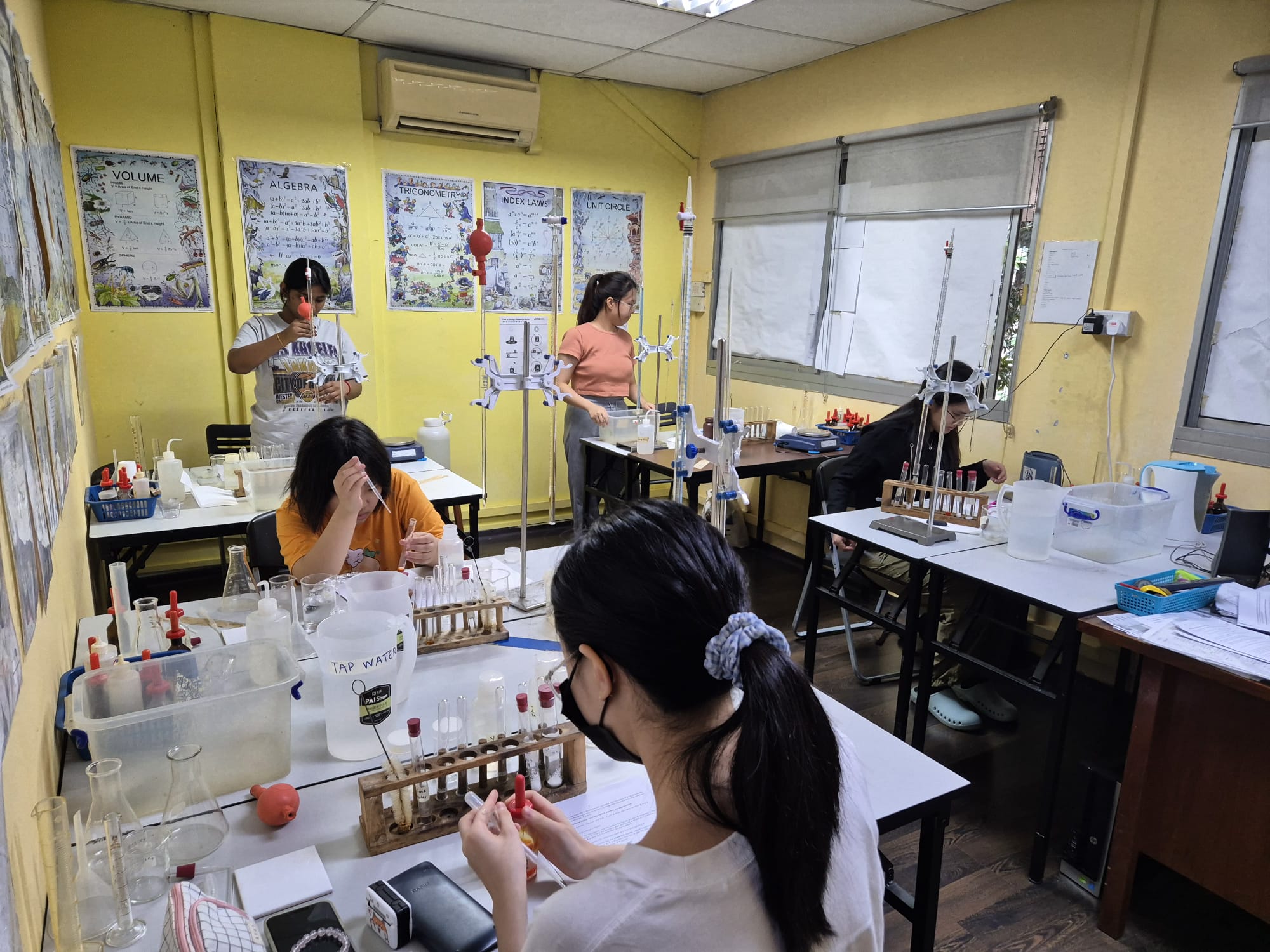
Our Main Practical Programmes:
A-LEVEL H2 PRACTICALS (Available Jan to Oct)
PRACTICAL CRASH COURSES (Mar, Jun, Sep and Oct)
MOCK EXAMS FOR SCIENCE PRACTICAL (Sep and Oct)
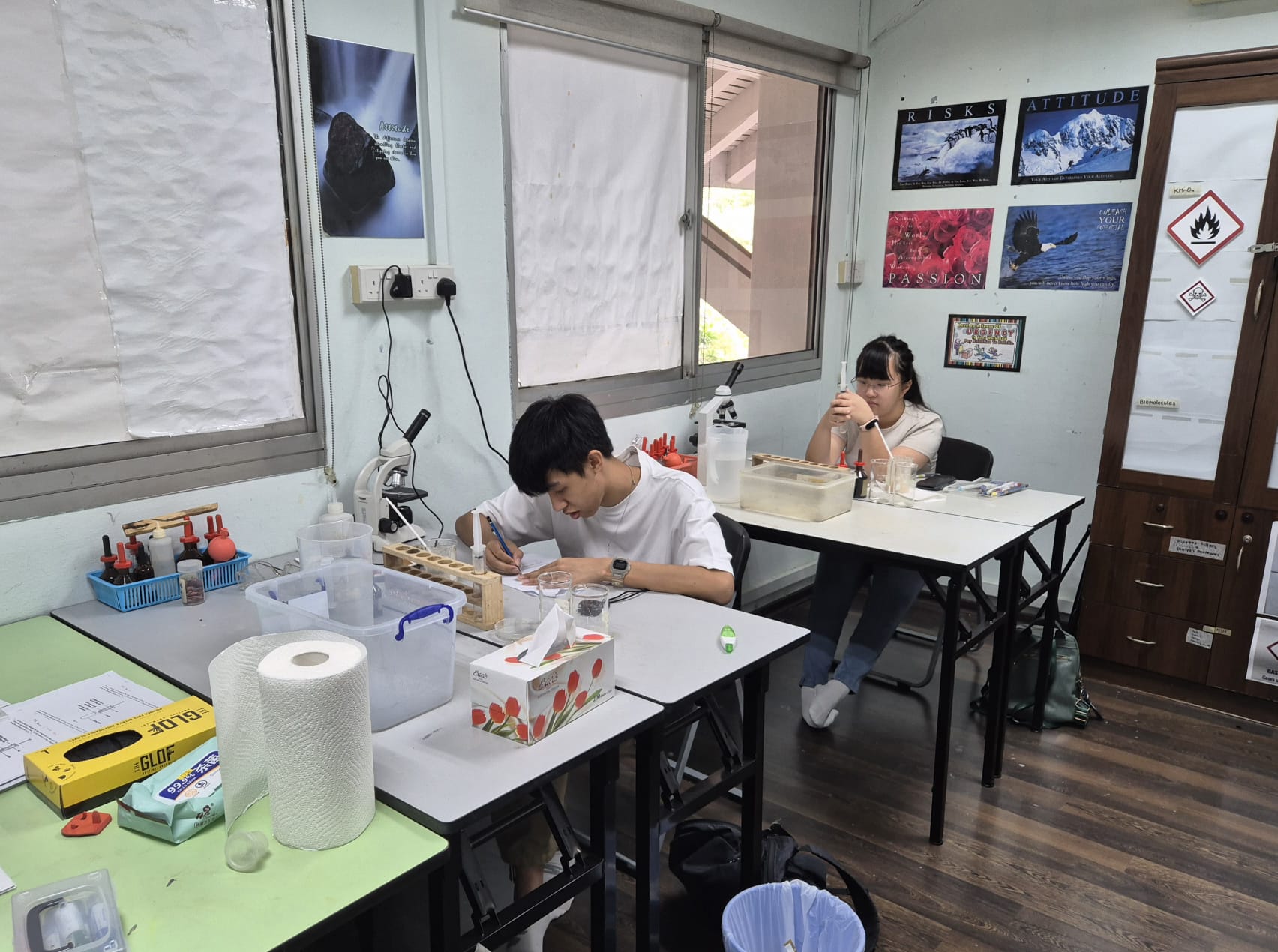


Other Practical Programmes We Provide:
CIE A-LEVEL PRACTICALS
INDIVIDUAL 1-1 PRACTICAL COACHING

Why Us?
-
Our teachers are highly qualified and very experienced, and we actually TEACH you good practical techniques.
-
We have been a one-stop comprehensive science practical centre providing solid practical training for ALL THREE sciences and for all levels and streams since 2017.
-
Our laboratory apparatus are exam-grade and the same as those used in MOE schools and our chemicals are all NEA-approved.
-
We have a structured practical training programme catering to the needs of both beginners and experienced students.
-
We have a small class size so that the teacher is able to observe the actions of each student more closely and demonstrate the correct practical techniques where and when necessary.

You may need science practical lessons if you are a private candidate who needs a science lab and apparatus as well as practical coaching, or you are a school candidate who needs more practical training to get top grades.

Singapore Learner @ Bukit Batok
Blk 644, Bukit Batok Central, #01-68. S(650644).
Tel: +(65) 6569 4897, +(65) 88765498
Email: singaporelearner@gmail.com
If you wish to visit us, kindly call or sms first. Thank you.