H2 PHYSICS PRACTICAL (20% weightage)
We provide A-Level / H2 and O-Level Physics, Chemistry, Biology and Science (Physics/Chemistry/Biology) Practical training for private / school candidates and homeschoolers, for both local (eg. H2, Singapore-Cambridge) and international exams (CIE, IGCSE).
A-LEVEL H2 PRACTICALS (Available Nov to Oct)
PRACTICAL CRASH COURSES (Jun, July, Sep and Oct)
MOCK EXAMS FOR SCIENCE PRACTICAL (Apr to Oct)
MOE/SEAB SYLLABUS FOR H2 PHYSICS PRACTICAL
Paper 4 (Practical) is weighted to 20% of the Higher 2 assessment.
Candidates are expected to have been exposed to a range of topics and experimental techniques such as:
- Measurement and Uncertainty, including the use of vernier callipers and the micrometer screw gauge
- Calculation of percentage errors
- Precision of instruments, including decimal places and significant figures
- Kinematics and Forces, including the use of the Newton-meter, springs and pulleys.
- Period of Oscillations
- Moments and Centre of Gravity
- Thermal Physics
- Electricity, including the use of potentiometers, diodes, capacitors and digital multimeters
- Electromagnetism
- Recording of observations in tables and plotting of graphs
- Identification of Sources of Error in experiments and ways to overcome them
- Planning an experiment including identification of independent, dependent and control variables as well as safety precautions


OUR STRUCTURED PRACTICAL TRAINING SYSTEM
Based on the above syllabus, we have several structured programs for you, depending on whether you are a private or school candidate.
PRIVATE CANDIDATES
If you are a private candidate, for each subject, you must complete 4 Basic practicals plus a further 2 Exam-Paper-Style practicals, before we issue you a certificate to acknowledge that you have completed a sufficient amount of practical training necessary for your actual exam. Beyond these 6 practical sessions, you may also opt to attend our Practical Crash Courses and our Practical Mock Exams in June, September or October.
SCHOOL CANDIDATES
If you are a current school candidate, you may select any of the training labs found in our schedule, and you are strongly encouraged to sign up early for our Practical Crash Courses and our Practical Mock Exams which will be held in June, September or October.
OUR H2 PHYSICS PRACTICAL SCHEDULE (Jan to Oct)

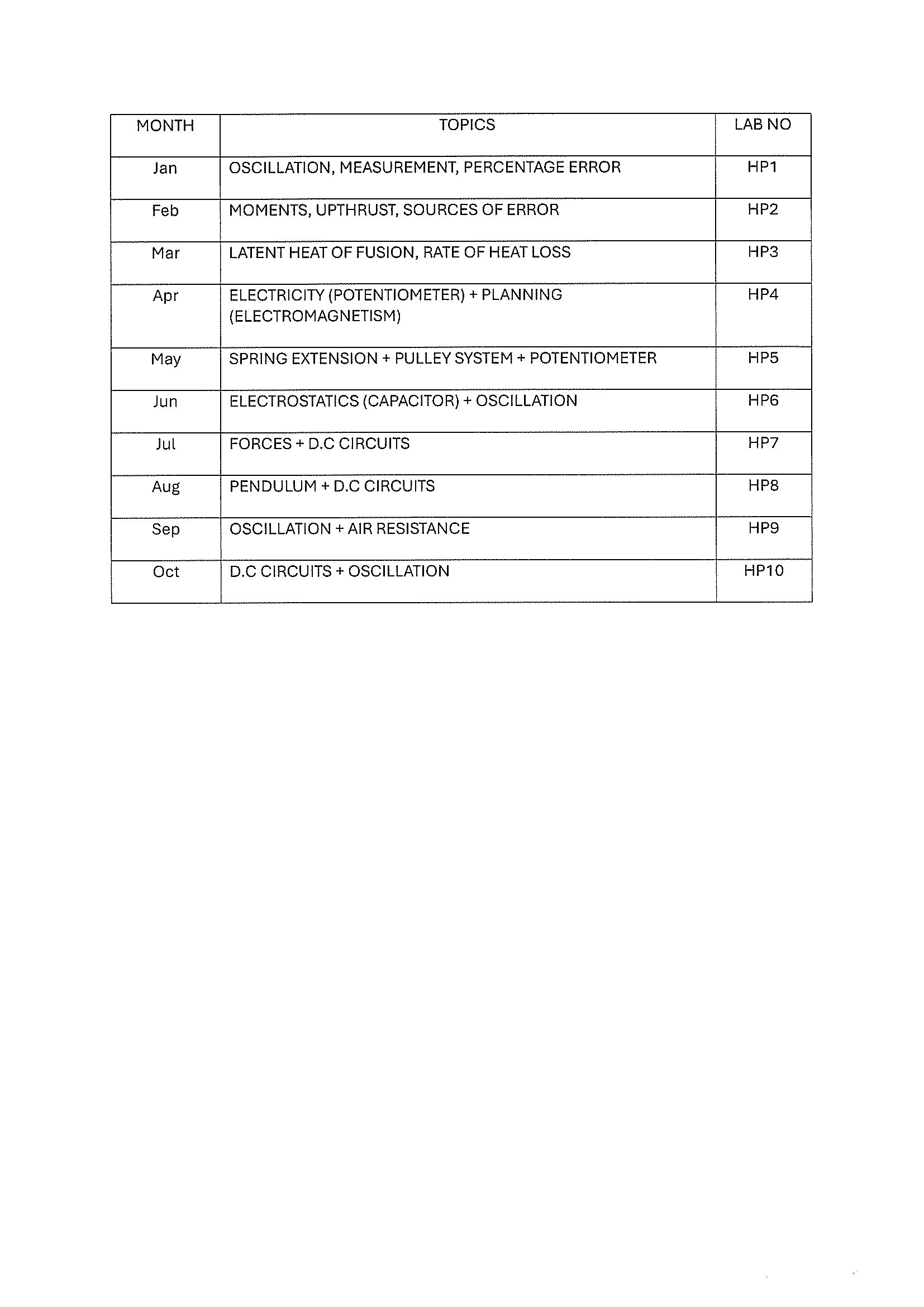
*Other labs, such as HP11-16, are also available for those who want further training or as mock exams.
IMPORTANT POINTS TO NOTE:
The above is the ideal schedule for students who want to excel in their H2 Physics practical exams, by starting in Jan and having a final practical revision or mock exam in Oct. The practical sessions are well spread out, giving students time to study the theory components as well as other subjects. Thus it is highly recommended that you commence your practical training in January.
HOW TO BOOK A LAB SESSION:
(1) Decide which Program or Lab sessions you need or most suitable for.
(2) Whatsapp or Message our staff at 88765498 with your Name, Private or School Candidate, A or O level, Subject or Lab Name (e.g Lab PP2), Date and Time of Lab. (Our staff will then guide you on how to register and make payment. If you are not sure about the lab sessions, just state your Name and the Subjects and we will get back to you)
(3) Register Online by clicking below:

Suggested Answers to 2014 A Level H2 Physics 9646 PAPER 3
1 ai) The horizontal component of the velocity is unchanged.
ii) Along the vertical direction, the object’s velocity increases linearly from zero. This is because a resultant downward force acts on the object to cause it to accelerate. Thus velocity increases with t by the relationship of v(y) = gt.
bi) Horizontal component of the velocity decreases with time due to air resistance acting opposite to the object’s direction of motion.
ii) Vertical component of the object’s velocity increases from 0 with time at a slower rate due to air resistance. Thus the downward acceleration is less than g.
c) Path with air resistance will fall closer to the building.
2 ai) The angle which is subtended at the centre of a circle by an arc length equal to the radius of the circle.
ii) The product of 2π radian and the frequency.
bi) Ek = 0 , Ep = mgh = 4.7 x 10^-3 J
ii) 0.557 Hz
3 a) Increase in internal energy of a system is the sum of work done on the system and the heat supplied to the system.
bi) 4.98 x 10^-2 mol
ii) 1. -226 J
- 0 J
iii) work done on gas: -226 , heat supplied to gas: -884
increase in internal energy: 344, 540, -884
4 a) Resultant displacement at a point due to two or more waves is the vector sum of the displacements due to those waves acting individually.
bi) 57.3º
ii) 0.49 : 1
5 a) Emax = h (c/f) – hf
bi) 4.35 x 10^-7
ii) Gradient of graph = hc
h = 6.667 x 10^34 J
c) Draw a line parallel to the original line but cutting the x-axis at a larger value.
6 a) A region of space set up by a mass, a charged particle or magnet, and surrounding the body, a field which can exert a force on another body that is not physical.
ii) The statement did not specify the type of field and state of particle. Hence the field may be gravitational field, and the force is due to the mass of the particle. The field may also be magnetic field. The magnetic force on the particle is only zero when it is in motion and not moving parallel to the magnetic field.
bi) Any point within a charged sphere will have no electric field.
ii) 1. A = 4.0cm B = 2.0cm
- The spheres have opposite signs. Since E is always >0, indicating that the electric fields from A and B are in the same direction.
iii) 1. 3.00 x 10^-15 J
- a= 1.24 x 10^13 m/s²
-
From 4 to 18.5 cm, the electric field is predomniantly contributed by sphere A and decreasing with distance from A. Acceleration is +3eE/m
The acceleration of the nucleus decreases from a max value at 4cm to a minimum value at 18.5cm
From 18.5 to 28 cm, the minimum E starts to increase again, indicating that the E-field from 18.5cm onwards is predominantly from B. The E field’s direction is the same, and E >0, the lithium nucleus acceleration increases again.
7 ai) The ratio of the potential difference across the wire to the current flowing through the wire.
ii) The resistivity of a wire is a property of the material. It is related to the resistance by the equation R = pl/A
bi) 4.9Ω
ii) 118 turns
c) B = 0.72μ (NI/r)
di) 8.54 x 10^-24
ii) 4.58 x 10^-2
e) Vertical component of the electron’s velocity is perpendicular to the B field and hence it is subjected to a centripetal force. Horizontal component is parallel to the B field and remains constant as there is no magnetic force accelerating the horizontal velocity. Hence the resultant path is helical.
8 ai) A spontaneous and random process in which an unstable nucleus changes into a different nuclide, emitting radiation.
ii) It is unpredictable in both when and which particular nuclide will decay.
iii) Not triggered by external factors.
bi) 2.54 x 10^-10
ii) 4.25kg
ci) 156 W
di) The half life of plutonium is much longer than polonium. For a space flight lasting several years, the original quantity of polonium will have decayed to less than half in a year. Since plutonium has a long half life, over seven years, more than half would still be remaining.
ii) Plutonium has a higher power density as strontium has a much smaller mass and energy release.
A-LEVEL H2 MATH JUNE HOLIDAYS INTENSIVE REVISION
A-LEVEL H2 PHYSICS JUNE HOLIDAYS INTENSIVE REVISION
JUNIOR COLLEGE / A-LEVEL TUITION:


_______________________________________________________________________

______________________________________________________________