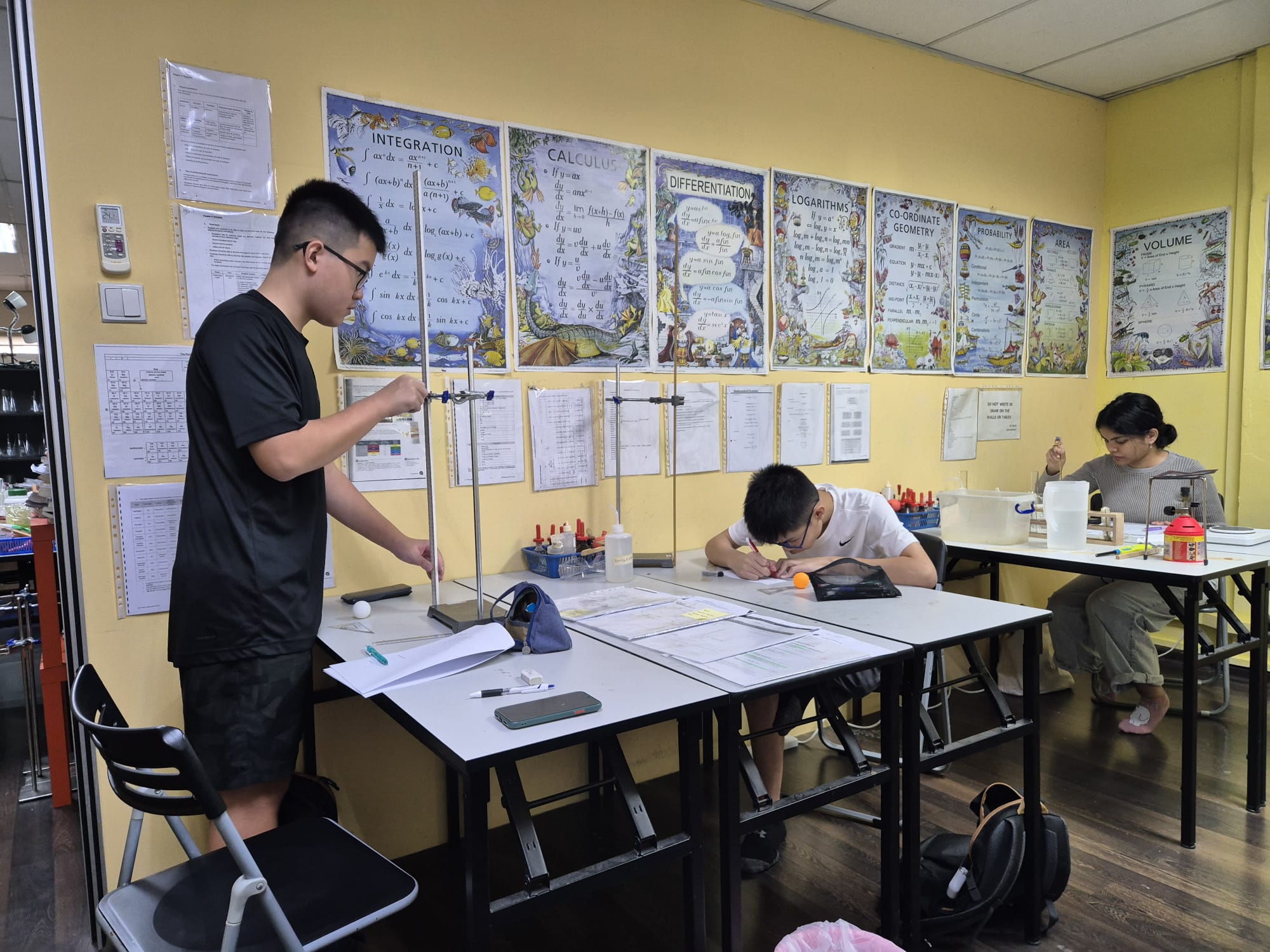
Posted in A-Level, H2 Math, H2 Physics

Our JC1 H2 MATH and PHYSICS Learn Ahead tuition classes will commence on Sun, 9 Feb.

JC1 H2 Math: Every Sunday, 2.00pm – 3.45 pm; Code: J1M3.

JC1 H2 Physics:  Every Sunday, 4.00pm – 5.45pm; Code J1P1.

———————————————————————————————————-

Administrative Matters:

Location: Blk 627, Bukit Batok Central. It is just a 3-min walk from the Bukit Batok MRT station as well as the Bukit Batok Bus Interchange.

Max Class Size: 8

Monthly fee for each JC subject or slot is $240, inclusive of materials fee. Discounts apply for multiple subjects or slots.

TO REGISTER, SMS <FULL STUDENT NAME>, <CODE> TO 97860411.

For enquiries, kindly call or sms to 9786 0411.

———————————————————————————————————–

Why Learn Ahead?

As you know (you can find out from your seniors), JC Math and Physics are much tougher than their O-level counterparts. Not only are their contents deeper and scope wider, the JC lecturers and class tutors also teach at a very fast pace. From our years of tutoring experience, students who learn ahead are able to cope with their school work and eventually perform better at the A-levels than those who don’t have a headstart.

If you obtained anything less than an A1 at the O-level in Math and/or Physics, we strongly encourage you to join our Learn Ahead Programme as it means your foundation in these subjects are still weak. If you wait till you fail your first common test, it might be too late for you to catch up. Imagine trying to relearn past concepts when new concepts are being introduced to you at a fast pace.

Posted in A-Level, Educational Advice

Which subject combination to choose in JC?

SCIENCE PRACTICAL TRAINING

H2 PHYSICS PRACTICAL

H2 CHEMISTRY PRACTICAL

H2 BIOLOGY PRACTICAL


This is another important question and how you decide may affect your career.

My informed opinion is as follows:

(a) If you are passionate about or highly interested in something, say, History, then include it as one of your H2 subjects.

(b) Include Economics as one of your subjects, whether at H1 or H2 level. It will give you a macro and micro view of the financial workings of society. Economics is also a first-year module in almost all professional courses in universities. However, it is not easy to score in Econs because like GP, it is a subject meant for mature minds and students who can express themselves clearly and logically in essays.

(c) Include Math as one of your subjects, whether at H1 or H2 level. It trains you to be precise and accurate while thinking logically. A pass or a good grade in Math is also included in the admission criteria of many courses in universities.

(d) If you are still unsure, then take the following combination if you meet the minimum criteria and your JC provides it: H2: Physics, Chemistry, Math; H1: Econs. It is the most versatile combination, allowing you to enter any course in the local universities, including Medicine, Law, Engineering and Accountancy. If you don’t intend to be an Engineer, then drop Physics and make Econs your H2 subject.

(e) If you want a Singapore government scholarship, remember to take all four subjects at H2 level. To get a scholarship, you have to be consistent in your work and performance.

(f) If you intent to study Medicine overseas, it may be necessary to do Biology as some universities still insist on it.

(g) Before you select a combination, it is important that you know what course you wish to do at the university that you want. Visit the website of the university, read the course prospectus and identify the minimum criteria for admission. Refer to my “Uni Links” to check out the subject requirements for the different universities. For SUTD, they do not have specific course pre-requisites, but students are encouraged to have a Mathematics and a Science subject at the H2 or equivalent level.

(h) If you intent to do undergrad studies in the US, you also need to prepare for and do well in the SAT test.

(i) If you intend to do Medicine or Law in Singapore, please immerse
yourself in medicine or law-related volunteer work during your holidays and be sincere about service. Entry into Medicine and Law requires passing an interview. You need to have knowledge beyond your A-Level subjects to convince the interviewers that you are a worthy candidate.

Students who are unaware of many of the above points often end up in a university doing a course they do not want. Good luck.

Rgds,

Ilyasa


A-LEVEL H2 PRACTICALS


TUITION CLASSES:

jcbutton          secbutton

ipbutton


Singapore Learner provides Group Tuition, Individual Tuition, Intensive Revision, Enrichment Workshops, Headstart Classes, Holiday Classes and Crash Courses at the Primary, Secondary and Junior College levels in the areas of Math, Pure Physics, Pure Chemistry, Science, Economics, and General Paper for the Singapore A-Levels, O-Levels and PSLE.


Posted in Pure Physics

New Sec 3 PHYSICS class every Wednesday 8 pm starting 22 Jan

Due to demand, I’m opening another Sec 3 Physics class on Wednesday evenings. It will be a Learn Ahead coaching class.

——————————————————————————————————

Sec 3 Physics:      Every Wednesday, 8.00 pm – 9.30 pm; Code: S3P1.

Sec 3 Physics:      Every Sunday, 9.30 am – 11.00 am; Code: S3P2.

——————————————————————————————————

The Tutor:

Mr Ilyasa:  A former MOE school teacher, Mr Ilyasa has been coaching students in ‘A’ Level & IB Physics and Mathematics for more than 6 years, as well as ‘O’ Level & IP Physics, Additional Math, E. Math and PSLE Math for more than 10 years. An alumnus of RI and RJC, Mr Ilyasa holds both a Master of Education degree and a Postgraduate Diploma in Education with Credit from the National Institute of Education, as well as a Bachelor of Science degree from the National University of Singapore.

———————————————————————————————————–

Administrative Matters:

Location: Blk 627, Bukit Batok Central. (Our location is just a 3-min walk from either the Bukit Batok MRT station or the Bukit Batok bus interchange. Buses that stop along the road in front of Blk 627 are numbers 157, 178, 66, 506, 173, 174, 176, 187, 941, 947, 985)

Max Class Size: 8

Monthly fee for each subject or slot is $180 respectively, inclusive of materials fee. Discounts apply for multiple subjects or slots.

TO REGISTER, SMS <FULL STUDENT NAME>, <CODE> TO 97860411.

For enquiries, kindly call or sms to 9786 0411.

Posted in A-Level, Educational Advice, Personal, Schools

Between JC and Poly …

Should a O-Level grad choose to go to a JC or a Polytechnic?

Since many students and parents ask me this question every year, here is my opinion on the matter.

The answer is: It depends on several factors:

(a) Your method of learning;

(b) How sure you are about what you want to do as a career;

(c) Your strength in English and Mother Tongue;

(d) Which university you want to go to;

(e) Your level of self-discipline.

Let’s examine each one in detail:

(a) Your method of learning:

In general, if you learn more by reading, go to JC. If you learn more through hands-on activities and projects, go to Poly. If you learn well via both methods equally, go to part (b).

(b) How sure you are about what you want to do as a career:

In general, if you are undecided, go to JC. If you know what you want, go to
the Poly offering your course. For example, if you are sure you want to be a
physiotherapist, go to Nanyang Poly.

(c) Your strength in English and Mother Tongue:

In JC, you must take General Paper and Mother Tongue. If you are weak in English especially, you will suffer terribly in JC. In general, if you are not confident of vastly improving your English in a short time, go to Poly. Of course the Poly also expects you to write English well, but not at the level GP demands.

(d) Which university you want to go to:

If you insist on going to NUS, NTU, SMU, SUTD or SUSS, please go to JC and work hard. If you go to Poly, you have to work extra hard to be the top 5 or 10% of your cohort or course, then you can be admitted to a local public university. However, SIT is a university that takes in lots of Poly grads. More than 70% of JC students make it to the local universities every year, so the chances of getting into the local universities are higher through JC than through Poly. If you go to Poly and don’t do well enough, be prepared to go to an overseas university (which is not a bad idea; don’t worry, money can be borrowed).

(e) Your level of self-discipline:

In JC, you are more supervised. Poly environment is like that of a university; you have to be more independent and responsible. I have ex-students from both sides regretting their choice, because they didn’t think about this issue.

There’s one more route that people often overlook: doing a three-year pre-university course at the Millenia Institute (MI). Bear in mind that only MI offers Management of Business and Principles of Accounting as A-level courses.

Lastly, please bear in mind that the above are just guidelines. Central to all forms of academic success is pure hard work and a thinking disposition.

I wish all O-Level graduates great success in their future endeavours.

Best Rgds,

Ilyasa

_______________________________________

TUITION CLASSES:

jcbutton          secbutton

ipbutton                    pributton

_______________________________________________________________

EDUCATIONAL SERVICES:

hwsupervbutton                   intensivebutton

alevelprepbutton                   olevelprepbutton

______________________________________________________________

By EX-MOE TEACHERS & EXPERIENCED TUTORS

@ BLK 644, BUKIT BATOK CENTRAL, #01-68. S(650644).

CALL 65694897 OR SMS 98530744 OR 97860411.


_________________________________________________________

Singapore Learner provides Group Tuition, Individual Tuition, Intensive Revision, Enrichment Workshops, Headstart Classes, Holiday Classes and Crash Courses at the Primary, Secondary and Junior College levels in the areas of Math, Pure Physics, Pure Chemistry, Science, Economics, and General Paper for the Singapore A-Levels, O-Levels and PSLE.


Posted in Educational Advice, Exam Results

What to do if your O-Level results are bad ….

IMPORTANT INFORMATION FOR PRIVATE CANDIDATES

The registration for ‘A’ and ‘O’ Level exams as a private candidate usually opens around mid-April (Please check SEAB website) and closes before mid-May. If you are registering for a Science subject (Physics, Chemistry, Biology or Combined Sciences), at the time of registration, you will be asked whether you have done any science practical training in any school, centre, or institute. Thus you must begin your science practical training before April. Science practical training in Singapore Learner qualifies as practical training for the purpose of registration for Science subjects for the ‘A’ and ‘O’ level exams.

Thus if you are considering Singapore Learner as your science practical training provider, you must register with us and complete at least 4 practical sessions for each subject by 31st April for us to certify that you have attended science practical training. As students usually do about 10 practical sessions per subject to be competent in practicals, the rest of the lab sessions can be done from May to early October, including the prelim/mock practical exams.

To proceed, please click on the following:

O-LEVEL PRACTICALS


What I mean by bad O-level results is that you neither qualify for JC nor Poly. And like I’ve said elsewhere, it’s ok if you cried at first, because chances are, you are below 21 and legally, you are still a child (I had a 43 yr old O-Level student once though). But let your sadness be for just one day, and no more after that. The past is over. You cannot change it, but you can still influence your future.

What to do (and what not to do) if your O-level results are bad:

(1) Do not blame others. The first step in making any kind of improvement to yourself is not to blame your teachers, your tutors, your textbooks and certainly not your pet who once chewed up your homework (or so you claimed). Blame yourself. It was YOUR show. Only YOU can fail your self and only YOU can make your self succeed. Got it? Thank you.

(2) Reflect on yourself. What went wrong – your lack of revision, your poor time-management, your addiction to computer games etc.?

(3) Search and find your true self. What are your real interests? What is your passion? Maybe you are not the type to just sit still and study? Maybe you have real talent in Music or the Arts instead?

(4) Plan your next course of action. What can you do with poor O-level results? Here are some options:

(a) Redo your O-levels. If you are below a certain age (check with the MOE), you can redo it in your sec school; you’d still need the right environment and the support. But if you dislike the teachers in your former school, then you either self-study (but don’t forget to register for the O-levels), get tuition, or enrol yourself in a private school or a private education programme.

. But re-taking O-levels will not bear fruit unless you do steps (2) and (3) above properly; if you continue your bad habits and bad strategies or you simply did not like the subjects you were taking, it’d be very hard for you to be self-disciplined and to maintain focus. You don’t get different results by doing the same things the same way over and over again (in fact, Einstein called that kind of expectation, “insanity”).

(b) Apply to the ITE. No, it’s not The End. But what course to do at the ITE? Don’t go to the ITE with the aim of working for someone later in life. Instead, go to the ITE in order to pick up a skill that will allow you to set up your own business. So what technical skills are good for business? What can you find in all homes and buildings that no ordinary person can install or repair? I can think of three: air-cons, electrical wiring and water pipes. In fact, you need a license from the government in order to do electrical wiring or plumbing work. Some day, you can become the owner or managing director of an electrical or plumbing company. Or you can migrate to Europe, America or Australia which are all in need of skilled personnel, instead of university graduates. And talking about skilled work or migration, don’t ignore nursing as a career. The thing is, don’t be lazy. And have some courage.

(c) If you are very very talented in some sport, music or the arts, apply to a school catering to such talent whether local or overseas (which might be more forgiving of your past). Or try to catch attention by posting a video of your gig on Youtube. Ask Bieber and Psy what happened to them. And some day, Jack Neo might come looking for you …. The thing is, don’t be lazy. And have some courage.

(d) Work first to get some experience of what you like doing. It would be good if you can be an apprentice in some place where there is skilled work, such as in a spectacle shop, watch shop, jewellery shop, air-con repair shop, bakery etc.

(e) If you are eligible for NS, do NS. Who knows, you might actually like working in the armed services, where food, clothing and accommodation (and even car park lots) are provided free. Before you think I’m crazy, why not you add up the total of cost of food, clothing and accommodation for some 30 years of work!

(f) Set up a business. No, you are not too young to set up a business. In fact, you can be a millionaire by the time you are 21. Do an online, e-commerce business, or simply a popular website that companies are dying to advertise in. The thing is, don’t be lazy. And have some courage.

(g) Apply to do a diploma or even a degree in a private school here, such as SIM. However, such a diploma or degree may not be recognised by the Singapore government for employment purposes in public service or even in govt-linked companies such as SIA or Singtel. And schools like SIM may require you to first complete a foundation course before you can be enrolled in a diploma or degree course. I know many students who have done poorly at the O-Levels will choose this option, because it makes them feel better this way, even if the diploma or degree is an external one, but let me tell you one thing – if you didn’t get 5 O-Level passes including passes in English and Math, it might come back to haunt you some day, because I’ve met adults who can’t be promoted or can’t change their jobs because of their grades at O-levels.

(5) Take action. Strategise. Gather resources. Believe in youself and your abilities. Adopt the right values and attitude. Set your short-term and long-term goals clearly. Write these down somewhere. Be positive, and be with positive people.

You see, there are so many ways to move on. Do not let setbacks affect you too much. Pick up and join back the pieces. Get up if you are down. Spend time with your loved ones. Remember these lines from Miley Cyrus’ song (if you don’t hate her of course):

“But I gotta keep tryin’. Gotta keep my head held high. There’s always gonna be another mountain. I’m always gonna wanna make it move. Always gonna be an uphill battle. Sometimes I’m gonna have to lose. Ain’t about how fast I get there. Ain’t about what’s waitin’ on the other side. It’s the climb.”

Do not worry about being left behind as your friends move forward. Chances are, you are going to live for another 60 years or so. When you look back someday, it wouldn’t matter that you ‘lost’ one or two years somewhere along the way. Setbacks happen to everybody; I had my fair share of failures and setbacks. How we respond to these setbacks matter.

If you still feel down, then please watch this video, http://www.youtube.com/watch?v=wOlTdkYXuzE. It might help you a bit. : )

Good luck and take care.  : )


For Practical courses, mock exams or schedules, please click on any of the following:

O-LEVEL PHYSICS PRACTICAL


O-LEVEL CHEMISTRY PRACTICAL


O-LEVEL BIOLOGY PRACTICAL


O-LEVEL SCIENCE (PHYSICS) PRACTICAL


O-LEVEL SCIENCE (CHEMISTRY) PRACTICAL


O-LEVEL SCIENCE (BIOLOGY) PRACTICAL


Singapore Learner @ Bukit Batok

Blk 644, Bukit Batok Central, #01-68. S(650644).

Tel: +(65) 6569 4897,   +(65) 88765498

Email:  principal@singaporelearner.com

If you wish to visit us, kindly call or sms first. Thank you.

___________________________________________

Posted in A-Level, IB

Which one to choose? The IB or the A-levels?

SCIENCE PRACTICAL TRAINING

H2 PHYSICS PRACTICAL

H2 CHEMISTRY PRACTICAL

H2 BIOLOGY PRACTICAL


I’ve had the privilege of teaching and tutoring students Math and Physics in both the A-level and IB programmes, so here I’m sharing with you my sincere thoughts on the two programmes.

Whether you choose to do the IB progamme or the A-levels depends on several factors:

(1) Your method of studying.

If you are the lazy type and you prefer to just study VERY intensively for three months prior to a high-stakes exam, then do the A-levels. If you can continually work hard and can cope with the pressure of being constantly assessed, then do the IB Diploma programme. This is serious. I have a student who dropped out of IB to do the the A-levels, precisely because he was not able to cope with being continually FORMALLY assessed.

(2) The university you want to go to:

If you are Singaporean and you intend to go to a local university such as NUS or NTU, it’s better for you to do the A-Levels. This is because you will be compared only with local students performing the same exam in your country, as far as I have been informed. At the moment, a lot of local students doing the IB are from ACS (I), who only take in students who obtained a minimum score of 247 at the PSLE or those who obtained an L1R5 of 5 (incl. bonus points) at the O-Levels. So not surprisingly, the average score at ACS (I) for the IB exams last year was a whopping 41.65! Do you know that a score of 36 and above in the IB diploma exams is considered excellent by educators?

Imagine that you have obtained a score of 40 in the IB exam. In the world, you will be considered a top student. But at ACS (I), you are below average! Thus you may find yourself rejected by NUS but accepted by Oxford or Cambridge University! This weird situation was first highlighted to me by a parent of my tutee a few years ago. She regretted sending her daughter to ACS (I) because although the latter obtained a score of 38 and thus a top student for the rest of the world, she was rejected by a local university (reason being she was below average for her IB cohort) and finally applied to do teaching at the NIE as she did not want to go overseas.

Thus if you are a local student and you intend to study overseas for your degree, then by all means do the IB programme.

(3) The breadth or depth of the subjects you want to learn:

Generally, the IB programme is broader in academic scope while the A-Levels is deeper. For example, when I was covering an IB Physics class, I was surprised to discover that they also learn Astrophysics and the Carnot Cycle, topics not covered in Singapore’s A-Level H2 Physics. Thus I feel that if you want a more holistic programme, do the IB diploma as you’ll be exposed to the Theory of Knowledge as well as doing a community service project.

The above are just my personal albeit informed views. What is clear and certain is that if you DON’T have a thinking disposition, you’ll do badly in either course. Good luck. : )

Rgds,

Ilyasa, M.Ed, PGDE, ex-MOE Teacher.


TUITION CLASSES:

Please click on one of the following:

TUITION FOR INTERNATIONAL BACCALAUREATE (IB) MATH OR PHYSICS

jcbutton

ipbutton


Posted in A. Math, Schools, Track Record

Yay, my student passed his A. Math!

I’m so happy that Sheng Ze, one of my tutees in 2013, obtained a C6 in his A. Math in the recent ‘O’ Level exams, after getting F9s almost all the time from Sec 3 to Sec 4. He was even asked many times, directly and indirectly, to drop this subject but each time I advised his mum and him to continue doing the subject because he himself felt he was improving and did not want to drop it.

I’ve said it elsewhere and I will say it again: Schools generally do not care about their students or their students’ future; they are only interested in their own academic reputation such as percentage passes.

Schools can improve their percentage passes in certain subjects by simply disallowing their weaker students to study or take the exam for these tough subjects, such as A. Math and the Pure Sciences. But by doing this, they are adversely affecting the future of their students who will be denied many future courses and future jobs.

A. Math is an important subject for both Science and Business courses at higher levels. DO NOT DROP A. MATH SO LONG AS YOU ARE STILL INTERESTED TO DO WELL IN IT. Schools have no power to force you to drop any subject. The teachers will try their best to coax you to drop it, but ignore them please.

One of my existing tutees, Syakir, was also “offered” to drop A. Math at the end of last year due to his poor performance throughout Sec 3. But I offered to tutor him intensively instead in Nov and Dec and now he is in the top one-third of his class based on his latest post-holiday test.

Where there is a will there is a way. You can do well in any subject, in fact in anything, if you keep your focus on it and persevere. Do not feel disheartened or lose hope just because someone says you are not good enough. Prove them wrong instead.

Rgds,

Ilyasa

Posted in A-Level

Our JC1 Learn Ahead classes will most likely start in early Feb

Although I’ve already received requests for JC1 Math, PhysicsGP and Economics tuition classes to start as soon as possible, I think most likely we will start the classes in the first or 2nd week of Feb.

If you didn’t get A1 at O-level for the same subject you intend to take at A-level, I would encourage you to join our Learn Ahead Programme so that your academic life in your JC would be smoother.

For enquiries, kindly contact or SMS to 97860411. Thank you.

Posted in Exam Results

‘O’ Level Results 2013-2014

ALL THE BEST to those of you who will be receiving your ‘O’ Level results tomorrow, especially my 35 Sec4 tutees in 2013.

I will update their results here as and when they update me.

Please remember that if for some reason your results are not very good, you’d still need to get over it and move on; plan your next steps, re-strategise and take action. And if instead your results are very good, you have only become Ordinary; the battle for the ‘A’ levels or Diploma is still waiting to start.  : )

Rgds,

Ilyasa

——————————————————————————————————-

Amirah (CTSS): A. Math A1, E.Math A1 (from D7-F9);

Valerie (BPGH): A. Math B3 (from F9);

Johnson (BPGH): Physics A1 (from D7);

Ronald (BPGH): Physics A1 (from C6-D7) ;

Darren (BPGH): Physics A1 (from C6-D7);

Nirupa (SMSS):  Physics B3, Chemistry B3, A. Math B4 (all from D7-F9);

Yang Ming (Montfort): A. Math B3, Physics B3 (from E8-F9);

Hashfi (SCSS): Physics B3, A. Math B4 (from E8-F9);

Grace (NHH): Physics A2 (from prelim A2);

Jia Feng (NHH): Physics A2 (from C6-D7);

Sheng Ze (BVSS): A. Math C6 (from F9);

Ryan (BPGH): Physics A2 (from C6);

Regine (NHH): Physics B3 (from C6);

Rachel (Deyi): A. Math A2 (from D7);

———————————————————————————————————

Although some of the above results are not spectacular, I know my own students and how much they have worked and how much they have improved and thus I’m very proud of them.


Posted in A. Math, Pure Physics

Updates & Reflections on my Learn Ahead Programme (LAP) – A. Math & Physics

These are what I covered this week:

S4 A. Math:  We started on Differentiation – Idea of limits and the derivative, dy/dx, power rule. Students find it interesting that we can determine the gradient at a point on a curve without drawing a tangent.

S4 Physics: We started on Static Electricity – the idea of charge, the coulomb,  insulators, conductors, charging by friction, charging by induction, charging by contact, earthing, electric fields, applications of electrostatics. Unfortunately textbooks, don’t cover much about what happens when a charged insulator touches another insulator, when an insulator touches a conductor (either is charged), and when a conductor touches another conductor (either or both initially charged).

S3 A.Math: We revised the beginnings of Logarithms a bit as a new student has just joined. Conversion of index form to log form and vice versa, base e and base 10.

S3 Physics: We revised Kinematics because of a new student – distance vs displacement, speed vs velocity, deceleration vs negative acceleration, scalars and vectors, kinematics formulae.

Rgds,

Ilyasa (hp: 97860411)