Analysis, Conclusions and Evaluation (ACE) makes up 35% of the marks for Paper 3 — the single largest skill category, more than Planning, and equal in weight to Manipulation and Presentation combined with room to spare.
A large share of ACE marks comes from questions asking candidates to identify a source of error and suggest an improvement. Examiners consistently reward answers that are specific and causal, never generic.
These notes gather the sources of error that recur across the common O-Level Biology practicals, organised by topic, together with a working method for constructing full-mark answers.
1. How to Answer “Source of Error” Questions
1.1 The Three-Part Answer
Every full-mark answer to this question type has three linked parts. Omitting any one part usually costs a mark, even when the other two are correct.
- Identify the source precisely — name the specific step, material or instrument involved, not a vague category. Write “the potato discs were cut by hand and so varied slightly in thickness”, not “human error”.
- Explain the effect, with direction — state whether the recorded result becomes higher or lower than the true value, and explain why using the relevant biological or physical principle.
- State a specific improvement — a concrete change to equipment or technique that removes or reduces the source of error. “Repeat and take an average” only earns credit for random error; it does not correct a systematic error.
1.2 Random Error versus Systematic Error
Distinguishing these two is essential, because they call for different types of improvement.
| Source of Error | Effect on Result | How to Overcome / Improve |
| Random error | Unpredictable variation that can push a result higher or lower on different trials, e.g. biological variation between specimens, reaction time in starting/stopping a stopwatch, or judging a colour end-point by eye. | Repeat the experiment / increase the sample size and calculate a mean. Circle and discard clear anomalies, then repeat those particular trials. |
| Systematic error | A consistent bias in one direction caused by a flaw in technique or apparatus, e.g. a wrongly calibrated balance, evaporation from an uncovered vessel, or heat from a lamp affecting what is meant to be a “light-only” variable. | Change the technique or apparatus responsible for the bias. Repeating the experiment will not remove it, since every repeat is affected in the same way. |
1.3 Key Terms Examiners Expect
| Source of Error | Effect on Result | How to Overcome / Improve |
| Accuracy | How close a measured value is to the true value. | Use a more precise instrument or a better technique (e.g. a burette instead of a measuring cylinder). |
| Precision | How close repeated measurements are to one another, regardless of whether they are accurate. | Standardise the technique so that every repeat is measured in exactly the same way. |
| Reliability | Whether an experiment gives consistent results when repeated. | Increase the number of repeats or trials. |
| Validity | Whether the experiment truly tests what it claims to — only the independent variable should change, with all other variables controlled. | Identify and control any variable that was allowed to change unintentionally. |
| Anomalous result | A result that clearly does not fit the trend shown by the rest of the data set. | Circle it on the graph, label it ‘anomalous result’, exclude it from the line of best fit and from any mean, and repeat that trial if time allows. |
The full set of notes, which includes sections such as Sources of Error by Practical Topic is available in hard copy for students who sign up for any of our regular practical lessons, Crash Courses or Mock Exams.
- Topics Tested in Past O-Level Physics Paper 3 Practical Exam
- Topics Tested in Past O-Level Chemistry Paper 3 Practical Exam
- Topics Tested in Past O-Level Biology Paper 3 Practical Exam
LOOKING FOR THE BEST PLACE TO DO YOUR SCIENCE PRACTICALS? JOIN US!
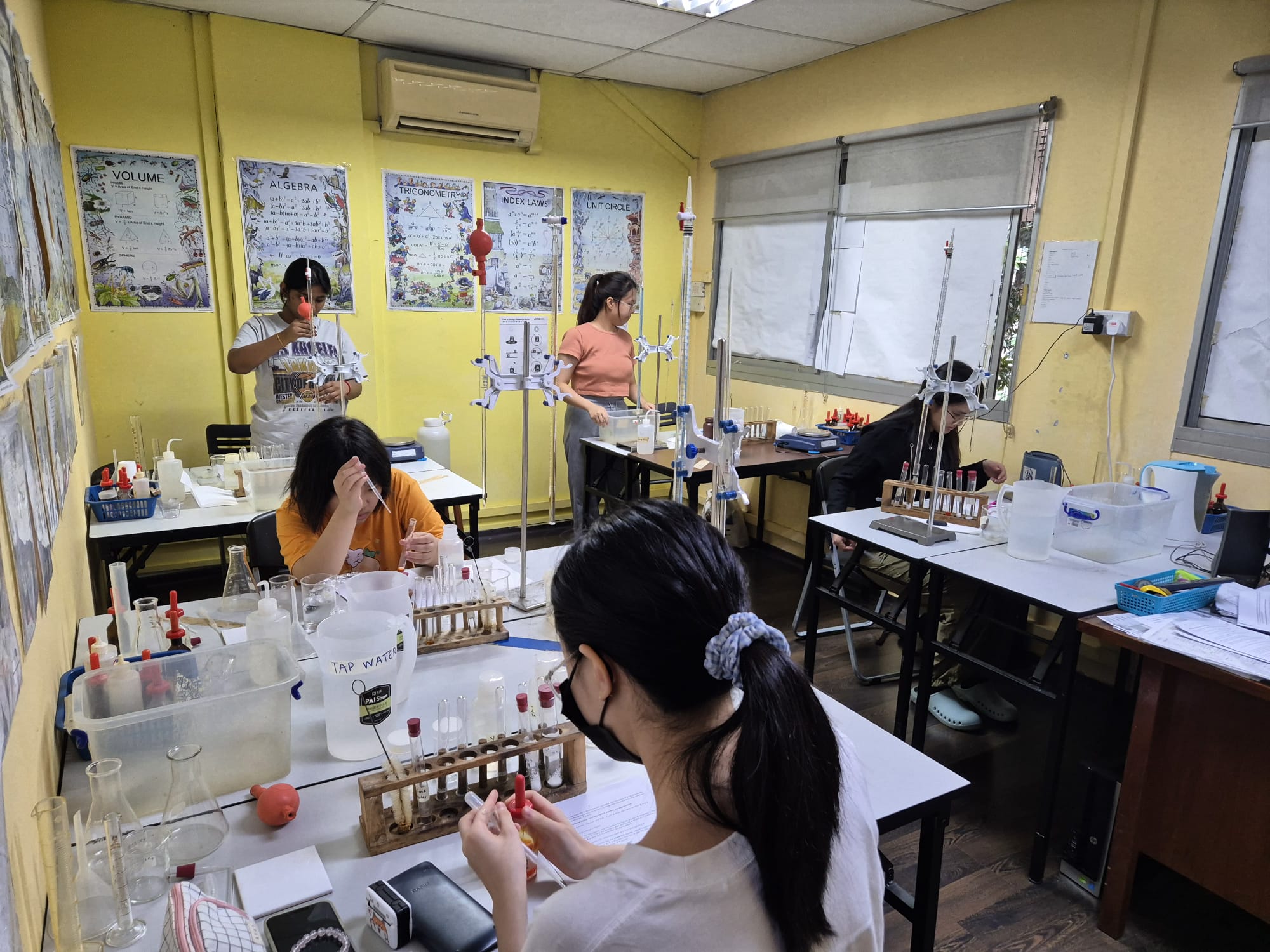
Singapore Learner has been a Comprehensive Science Practical Training provider since 2017.
As at 19 Apr 2026, we have trained about 1060 students for their science practical exams and we have conducted a total of about 4044 lab sessions.
Our laboratory apparatus are exam-grade and similar to those used in MOE schools and our chemicals are all NEA-approved.
We provide A-Level / H2 / IP and O-Level Physics, Chemistry, Biology and Combined Science (Physics/Chemistry/Biology) Practical Training/Crash Course/Mock Exams for both local (eg. H2, Singapore-Cambridge) and international exams (CIE, Pearson Edexcel, IGCSE).
Why Choose Us?
- Our teachers are very experienced, and we actually TEACH you good practical techniques.
- We have been a one-stop comprehensive science practical centre providing solid practical training for ALL THREE sciences and for all levels and streams since 2017.
- Our laboratory apparatus are exam-grade and similar to those used in MOE schools and our chemicals are all NEA-approved.
- We have a structured practical training programme catering to the needs of both beginners and experienced students.
- We have a small class size so that the teacher is able to observe the actions of each student more closely and demonstrate the correct practical techniques where and when necessary.
- Many private schools trust us to prepare and conduct science practical training and assessment for their students, including structured training, mock exams and even actual CIE science practical exams.
