Purpose of These Notes
These notes cover all five types of Planning questions tested in H2 Chemistry Paper 4: Volumetric Analysis (Titration), Gravimetric Analysis, Gas Collection, Energetics, and Kinetics. For each type, you will find: what the question is testing, the exact procedural format with precision-tagged steps, a worked example using the thermometric titration question from RVHS 2024, a mark scheme, and the most common errors.
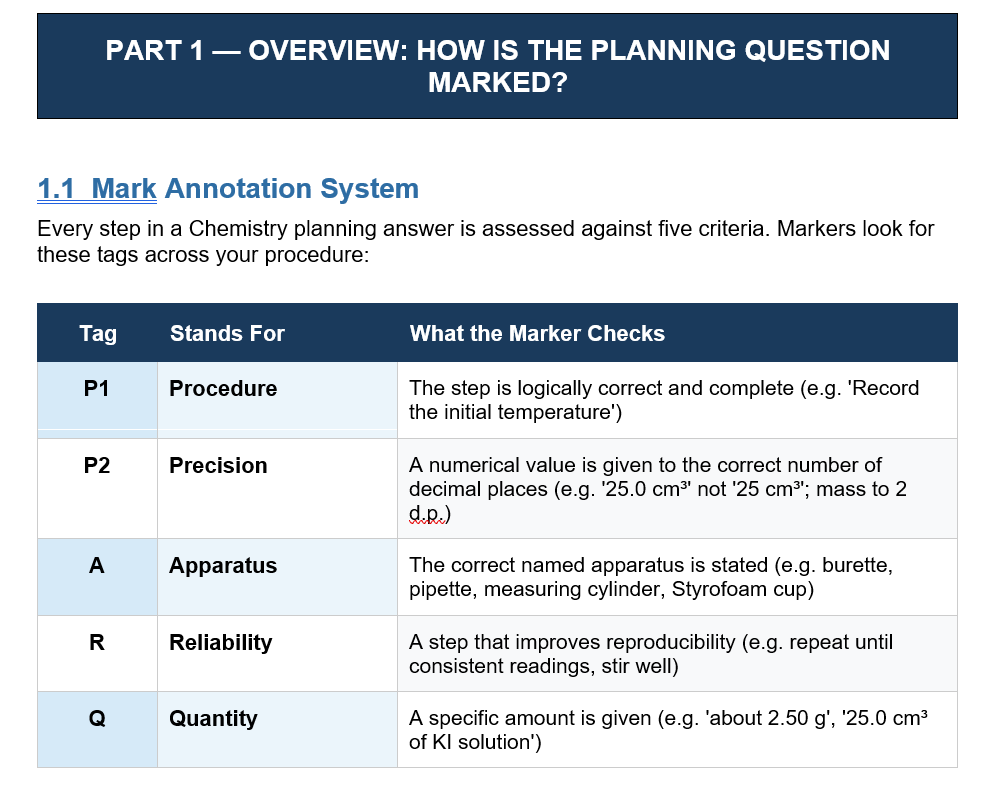
The mark annotation system used throughout: (P1) = Procedure, (P2) = Precision, (A) = Apparatus, (R) = Reliability, (Q) = Quantity.
1.2 General Rules That Apply to ALL Planning Questions
• Write your procedure in numbered steps — never continuous prose.
• Every step must name the apparatus and give the quantity to the correct precision.
• State both the initial and the final measurement for every instrument used.
• Reliability steps (repeat until consistent) must be specific — state the tolerance (e.g. ±0.10 cm³, ±0.01 g).
• Safety: name the specific chemical involved and the specific hazard it poses. Give the action to take, not the action to avoid.
⚠ Never repeat information already given in the question. Read the question stem carefully — restating given facts scores zero.
PART 2 — VOLUMETRIC ANALYSIS (TITRATION)
2.1 What is Tested
Titration questions ask you to determine an unknown concentration, basicity (number of acidic H⁺), or percentage purity. They may involve: acid-base titration, back titration, redox titration (MnO₄⁻ or iodometric), or thermometric titration. The planning always follows a three-phase structure: (i) preparation of standard solution, (ii) dilution if needed, (iii) the titration itself.
2.2 Pre-Experimental Calculation — Titre Volume
Before writing any procedure, check whether a dilution is needed. The key rule:
| Key Rule | Target titre volume: 10.00 – 40.00 cm³. If concentrations differ by a factor of 10 or more, dilute first using C₁V₁ = C₂V₂. Use a 250 cm³ volumetric flask for dilution. |
A titre that is too high → requires burette refill → high % error.
A titre that is too low → small volume → high % error from burette uncertainty (±0.05 cm³ per reading).
Percentage error in burette = (0.10 / titre volume) × 100%. Target ≤ 0.5%.
2.3 Indicator Selection
Choosing the wrong indicator is a common and costly error. Always match indicator to the type of titration.
2.4 The Standard Procedure — Step by Step
Phase 1: Preparation of Standard Solution (from solid)
- Weigh accurately about [mass to 2 d.p.] g (P2), (Q) of [name of solid] into a dry and clean (R) weighing bottle (A), (P1).
- Transfer the solid quantitatively into a 100 cm³ beaker (A). Reweigh the emptied weighing bottle and record its mass (P1). Calculate the actual mass transferred (P1).
- Add from a 50.00 cm³ (P2) burette (A), [volume to 2 d.p.] cm³ (P2) of [solvent/acid] to dissolve the solid. Swirl until fully dissolved (R), (P1).
- Transfer the solution and all washings into a 250 cm³ volumetric flask (A). Make up to the mark with deionised water (P1).
- Stopper and shake the flask and mix thoroughly to obtain a homogeneous solution (P1).
⚠ Always reweigh the emptied weighing bottle — this gives the actual mass transferred. Do NOT weigh into the volumetric flask directly.
Phase 2: The Titration
- Pipette 25.0 cm³ (P2), (Q) of [analyte solution] into a 250 cm³ conical flask (A), (P1).
- Add 2–3 drops of indicator name into the conical flask.
- Fill a 50.00 cm³ burette (A) with [titrant solution] and record the initial burette reading to 2 d.p. (P1), (P2).
- Titrate [titrant] against [analyte]. Add dropwise near the endpoint. Swirl the flask continuously (R). Stop when the solution changes from [colour A] to [colour B] and the colour persists for 30 s (P1).
- Record the final burette reading and calculate the titre (P1). Repeat until two titre values are consistent within ±0.10 cm³ (R). Use the mean of the consistent readings (P1).
The full set of Planning notes is available in hard copy for students who sign up for any of our regular practical lessons, Crash Courses or Mock Exams.
LOOKING FOR THE BEST PLACE TO DO YOUR SCIENCE PRACTICALS? JOIN US!
Singapore Learner has been a Comprehensive Science Practical Training provider since 2017.
As at 19 Apr 2026, we have trained about 1060 students for their science practical exams and we have conducted a total of about 4044 lab sessions.
Our laboratory apparatus are exam-grade and similar to those used in MOE schools and our chemicals are all NEA-approved.
We provide A-Level / H2 / IP and O-Level Physics, Chemistry, Biology and Combined Science (Physics/Chemistry/Biology) Practical Training/Crash Course/Mock Exams for both local (eg. H2, Singapore-Cambridge) and international exams (CIE, Pearson Edexcel, IGCSE).
Why Choose Us?
- Our teachers are very experienced, and we actually TEACH you good practical techniques.
- We have been a one-stop comprehensive science practical centre providing solid practical training for ALL THREE sciences and for all levels and streams since 2017.
- Our laboratory apparatus are exam-grade and similar to those used in MOE schools and our chemicals are all NEA-approved.
- We have a structured practical training programme catering to the needs of both beginners and experienced students.
- We have a small class size so that the teacher is able to observe the actions of each student more closely and demonstrate the correct practical techniques where and when necessary.
- Many private schools trust us to prepare and conduct science practical training and assessment for their students, including structured training, mock exams and even actual CIE science practical exams.
