Purpose of These Notes
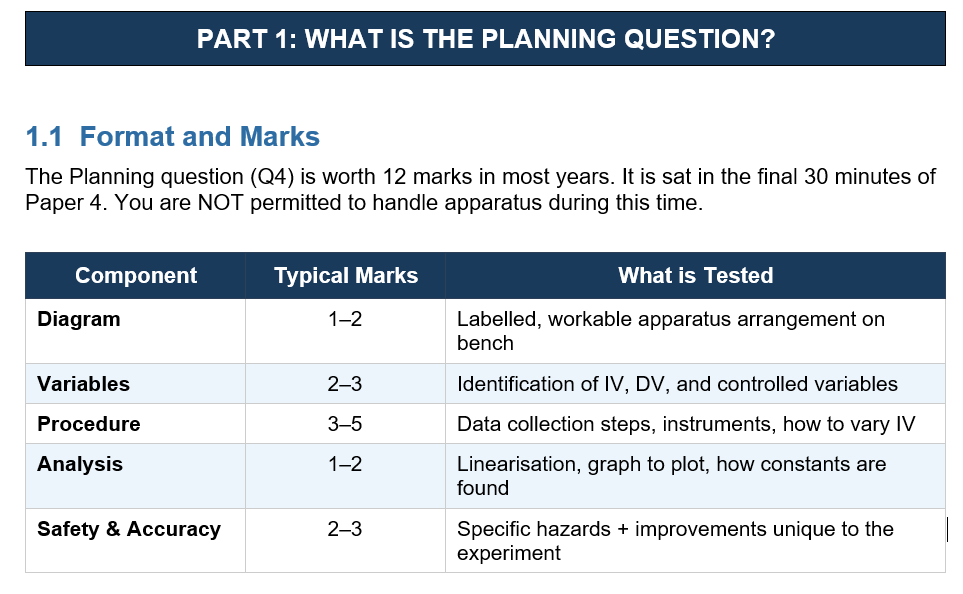
These notes provide a complete framework for answering the Planning question in the H2 Physics A-Level Paper 4 practical examination. A full Planning question is worth 11–12 marks and must be answered in the final 30 minutes of the paper. You may not touch any apparatus during this time.
Use these notes to understand: what each component of the answer is testing, exactly how to write it, common errors to avoid, and how a top-band response is structured.
1.2 How to Approach the Question (Time Strategy)
• Read the question carefully twice (2 min). Identify the equation and what constants need to be found.
• Sketch the diagram first — this locks in your apparatus before writing.
• Write variables explicitly before the procedure — markers look for these early.
• Write the procedure in numbered steps — never continuous prose.
• End with Safety and Accuracy — these often carry 3 marks and are easy to score.
⚠ You CANNOT earn marks by repeating information already given in the question. Read the question carefully and ensure every point you write adds new, specific information.
PART 2: THE EXACT FORMAT — COMPONENT BY COMPONENT
(a) Diagram
The diagram is worth 1–2 marks. It must show a WORKABLE setup that a student could actually build in a lab.
What a top-band diagram must include:
• A clear 2D side-view (or top-view if needed) — label it as such
• A drawn table-top (horizontal line at the bottom) — all apparatus rests on it
• All relevant apparatus labelled, including instrument names (e.g. ‘metre rule’, ‘GM tube’, ‘ratemeter’)
• Quantities to be measured labelled directly on the diagram (e.g. arrows showing distance d, thickness t)
• Retort stands and clamps shown where apparatus needs support
• Circuit diagrams (if electrical) using conventional symbols — do not draw 3D boxes
⚠ Equipment must not float in mid-air. If an instrument stands unsupported, it must be shown clamped to a retort stand. Equipment likely to topple (motors, heavy masses) must be firmly clamped.
Diagram Checklist: Table top drawn? All items labelled? Quantities marked with arrows/letters? Supports shown? No floating equipment?
(b) Defining the Problem — Variables
This section carries 2–3 marks. State variables explicitly, clearly, and quantifiably. Vague statements like ‘keep other factors the same’ score zero.
The full set of Planning notes is available in hard copy for students who sign up for any of our regular practical lessons, Crash Courses or Mock Exams.
LOOKING FOR THE BEST PLACE TO DO YOUR SCIENCE PRACTICALS? JOIN US!
Singapore Learner has been a Comprehensive Science Practical Training provider since 2017.
As at 19 Apr 2026, we have trained about 1060 students for their science practical exams and we have conducted a total of about 4044 lab sessions.
Our laboratory apparatus are exam-grade and similar to those used in MOE schools and our chemicals are all NEA-approved.
We provide A-Level / H2 / IP and O-Level Physics, Chemistry, Biology and Combined Science (Physics/Chemistry/Biology) Practical Training/Crash Course/Mock Exams for both local (eg. H2, Singapore-Cambridge) and international exams (CIE, Pearson Edexcel, IGCSE).
Why Choose Us?
- Our teachers are very experienced, and we actually TEACH you good practical techniques.
- We have been a one-stop comprehensive science practical centre providing solid practical training for ALL THREE sciences and for all levels and streams since 2017.
- Our laboratory apparatus are exam-grade and similar to those used in MOE schools and our chemicals are all NEA-approved.
- We have a structured practical training programme catering to the needs of both beginners and experienced students.
- We have a small class size so that the teacher is able to observe the actions of each student more closely and demonstrate the correct practical techniques where and when necessary.
- Many private schools trust us to prepare and conduct science practical training and assessment for their students, including structured training, mock exams and even actual CIE science practical exams.
