O LEVEL PURE CHEMISTRY
Paper 3 Practical — Planning (P)
Complete Student Notes, Strategies & Worked Example | 6092/03
| Paper 3 40 marks | 1h 50 min | Planning (P) ~4–6 marks per question | Overall Paper 3 = 20% of O Level | Syllabus 6092 (Pure Chemistry) |
Section 1: What is Planning in O Level Chemistry?
Planning questions test your ability to design a complete, logical chemical investigation from scratch. Unlike Biology, Chemistry planning is less about biological mechanisms and more about: choosing the right apparatus, using correct quantities with precise measurements, applying chemical knowledge (equations, molar calculations, expected observations), and showing how you would interpret results to reach a conclusion.
Chemistry Planning is different from Biology Planning: You must always include specific masses/volumes (with units), name the specific instrument used to measure each quantity, state expected observations, and show any necessary molar calculations. Vague answers like ‘add some acid’ score zero.
The Four Pillars of Every Chemistry Planning Answer
| Pillar | What It Requires | Mark Value |
| 1. Variables | State IV (what you change), DV (what you measure), and CVs (what you keep constant) with specific quantities | 1 mark |
| 2. Procedure | Numbered steps with: specific apparatus, specific masses/volumes, method of measurement, expected observations | 1–2 marks |
| 3. Calculations / Treatment of Results | Show how the measurements are used to calculate the answer or compare results, with equations and units | 1–2 marks |
| 4. Conclusion | State clearly how results are interpreted to answer the investigation question | 1 mark |
Key O Level Chemistry Rule: Always use mass, volume, or concentration — NEVER ‘amount’. Use specific instrument names: ‘electronic balance’, ‘measuring cylinder’, ‘gas syringe’, ‘burette’. Quantities must be specific and reasonable.
Section 2: The Three Types of Chemistry Planning Questions
O Level Chemistry planning questions fall into three broad types. Recognising the type immediately tells you what the DV is, what apparatus you need, and what your calculation/conclusion looks like.
Type A: Rate of Reaction Investigations
You investigate how a factor (temperature, concentration, surface area, catalyst) affects how fast a reaction proceeds.
| Feature | Details |
| Typical IVs | Temperature / °C, concentration of acid / mol dm⁻³, particle size (powder vs chips), presence/absence of catalyst |
| Typical DVs | Time for reaction to complete (disappearing cross / colour change) / s; volume of gas collected / cm³ in fixed time; initial rate of gas production |
| Key CVs | Same mass/volume of reactant; same concentration of other reagent; same temperature (if not the IV); same total volume of solution |
| Measurement | Stopwatch for time; gas syringe for volume; electronic balance for mass |
| Conclusion | Lower time = higher rate. Higher volume of gas in fixed time = higher rate. Draw graph of rate vs IV; steeper gradient = greater effect. |
Calculating rate: Rate = volume of gas (cm³) / time (s) OR Rate = 1 / time (s⁻¹). Use rate (not just time) as your DV when you want to show ‘how fast’.
The full set of notes, which includes sections such as Types of Chemistry Planning Questions, is available in hard copy for students who sign up for any of our regular practical lessons, Crash Courses or Mock Exams.
- Topics Tested in Past O-Level Physics Paper 3 Practical Exam
- Topics Tested in Past O-Level Chemistry Paper 3 Practical Exam
- Topics Tested in Past O-Level Biology Paper 3 Practical Exam
LOOKING FOR THE BEST PLACE TO DO YOUR SCIENCE PRACTICALS? JOIN US!
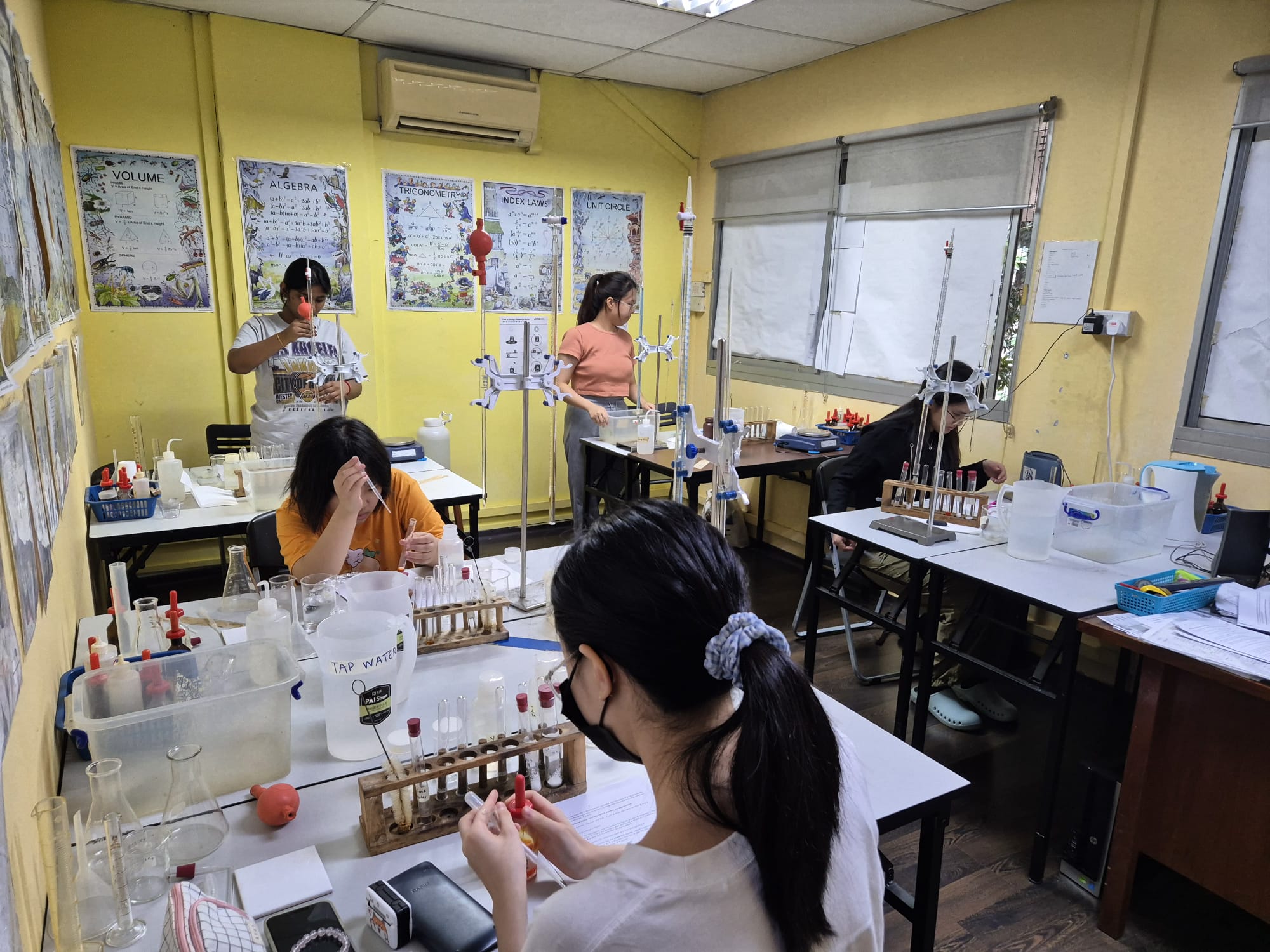
Singapore Learner has been a Comprehensive Science Practical Training provider since 2017.
As at 19 Apr 2026, we have trained about 1060 students for their science practical exams and we have conducted a total of about 4044 lab sessions.
Our laboratory apparatus are exam-grade and similar to those used in MOE schools and our chemicals are all NEA-approved.
We provide A-Level / H2 / IP and O-Level Physics, Chemistry, Biology and Combined Science (Physics/Chemistry/Biology) Practical Training/Crash Course/Mock Exams for both local (eg. H2, Singapore-Cambridge) and international exams (CIE, Pearson Edexcel, IGCSE).
Why Choose Us?
- Our teachers are very experienced, and we actually TEACH you good practical techniques.
- We have been a one-stop comprehensive science practical centre providing solid practical training for ALL THREE sciences and for all levels and streams since 2017.
- Our laboratory apparatus are exam-grade and similar to those used in MOE schools and our chemicals are all NEA-approved.
- We have a structured practical training programme catering to the needs of both beginners and experienced students.
- We have a small class size so that the teacher is able to observe the actions of each student more closely and demonstrate the correct practical techniques where and when necessary.
- Many private schools trust us to prepare and conduct science practical training and assessment for their students, including structured training, mock exams and even actual CIE science practical exams.
