Posted in Practical

Notes on Planning for O-Level Chemistry Practicals

O LEVEL PURE CHEMISTRY

Paper 3 Practical — Planning (P)

Complete Student Notes, Strategies & Worked Example  |  6092/03

Paper 3 40 marks | 1h 50 minPlanning (P) ~4–6 marks per questionOverall Paper 3 = 20% of O LevelSyllabus 6092 (Pure Chemistry)

Section 1: What is Planning in O Level Chemistry?

Planning questions test your ability to design a complete, logical chemical investigation from scratch. Unlike Biology, Chemistry planning is less about biological mechanisms and more about: choosing the right apparatus, using correct quantities with precise measurements, applying chemical knowledge (equations, molar calculations, expected observations), and showing how you would interpret results to reach a conclusion.

Chemistry Planning is different from Biology Planning: You must always include specific masses/volumes (with units), name the specific instrument used to measure each quantity, state expected observations, and show any necessary molar calculations. Vague answers like ‘add some acid’ score zero.

The Four Pillars of Every Chemistry Planning Answer

PillarWhat It RequiresMark Value
1. VariablesState IV (what you change), DV (what you measure), and CVs (what you keep constant) with specific quantities1 mark
2. ProcedureNumbered steps with: specific apparatus, specific masses/volumes, method of measurement, expected observations1–2 marks
3. Calculations / Treatment of ResultsShow how the measurements are used to calculate the answer or compare results, with equations and units1–2 marks
4. ConclusionState clearly how results are interpreted to answer the investigation question1 mark

Key O Level Chemistry Rule: Always use mass, volume, or concentration — NEVER ‘amount’. Use specific instrument names: ‘electronic balance’, ‘measuring cylinder’, ‘gas syringe’, ‘burette’. Quantities must be specific and reasonable.

Section 2: The Three Types of Chemistry Planning Questions

O Level Chemistry planning questions fall into three broad types. Recognising the type immediately tells you what the DV is, what apparatus you need, and what your calculation/conclusion looks like.

Type A: Rate of Reaction Investigations

You investigate how a factor (temperature, concentration, surface area, catalyst) affects how fast a reaction proceeds.

FeatureDetails
Typical IVsTemperature / °C, concentration of acid / mol dm⁻³, particle size (powder vs chips), presence/absence of catalyst
Typical DVsTime for reaction to complete (disappearing cross / colour change) / s; volume of gas collected / cm³ in fixed time; initial rate of gas production
Key CVsSame mass/volume of reactant; same concentration of other reagent; same temperature (if not the IV); same total volume of solution
MeasurementStopwatch for time; gas syringe for volume; electronic balance for mass
ConclusionLower time = higher rate. Higher volume of gas in fixed time = higher rate. Draw graph of rate vs IV; steeper gradient = greater effect.

Calculating rate: Rate = volume of gas (cm³) / time (s)   OR   Rate = 1 / time (s⁻¹). Use rate (not just time) as your DV when you want to show ‘how fast’.


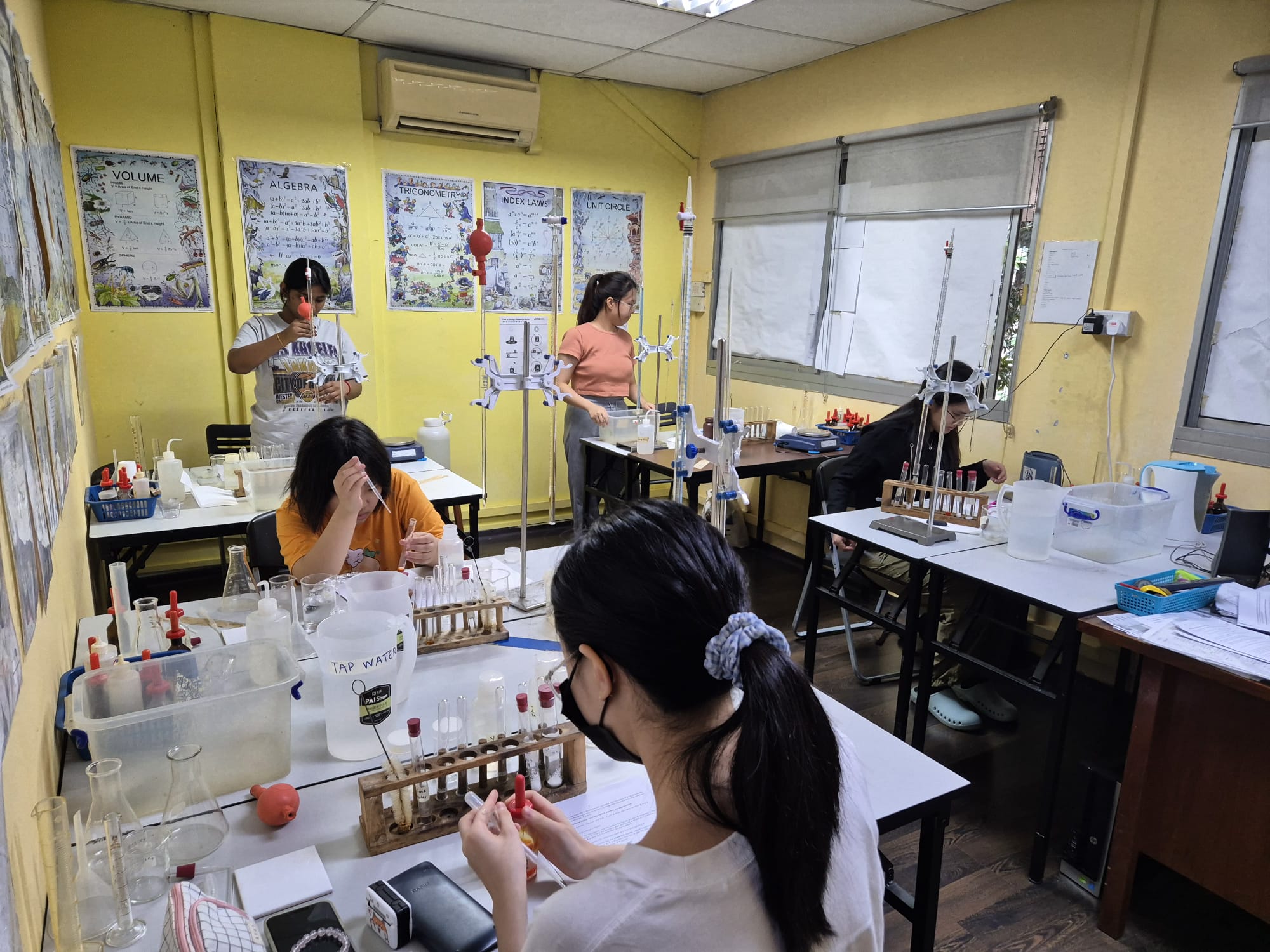
LOOKING FOR THE BEST PLACE TO DO YOUR SCIENCE PRACTICALS? JOIN US!

Singapore Learner has been a Comprehensive Science Practical Training provider since 2017.

As at 19 Apr 2026, we have trained about 1060 students for their science practical exams and we have conducted a total of about 4044 lab sessions.

Our laboratory apparatus are exam-grade and similar to those used in MOE schools and our chemicals are all NEA-approved.

We provide A-Level / H2 / IP and O-Level Physics, Chemistry, Biology and Combined Science (Physics/Chemistry/Biology) Practical Training/Crash Course/Mock Exams for both local (eg. H2, Singapore-Cambridge) and international exams (CIE, Pearson Edexcel, IGCSE).

Why Choose Us?

  • Our teachers are very experienced, and we actually TEACH you good practical techniques.
  • We have been a one-stop comprehensive science practical centre providing solid practical training for ALL THREE sciences and for all levels and streams since 2017.
  • Our laboratory apparatus are exam-grade and similar to those used in MOE schools and our chemicals are all NEA-approved.
  • We have a structured practical training programme catering to the needs of both beginners and experienced students.
  • We have a small class size so that the teacher is able to observe the actions of each student more closely and demonstrate the correct practical techniques where and when necessary.
  • Many private schools trust us to prepare and conduct science practical training and assessment for their students, including structured training, mock exams and even actual CIE science practical exams.

Our Main Practical Programmes:

A-LEVEL H2 PRACTICALS (Available Nov to Oct)

O-LEVEL PRACTICALS (Available Nov to Oct)

SEC 3 PRACTICALS (Available Nov to Jun)

PRACTICAL CRASH COURSES (Jun, July, Sep and Oct)

MOCK EXAMS FOR SCIENCE PRACTICAL (Apr to Oct)

Posted in Practical

Notes on Planning for O-Level Physics Practicals

O LEVEL PURE PHYSICS Paper 3 Practical — Planning (P)
Paper 3Planning (P)OverallSyllabus
40 marks │ 1h 50 min~5–6 marks per planning questionPaper 3 = 20% of O Level6091 (Physics)

Section 1: What is Planning in O Level Physics?

Planning questions test your ability to design a complete, logical physics investigation from scratch. Unlike open-ended experiments, a planning question gives you a proposed relationship between two quantities and asks you to design an experiment to verify it or find constants within it.

Physics Planning: You must always state clearly how you will measure each physical quantity, name the specific instrument, state how to control other variables, and describe how to extract a constant from a graph. Vague answers like ‘measure the voltage’ with no mention of instrument or method score zero.

The Four Pillars of Every Physics Planning Answer

PillarWhat It RequiresMark Value
1. VariablesState IV (what you change), DV (what you measure), and CVs (what you keep constant) — with specific quantities and symbols1 mark
2. ProcedureNumbered steps describing: specific apparatus, how IV is changed, how DV is measured, how many readings to take2–3 marks
3. Graph & AnalysisState the graph to plot, what gradient and intercept represent, and how to find the unknown constant from the graph1–2 marks
4. Additional DetailSafety precautions linked to specific hazards, and accuracy improvements specific to this experiment1 mark
Key O Level Physics Rule: Always use the same symbols as the equation given in the question. Write variables explicitly as ‘the independent variable is [symbol], which is [quantity].’ Measurements must be linked to a named instrument. Equations must be linearised step-by-step before stating the graph.

Section 2: The Three Types of Physics Planning Questions

O Level Physics planning questions fall into three broad types. Recognising the type immediately tells you what the DV is, what apparatus you need, and how to linearise the equation.

Type A: Electrical Circuit Investigations

You investigate how a circuit component (resistor, LDR, thermistor, capacitor) behaves as one electrical quantity is varied.

FeatureDetails
Typical IVsDistance from a light source / cm; temperature / °C; resistance / Ω; voltage / V; time / s
Typical DVsCurrent I / A; voltage V / V; resistance R / Ω; charge Q / C; count rate
Key CVsSupply voltage; other resistances in circuit; temperature of environment; light intensity of surroundings
MeasurementVoltmeter across component; ammeter in series; ohmmeter or calculate R = V/I; ruler for distance
ConclusionPlot suitable graph (e.g. R against d); gradient or intercept gives the unknown constant
Calculating Resistance: R = V / I. If measuring voltage across LDR (V_L) and voltage across fixed resistor (V_AB) with known R: current I = V_AB / R. Then R_LDR = V_L / I. Always state which voltmeter reading you are using.


LOOKING FOR THE BEST PLACE TO DO YOUR SCIENCE PRACTICALS? JOIN US!

Singapore Learner has been a Comprehensive Science Practical Training provider since 2017.

As at 19 Apr 2026, we have trained about 1060 students for their science practical exams and we have conducted a total of about 4044 lab sessions.

Our laboratory apparatus are exam-grade and similar to those used in MOE schools and our chemicals are all NEA-approved.

We provide A-Level / H2 / IP and O-Level Physics, Chemistry, Biology and Combined Science (Physics/Chemistry/Biology) Practical Training/Crash Course/Mock Exams for both local (eg. H2, Singapore-Cambridge) and international exams (CIE, Pearson Edexcel, IGCSE).


Why Choose Us?

  • Our teachers are very experienced, and we actually TEACH you good practical techniques.
  • We have been a one-stop comprehensive science practical centre providing solid practical training for ALL THREE sciences and for all levels and streams since 2017.
  • Our laboratory apparatus are exam-grade and similar to those used in MOE schools and our chemicals are all NEA-approved.
  • We have a structured practical training programme catering to the needs of both beginners and experienced students.
  • We have a small class size so that the teacher is able to observe the actions of each student more closely and demonstrate the correct practical techniques where and when necessary.
  • Many private schools trust us to prepare and conduct science practical training and assessment for their students, including structured training, mock exams and even actual CIE science practical exams.

Our Main Practical Programmes:

A-LEVEL H2 PRACTICALS (Available Nov to Oct)

O-LEVEL PRACTICALS (Available Nov to Oct)

SEC 3 PRACTICALS (Available Nov to Jun)

PRACTICAL CRASH COURSES (Jun, July, Sep and Oct)

MOCK EXAMS FOR SCIENCE PRACTICAL (Apr to Oct)

Posted in Practical

Notes on Planning for O-Level Biology Practicals

O LEVEL PURE BIOLOGY

Paper 3 Practical — Planning (P)

Paper 3 40 marks | 1h 50 minPlanning (P) 15% of Paper 3Overall Paper 3 = 20% of O LevelSyllabus 6093 (Pure Biology)

Section 1: Understanding the Planning Question

Planning questions in O Level Biology Paper 3 ask you to design a complete biological experiment to investigate a stated effect. They are worth 5 marks and test four core skills: identifying variables, describing a clear procedure, explaining how data leads to a conclusion, and assessing risks.

Key difference from H2: O Level Planning questions are more concise — typically 5 marks — but you still need all the same components. Every mark is attached to a specific component. Missing one component = losing a mark.

What Every Planning Answer Must Cover

ComponentWhat Examiners ExpectMarks at Stake
Independent Variable (IV)Clearly named with units. Must be the factor you deliberately change. 1
Dependent Variable (DV)Clearly named with how it is measured and units. 
Controlled VariablesAt least 2 variables kept constant, each with a method of control. One mark for naming + method. 1
Step-by-step ProcedureClear, numbered steps that another person could follow. Include quantities, volumes, timings. 1
Data / ConclusionHow results will be recorded (table), presented (graph) and interpreted to answer the research question. 1
Control ExperimentReplacement setup described with purpose stated. (Often embedded in procedure mark.)
Safety PrecautionSpecific hazard + specific precaution. Often 1 mark available. 1

O Level Reality Check: A 5-mark planning question typically allocates marks as: IV+DV [1], CVs [1], Procedure [1], Data/Conclusion [1], Control or Safety [1]. Always verify by re-reading the question’s bullet points.

Section 2: The 5-Step Formula for a Perfect O Level Plan

Use this structure every time. Examiners follow a mark scheme checklist. Organise your answer with numbered headings so each component is immediately visible.

Step 1: State the Independent and Dependent Variables

Always begin by explicitly naming both variables with their units. Do not make the examiner guess.

FORMAT: “Independent variable (IV): [Factor you change] / [unit]. Dependent variable (DV): [What you measure] / [unit].”

Common IV–DV pairs for O Level topics

TopicIndependent Variable (IV)Dependent Variable (DV)
EnzymesTemperature / °C, pH, enzyme/substrate concentration / %Time taken for reaction / s  OR  rate of reaction / s⁻¹
PhotosynthesisLight intensity (distance of lamp / cm), CO₂ conc. / %, temperature / °CNumber of bubbles / min  OR  time for indicator colour change / s
Respiration (yeast)pH, temperature / °C, glucose concentration / %Volume of CO₂ gas collected / cm³ per min  OR  height of froth / mm
OsmosisConcentration of sucrose / salt solution / mol dm⁻³Change in length / mass of plant tissue / mm or g
TranspirationWind speed (fan on/off), humidity, temperature / °C, light intensityRate of water uptake by potometer / cm³ min⁻¹

The full set of notes, which includes sections such as TopicSpecific Planning Tips is available in hard copy for students who sign up for any of our regular practical lessons, Crash Courses or Mock Exams.


LOOKING FOR THE BEST PLACE TO DO YOUR SCIENCE PRACTICALS? JOIN US!

Singapore Learner has been a Comprehensive Science Practical Training provider since 2017.

As at 19 Apr 2026, we have trained about 1060 students for their science practical exams and we have conducted a total of about 4044 lab sessions.

Our laboratory apparatus are exam-grade and similar to those used in MOE schools and our chemicals are all NEA-approved.

We provide A-Level / H2 / IP and O-Level Physics, Chemistry, Biology and Combined Science (Physics/Chemistry/Biology) Practical Training/Crash Course/Mock Exams for both local (eg. H2, Singapore-Cambridge) and international exams (CIE, Pearson Edexcel, IGCSE).


Why Choose Us?

  • Our teachers are very experienced, and we actually TEACH you good practical techniques.
  • We have been a one-stop comprehensive science practical centre providing solid practical training for ALL THREE sciences and for all levels and streams since 2017.
  • Our laboratory apparatus are exam-grade and similar to those used in MOE schools and our chemicals are all NEA-approved.
  • We have a structured practical training programme catering to the needs of both beginners and experienced students.
  • We have a small class size so that the teacher is able to observe the actions of each student more closely and demonstrate the correct practical techniques where and when necessary.
  • Many private schools trust us to prepare and conduct science practical training and assessment for their students, including structured training, mock exams and even actual CIE science practical exams.

Our Main Practical Programmes:

A-LEVEL H2 PRACTICALS (Available Nov to Oct)

O-LEVEL PRACTICALS (Available Nov to Oct)

SEC 3 PRACTICALS (Available Nov to Jun)

PRACTICAL CRASH COURSES (Jun, July, Sep and Oct)

MOCK EXAMS FOR SCIENCE PRACTICAL (Apr to Oct)

Posted in Pure Physics

Study Tips: O-Level Physics Chapter 16- Static Electricity

Key Ideas
1. There are two types of electric charges: positive and negative charges.

2. Like charges repel, unlike charges attract.

3. Electric charge is measured in coulombs (C).

4. Electrostatic charging of insulators by friction involves a transfer of electrons.

5. Electrical insulators do not conduct electricity because they do not contain mobile charged particles.

6. Electrical conductors are able to conduct electricity because they contain mobile charged particles (electrons).

7. Electrical conductors can be charged by induction.

8. Electrical insulators that are charged can be neutralised (discharged) by heating or exposure to humid conditions. Electrical conductors that are charged can be neutralised by earthing.

9. During electrostatic charging and discharging, only electrons are transferred.

10. An electric field is a region in which an electric charge experiences an electric force.

11. The direction of the electric field is the direction of the force acting on a small positive charge placed in the field.

12. Some hazards of electrostatic charging are lightning, and electrostatic discharge near flammable substances.

13. Electrostatic charging is used in photocopiers, electrostatic precipitators to reduce air pollution, spray painting to produce an even coat of paint.

IMPORTANT STUDY POINTS

1. Be aware of the formula Q = nq to calculate the number (n) of charge carriers given the the charge (q) on one particle and the total amount of charge (Q).
2. As 1 C is a large amount of charge, must know how to use or convert units such as millicoulomb and microcoulomb.
3. Must know the difference between how insulators and conductors are charged, and how they are discharged, and be able to explain these processes only in terms of the transfer of electrons.
4. Must know the difference between what happens when an insulator touches a charged object and when a conductor touches a charged object.
5. Must know the correct sequence for producing two similarly charged conductors, two oppositely charged conductors and a single charged conductor.
6. Must be able to define electric field and draw electric field patterns.
7. Be able to describe the dangers of electrostatic charging.
8. Be able to describe how electrostatic charging is used in photocopiers, precipitators and spray painting.

O-LEVEL PHYSICS PRACTICAL


O-LEVEL CHEMISTRY PRACTICAL


HOW TO BOOK A LAB SESSION:

(1) Decide which Program or Lab sessions you need or most suitable for.

(2) Whatsapp or Message our staff at 88765498 with your Name, Private or School Candidate, A or O level, Subject or Lab Name (e.g Lab PP2), Date and Time of Lab. (Our staff will then guide you on how to register and make payment. If you are not sure about the lab sessions, just state your Name and the Subjects and we will get back to you)

(3) Register Online by clicking below:

(4) Pay Registration fee of $50 via Paynow or funds transfer.

(5) Make the required payment for each lab session at least 7 days before the date of the lab session. (You may also pay for several sessions at one go to ensure that you will have a place in future slots)