1. Answering a Source-of-Error Question
Give the one or two factors inherent to the procedure, not a general list.
Every answer has three parts: (i) the specific step and the physical or chemical reason the recorded quantity deviates from the true value; (ii) the quantity affected, stated as too high, too low, or inconsistent; (iii) a concrete precaution.
State the effect on the quantity actually recorded — a mass, a volume, a temperature, a time — not on the underlying chemistry itself. “The reaction is faster” is not an answer; “the time recorded is shorter than expected” is.
Rejected as “too general” unless further justified for the exact procedure:
- Parallax error, without stating which scale and why it cannot be avoided here.
- “Human error” or “random error”, without a stated cause.
- Zero error — correctable by taring or calibration, not a genuine source of error.
- “Apparatus not accurate enough”, without naming the reading it limits.
- Anything solved by “being more careful” or “repeating the reading” — repetition addresses random error only, and most examined sources here are systematic.
1.1 Random and Systematic Error
| Source of Error | Effect on the Reading / Result | Precaution / Improvement |
| Random error | Scatter in either direction from the limit of instrument resolution or from inexact repetition — e.g. titre volumes of 24.50, 24.15, 24.40 cm³ for repeats of the same titration. | Repeat until two titres agree within 0.10 cm³ (concordant results) and average these; take repeated mass or temperature readings where practicable. |
| Systematic error | A constant bias in one direction throughout the experiment, from a fault in method or apparatus — e.g. heat loss to the surroundings in every run, or an indicator that changes colour before the true end-point. | Not reduced by repetition. Identify the fault and correct the method (insulate, change indicator, use a control) or apply a calculated correction (e.g. a cooling correction). |
1.2 Precision of Common Apparatus
| Apparatus | Precision (Uncertainty) | How to Read / Use Correctly |
| Burette | ± 0.05 cm³ (read to 2 d.p.) | Read the bottom of the meniscus at eye level for colourless solutions; for deeply coloured solutions (e.g. potassium manganate(VII)), read the top of the meniscus instead. |
| Pipette (25.0 cm³ / 20.0 cm³) | Fixed volume, delivered “to deliver” | Allow to drain fully; touch the tip against the vessel wall; do not blow out the last drop unless the pipette is marked to do so. |
| Measuring cylinder | ± 0.5 cm³ (10–100 cm³ sizes) | Read at eye level to the bottom of the meniscus; select the smallest cylinder that holds the required volume. |
| Thermometer (liquid-in-glass) | ± 0.5 °C | Read at eye level; keep the bulb fully immersed and clear of the container wall; allow time to reach a steady reading. |
| Digital stopwatch | ± 0.01 s (device); human reaction time ≈ 0.2–0.3 s dominates | Start and stop at a clearly defined visual or colour-change cue; where the cue is subjective, use the same observer for all repeats. |
| Electronic (top-pan) balance | ± 0.01 g | Tare before every measurement; close balance doors/draught shields if fitted; avoid draughts from open windows or fans. |
| Gas syringe | ± 0.5 cm³, with plunger friction as an added source of lag | Check the plunger moves freely before use; keep the syringe horizontal to avoid its own weight affecting the plunger. |
2. Volumetric Analysis (Titration)
MₐVₐ / MᵦVᵦ = x / y, from the mole ratio xA + yB → C + D; used to find an unknown concentration.
| Source of Error | Effect on the Reading / Result | Precaution / Improvement |
| Indicator chosen does not change colour sharply at the equivalence point of this acid–base pair (e.g. phenolphthalein used with a weak base–strong acid pair). | The volume of titrant recorded is too high or too low, giving a concentration that is too low or too high. | Choose an indicator whose colour-change range brackets the equivalence pH of this specific reaction; where the change is still not sharp, verify the end-point with a pH meter or data logger. |
| Too many drops of indicator added. | Excess indicator itself reacts with a small amount of titrant, so a larger volume of titrant is recorded than actually required by the analyte. | Add only 2–3 drops of indicator. |
| The titrant is a coloured solution (e.g. potassium manganate(VII)), so the meniscus is difficult to locate against the burette scale. | The initial or final burette reading is misjudged, giving an inaccurate titre. | Read the level at the top of the meniscus instead of the bottom, and take the reading against a white card held behind the burette. |
| An air bubble is trapped in the burette tip below the tap at the start of titration. | The bubble later escapes during titration and is counted as if it were titrant delivered, so the titre recorded is too high. | Run liquid through the tip before the initial reading to expel any air bubble, and check the tip is full before recording the initial volume. |
| The pipette, burette, or conical flask was rinsed with water only, and retains residual water that dilutes the solution added. | The concentration of the solution actually delivered is lower than intended, and calculated concentrations are inconsistent. | Rinse the pipette and burette with the solution they are about to hold (not water alone); the conical flask may be rinsed with water only, since the amount of analyte placed in it is unaffected by dilution. |
| The overshoot past the true end-point (one drop too many) is a fixed volume that is a larger fraction of a small titre than of a large one. | Percentage error in the titre is largest for reactions requiring a small volume of titrant. | Where possible, choose concentrations of analyte and titrant that require titre volumes in the region of 20–30 cm³, so a one-drop overshoot is a small percentage of the total. |
The full set of notes, which includes sections such as Sources of Error by Practical Topic is available in hard copy for students who sign up for any of our regular practical lessons, Crash Courses or Mock Exams.
- Topics Tested in Past O-Level Physics Paper 3 Practical Exam
- Topics Tested in Past O-Level Chemistry Paper 3 Practical Exam
- Topics Tested in Past O-Level Biology Paper 3 Practical Exam
LOOKING FOR THE BEST PLACE TO DO YOUR SCIENCE PRACTICALS? JOIN US!
Singapore Learner has been a Comprehensive Science Practical Training provider since 2017.
As at 19 Apr 2026, we have trained about 1060 students for their science practical exams and we have conducted a total of about 4044 lab sessions.
Our laboratory apparatus are exam-grade and similar to those used in MOE schools and our chemicals are all NEA-approved.
We provide A-Level / H2 / IP and O-Level Physics, Chemistry, Biology and Combined Science (Physics/Chemistry/Biology) Practical Training/Crash Course/Mock Exams for both local (eg. H2, Singapore-Cambridge) and international exams (CIE, Pearson Edexcel, IGCSE).
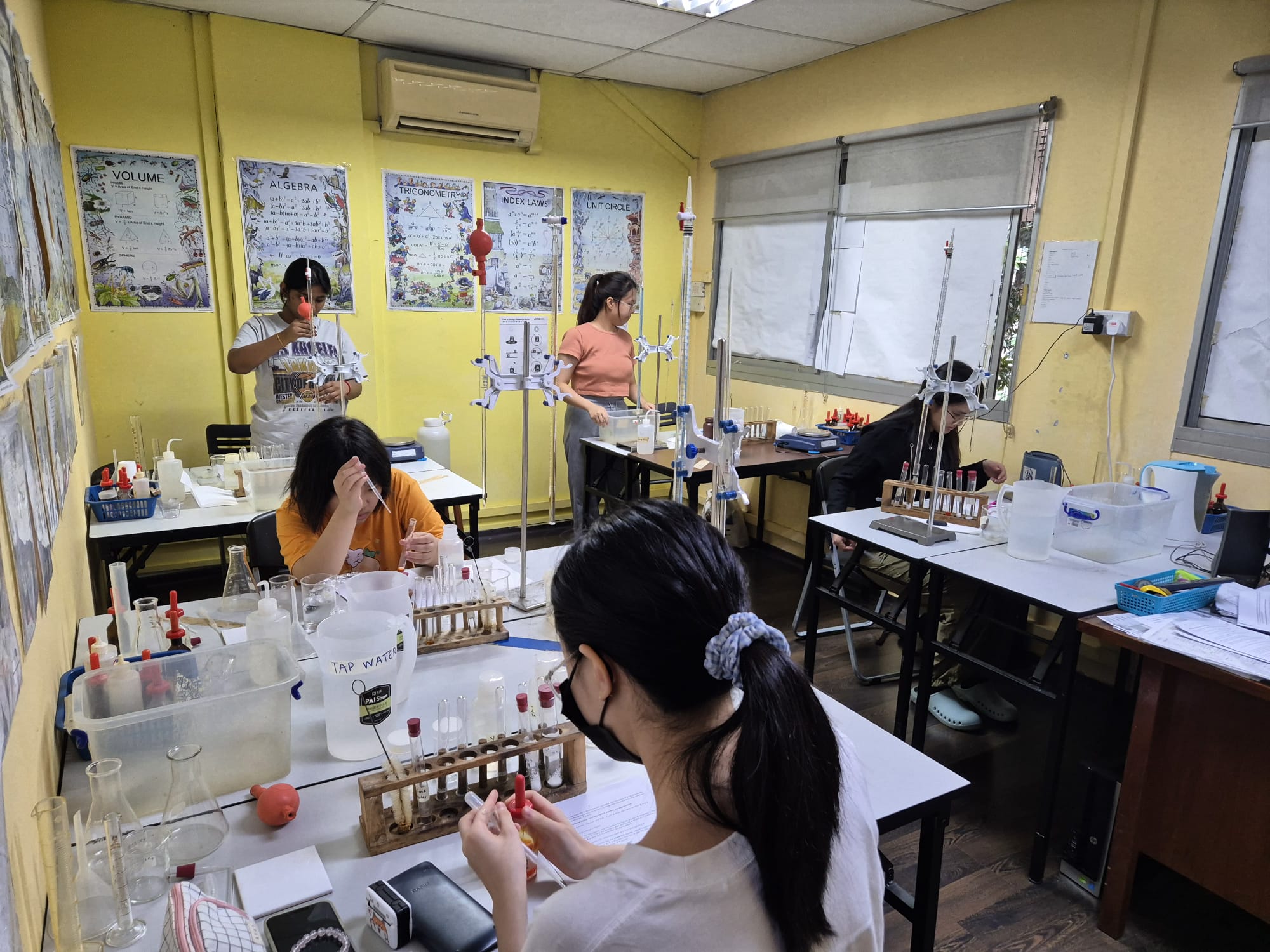
Why Choose Us?
- Our teachers are very experienced, and we actually TEACH you good practical techniques.
- We have been a one-stop comprehensive science practical centre providing solid practical training for ALL THREE sciences and for all levels and streams since 2017.
- Our laboratory apparatus are exam-grade and similar to those used in MOE schools and our chemicals are all NEA-approved.
- We have a structured practical training programme catering to the needs of both beginners and experienced students.
- We have a small class size so that the teacher is able to observe the actions of each student more closely and demonstrate the correct practical techniques where and when necessary.
- Many private schools trust us to prepare and conduct science practical training and assessment for their students, including structured training, mock exams and even actual CIE science practical exams.
