Posted in Practical

Notes on Sources of Error in A-Level H2 Chemistry Practicals

1. Answering a Source-of-Error Question

To get the mark for a sources-of-error question, give the one or two factors inherent to the procedure, not a general list.

Every answer has three parts: (i) the specific step and the chemical or physical reason the recorded quantity deviates from the true value; (ii) the quantity affected, stated as too high, too low, or inconsistent, and where relevant, how this propagates through the calculation (a rate constant, an enthalpy change, a Faraday constant); (iii) a concrete precaution, with the reasoning where this is not obvious.

State the effect on the quantity actually recorded, not on the underlying chemistry. At H2 level, examiners further expect the answer to engage with how the error enters the calculation — whether it biases a gradient, an intercept, or a value substituted directly into a formula.

Rejected as “too general” unless further justified for the exact procedure:

  • Parallax error, without stating which scale and why it cannot be avoided here.
  • “Human error” or “random error”, without a stated cause.
  • Zero error — correctable by taring or calibration, not a genuine source of error.
  • “Apparatus not accurate enough”, without naming the reading it limits and the resulting effect on the calculated quantity.
  • Anything solved by “being more careful” or “repeating the reading” — most sources examined at H2 level are systematic and are not removed by repetition.

1.1 Random and Systematic Error

Source of ErrorEffect on the Reading / ResultPrecaution / Improvement
Random errorScatter in either direction from the limit of instrument resolution or from inexact repetition — e.g. concordant titre volumes that still differ by up to 0.10 cm³.Repeat until titres are concordant (within 0.10 cm³) and average these; take multiple absorbance/conductivity readings and average; use the gradient of a best-fit line over single data points.
Systematic errorA constant bias in one direction throughout the experiment — e.g. heat loss to the surroundings in every calorimetry run, or a side reaction consuming part of a fixed current in electrolysis.Not reduced by repetition. Identify and correct the fault (insulate, use a control, correct for a side reaction), or choose what is plotted so the constant bias is confined to an intercept rather than a gradient.

1.2 Precision of Common H2 Chemistry Apparatus

ApparatusPrecision (Uncertainty)How to Read / Use Correctly
Burette± 0.05 cm³ (read to 2 d.p.)Read the meniscus at eye level; for deeply coloured titrants (e.g. iodine, potassium manganate(VII)), read the top of the meniscus.
Pipette (25.0 cm³ / 20.0 cm³)Fixed volume, delivered “to deliver”Allow to drain fully; touch the tip against the vessel wall; do not force the last drop out unless the pipette is graduated for it.
Electronic (top-pan) balance± 0.001 g to ± 0.01 g, model-dependentTare before each measurement; weigh by difference where possible, so any zero drift cancels.
Digital stopwatch± 0.01 s (device); human reaction time ≈ 0.2–0.3 s dominatesTrigger against a clearly defined cue (colour change, needle deflection); for a fast reaction, use continuous monitoring (colorimeter, gas syringe, pressure sensor) instead.
Colorimeter / UV-visible spectrophotometer± the last displayed digit of absorbance; also sensitive to cuvette handlingZero against a blank/reference solution before each run; handle cuvettes only by the ribbed sides, keeping optical faces clean and free of fingerprints.
pH meter / data logger± 0.01 pH unit (device); response time and calibration drift are larger sources of errorCalibrate with fresh buffer solutions immediately before use; allow the reading to stabilise before recording; rinse and blot the electrode between solutions.
Thermometer / temperature probe± 0.1 °C (probe); ± 0.5 °C (liquid-in-glass)Keep the sensor fully immersed and away from the vessel wall; allow thermal equilibrium before reading.
Gas syringe± 0.5 cm³, with plunger friction as an added source of lagCheck the plunger moves freely before use; keep the syringe horizontal and unobstructed.
Ammeter (electrolysis circuit)± the last displayed digit; also affected by drift in current over timeUse a variable resistor or rheostat to hold current constant; take ammeter readings at regular intervals and use the mean, or integrate current over time if it is not constant.

2. Volumetric Analysis

2.1 Preparation of a Standard Solution

n = m / M; the accuracy of every subsequent titration calculation depends on this concentration being correct.

Source of ErrorEffect on the Reading / ResultPrecaution / Improvement
Solid is not completely transferred from the weighing bottle/boat into the volumetric flask, or washings from the funnel and beaker are not added.Moles of solute actually in the flask is lower than the mass weighed implies, so the concentration prepared is lower than intended, biasing every titre calculated from it.Rinse the weighing bottle, funnel, and beaker several times with distilled water, adding all washings to the volumetric flask, before making up to the mark.
The flask is made up to the graduation mark with the meniscus viewed from above or below eye level, or is topped up past the mark.The true volume of solution differs from the flask’s stated volume, so the concentration calculated (moles / stated volume) does not match the true concentration.Add water dropwise near the mark with a dropping pipette, viewing the meniscus at eye level; discard and remake the solution if the mark is overshot.
The solution is not mixed thoroughly (inverted repeatedly with the stopper in place) after topping up.Concentration is not uniform throughout the flask, so aliquots withdrawn from different parts of it give inconsistent titres.Stopper the flask and invert it several times to ensure the solution is homogeneous before withdrawing any aliquot.

2.2 Acid–Base and Redox Titrations

n(analyte) = n(titrant) × mole ratio, from the stoichiometric equation; back titration finds excess unreacted reagent by titrating it against a second standard solution.

Source of ErrorEffect on the Reading / ResultPrecaution / Improvement
In an iodine–thiosulfate titration, starch indicator is added too early, while the iodine concentration is still high.Starch forms a strong iodine–starch complex that releases iodine only slowly, causing the end-point (loss of blue-black colour) to be over-run — titre recorded is too high.Add starch only when the solution has faded to a pale straw-yellow colour, close to the expected end-point, then continue titrating dropwise to the colourless end-point.
A back titration’s excess reagent is not accurately known — the volume/mass of excess-reagent solution added initially was not measured precisely, or the reaction with the analyte was incomplete before titrating the excess.The moles of reagent that reacted with the analyte (found by difference) carries forward the combined imprecision of both the initial addition and the second titration — the analyte’s calculated amount is inconsistent.Add the initial reagent by pipette or accurately prepared standard solution, and allow sufficient time (or gentle heating) for the first reaction to go to completion before titrating the unreacted excess.
Potassium manganate(VII), a self-indicating titrant, is used past its own colour fading point (solution is not swirled sufficiently near the end-point, so a local excess appears reacted).The end-point (first permanent trace of pink) is over-run in some regions of the flask while under-run in others — titre recorded is inconsistent between repeats.Swirl the conical flask continuously and add titrant dropwise near the expected end-point, until one drop causes a permanent, uniformly distributed, faint pink colour.
The reaction between titrant and analyte is slow at room temperature (e.g. some redox titrations), so the colour change appears to fade back after the recorded end-point.The volume recorded at the apparent end-point is too low, since the reaction had not yet reached completion.Warm the analyte solution gently (where the reaction permits, e.g. acidified oxalate–manganate(VII) titrations) to increase the rate, and titrate slowly near the end-point, allowing time for each addition to react fully.
A dichromate(VI) titration is carried out with no added indicator, on the mistaken assumption (true only of manganate(VII)) that the titrant is self-indicating.Dichromate(VI) and its reduced Cr³⁺ product are both coloured but do not give a sharp visual end-point on their own, so the end-point is missed or badly over-run.Add a redox indicator suited to the Cr⁶⁺/Cr³⁺ couple (e.g. a diphenylamine-based indicator), whose distinct colour change marks the end-point.

2.3 pH Titration Curves and Buffers

pH is monitored continuously as titrant is added; for a weak acid, pKa is read from the pH at the half-equivalence point.

Source of ErrorEffect on the Reading / ResultPrecaution / Improvement
The pH probe is not calibrated with fresh buffer solutions immediately before the titration, or calibration drifts over a long run.Every pH value recorded (and hence the pKa read from the curve) is offset from the true value by a roughly constant amount.Calibrate with two buffer solutions bracketing the expected pH range immediately before starting, and recalibrate if the titration is lengthy.
Titrant is added in large, evenly spaced volume increments throughout, including near the steep equivalence-point region.The equivalence point (steepest gradient) and half-equivalence point are poorly located, since few readings fall within the narrow volume range where pH changes fastest.Add titrant in small increments (e.g. 0.5 cm³) near the expected equivalence point; larger increments are acceptable elsewhere, so the curve is well-defined where it changes fastest.
The probe is rinsed insufficiently, or not rinsed at all, before being placed in a new solution.Contamination carried over from the previous solution biases early pH readings in the new titration.Rinse the electrode with distilled water and blot (do not rub) dry before each new titration or measurement.

The full set of notes, which includes more sections on Sources of Error by Practical Topic is available in hard copy for students who sign up for any of our regular practical lessons, Crash Courses or Mock Exams.


LOOKING FOR THE BEST PLACE TO DO YOUR SCIENCE PRACTICALS? JOIN US!

Singapore Learner has been a Comprehensive Science Practical Training provider since 2017.

As at 19 Apr 2026, we have trained about 1060 students for their science practical exams and we have conducted a total of about 4044 lab sessions.

Our laboratory apparatus are exam-grade and similar to those used in MOE schools and our chemicals are all NEA-approved.


Why Choose Us?

  • Our teachers are very experienced, and we actually TEACH you good practical techniques.
  • We have been a one-stop comprehensive science practical centre providing solid practical training for ALL THREE sciences and for all levels and streams since 2017.
  • Our laboratory apparatus are exam-grade and similar to those used in MOE schools and our chemicals are all NEA-approved.
  • We have a structured practical training programme catering to the needs of both beginners and experienced students.
  • We have a small class size so that the teacher is able to observe the actions of each student more closely and demonstrate the correct practical techniques where and when necessary.
  • Many private schools trust us to prepare and conduct science practical training and assessment for their students, including structured training, mock exams and even actual CIE science practical exams.

Our Main Practical Programmes:

A-LEVEL H2 PRACTICALS (Available Nov to Oct)

O-LEVEL PRACTICALS (Available Nov to Oct)

PRACTICAL CRASH COURSES (Jun, July, Sep and Oct)

MOCK EXAMS FOR SCIENCE PRACTICAL (Apr to Oct)

Posted in Practical

Notes on Sources of Error in O-Level Chemistry Practicals

1. Answering a Source-of-Error Question

Give the one or two factors inherent to the procedure, not a general list.

Every answer has three parts: (i) the specific step and the physical or chemical reason the recorded quantity deviates from the true value; (ii) the quantity affected, stated as too high, too low, or inconsistent; (iii) a concrete precaution.

State the effect on the quantity actually recorded — a mass, a volume, a temperature, a time — not on the underlying chemistry itself. “The reaction is faster” is not an answer; “the time recorded is shorter than expected” is.

Rejected as “too general” unless further justified for the exact procedure:

  • Parallax error, without stating which scale and why it cannot be avoided here.
  • “Human error” or “random error”, without a stated cause.
  • Zero error — correctable by taring or calibration, not a genuine source of error.
  • “Apparatus not accurate enough”, without naming the reading it limits.
  • Anything solved by “being more careful” or “repeating the reading” — repetition addresses random error only, and most examined sources here are systematic.

1.1 Random and Systematic Error

Source of ErrorEffect on the Reading / ResultPrecaution / Improvement
Random errorScatter in either direction from the limit of instrument resolution or from inexact repetition — e.g. titre volumes of 24.50, 24.15, 24.40 cm³ for repeats of the same titration.Repeat until two titres agree within 0.10 cm³ (concordant results) and average these; take repeated mass or temperature readings where practicable.
Systematic errorA constant bias in one direction throughout the experiment, from a fault in method or apparatus — e.g. heat loss to the surroundings in every run, or an indicator that changes colour before the true end-point.Not reduced by repetition. Identify the fault and correct the method (insulate, change indicator, use a control) or apply a calculated correction (e.g. a cooling correction).

1.2 Precision of Common Apparatus

ApparatusPrecision (Uncertainty)How to Read / Use Correctly
Burette± 0.05 cm³ (read to 2 d.p.)Read the bottom of the meniscus at eye level for colourless solutions; for deeply coloured solutions (e.g. potassium manganate(VII)), read the top of the meniscus instead.
Pipette (25.0 cm³ / 20.0 cm³)Fixed volume, delivered “to deliver”Allow to drain fully; touch the tip against the vessel wall; do not blow out the last drop unless the pipette is marked to do so.
Measuring cylinder± 0.5 cm³ (10–100 cm³ sizes)Read at eye level to the bottom of the meniscus; select the smallest cylinder that holds the required volume.
Thermometer (liquid-in-glass)± 0.5 °CRead at eye level; keep the bulb fully immersed and clear of the container wall; allow time to reach a steady reading.
Digital stopwatch± 0.01 s (device); human reaction time ≈ 0.2–0.3 s dominatesStart and stop at a clearly defined visual or colour-change cue; where the cue is subjective, use the same observer for all repeats.
Electronic (top-pan) balance± 0.01 gTare before every measurement; close balance doors/draught shields if fitted; avoid draughts from open windows or fans.
Gas syringe± 0.5 cm³, with plunger friction as an added source of lagCheck the plunger moves freely before use; keep the syringe horizontal to avoid its own weight affecting the plunger.

2. Volumetric Analysis (Titration)

MₐVₐ / MᵦVᵦ = x / y, from the mole ratio xA + yB → C + D; used to find an unknown concentration.

Source of ErrorEffect on the Reading / ResultPrecaution / Improvement
Indicator chosen does not change colour sharply at the equivalence point of this acid–base pair (e.g. phenolphthalein used with a weak base–strong acid pair).The volume of titrant recorded is too high or too low, giving a concentration that is too low or too high.Choose an indicator whose colour-change range brackets the equivalence pH of this specific reaction; where the change is still not sharp, verify the end-point with a pH meter or data logger.
Too many drops of indicator added.Excess indicator itself reacts with a small amount of titrant, so a larger volume of titrant is recorded than actually required by the analyte.Add only 2–3 drops of indicator.
The titrant is a coloured solution (e.g. potassium manganate(VII)), so the meniscus is difficult to locate against the burette scale.The initial or final burette reading is misjudged, giving an inaccurate titre.Read the level at the top of the meniscus instead of the bottom, and take the reading against a white card held behind the burette.
An air bubble is trapped in the burette tip below the tap at the start of titration.The bubble later escapes during titration and is counted as if it were titrant delivered, so the titre recorded is too high.Run liquid through the tip before the initial reading to expel any air bubble, and check the tip is full before recording the initial volume.
The pipette, burette, or conical flask was rinsed with water only, and retains residual water that dilutes the solution added.The concentration of the solution actually delivered is lower than intended, and calculated concentrations are inconsistent.Rinse the pipette and burette with the solution they are about to hold (not water alone); the conical flask may be rinsed with water only, since the amount of analyte placed in it is unaffected by dilution.
The overshoot past the true end-point (one drop too many) is a fixed volume that is a larger fraction of a small titre than of a large one.Percentage error in the titre is largest for reactions requiring a small volume of titrant.Where possible, choose concentrations of analyte and titrant that require titre volumes in the region of 20–30 cm³, so a one-drop overshoot is a small percentage of the total.

The full set of notes, which includes sections such as Sources of Error by Practical Topic is available in hard copy for students who sign up for any of our regular practical lessons, Crash Courses or Mock Exams.


LOOKING FOR THE BEST PLACE TO DO YOUR SCIENCE PRACTICALS? JOIN US!

Singapore Learner has been a Comprehensive Science Practical Training provider since 2017.

As at 19 Apr 2026, we have trained about 1060 students for their science practical exams and we have conducted a total of about 4044 lab sessions.

Our laboratory apparatus are exam-grade and similar to those used in MOE schools and our chemicals are all NEA-approved.

We provide A-Level / H2 / IP and O-Level Physics, Chemistry, Biology and Combined Science (Physics/Chemistry/Biology) Practical Training/Crash Course/Mock Exams for both local (eg. H2, Singapore-Cambridge) and international exams (CIE, Pearson Edexcel, IGCSE).

Why Choose Us?


Our Main Practical Programmes:

A-LEVEL H2 PRACTICALS (Available Nov to Oct)

O-LEVEL PRACTICALS (Available Nov to Oct)

SEC 3 PRACTICALS (Available Nov to Jun)

PRACTICAL CRASH COURSES (Jun, July, Sep and Oct)

MOCK EXAMS FOR SCIENCE PRACTICAL (Apr to Oct)


Topics Tested in Past O-Level Physics Paper 3 Practical Exam

Topics Tested in Past O-Level Chemistry Paper 3 Practical Exam

Topics Tested in Past O-Level Biology Paper 3 Practical Exam

Posted in EDUCATIONAL ADVICE

Topics Tested in Past O-Level Biology Paper 3 Practical Exam

  1. Cell Structure and Organisation: 2025
  2. Movement of Substances: 2024 (Osmosis), 2021 (Diffusion), 2020 (Diffusion in Planning question), 2019 (Osmosis/Plasmolysis), 2015 (Osmosis)
  3. Biological Molecules: 2025 (Enzymes), 2022 (Enzymes), 2020 (Benedict’s test), 2017 (Starch test), 2016 (Enzymes), 2014 (Biuret’s test)
  4. Nutrition in Humans: 2023
  5. Transport in Humans: 2017
  6. Respiration in Humans: 2023 (Yeast), 2018 (Yeast)
  7. Excretion in Humans: not tested yet
  8. Homeostasis, Co-ordination and Response in
    Humans: 2016 (Human eye)
  9. Infectious Diseases in Humans: not tested yet
  10. Nutrition and Transport in Flowering Plants: 2024, 2019, 2018, 2015
  11. Organisms and their Environment: not tested yet
  12. Molecular Genetics: not tested yet
  13. Reproduction: 2022 (Sperm cells), 2021 (Cell division), 2020 (Plants)
  14. Inheritance: 2022

So what topics are most likely to be tested THIS YEAR?

Biology Practical

Right now, ARE YOU CONFIDENT that you can complete your science practical exam and answer all its questions correctly in the time allocated?


Notes on Sources of Error in O-Level Biology Practicals


We provide A-Level / H2 / IP and O-Level Physics, Chemistry, Biology and Combined Science (Physics/Chemistry/Biology) Practical Training/Crash Course/Mock Exams for both local (eg. H2, Singapore-Cambridge) and international exams (CIE, Pearson Edexcel, IGCSE).


Why Choose Us?

  • Our teachers are very experienced, and we actually TEACH you good practical techniques.
  • We have been a one-stop comprehensive science practical centre providing solid practical training for ALL THREE sciences and for all levels and streams since 2017.
  • Our laboratory apparatus are exam-grade and similar to those used in MOE schools and our chemicals are all NEA-approved.
  • We have a structured practical training programme catering to the needs of both beginners and experienced students.
  • We have a small class size so that the teacher is able to observe the actions of each student more closely and demonstrate the correct practical techniques where and when necessary.
  • Many private schools trust us to prepare and conduct science practical training and assessment for their students, including structured training, mock exams and even actual CIE science practical exams.

Our Main Practical Programmes:

A-LEVEL H2 PRACTICALS (Available Nov to Oct)

O-LEVEL PRACTICALS (Available Nov to Oct)

SEC 3 PRACTICALS (Available Nov to Jun)

PRACTICAL CRASH COURSES (Jun, July, Sep and Oct)

MOCK EXAMS FOR SCIENCE PRACTICAL (Apr to Oct)


Posted in EDUCATIONAL ADVICE, H2 Biology

Topics Tested in Past H2 Biology Paper 4 Practical Exam

  1. Dilution of stock solutions through both simple dilution and serial dilution (2025, 2022, 2019).
  2. Microscopy which involves the proper use of the microscope for viewing specimen, calibration of eyepiece graticule (2022), using a stage micrometer, calculation of area of field of view, calculating mean density of specimen, finding the actual width of a specimen, making your own slide (2022-plasmolysis, 2019-banana, 2018-potato).
  3. Producing biological drawings at low-power and high-power as well as calculating the drawing magnification. (2025-stem of willow tree, 2023-plant stem, 2022-leaf of tea plant, plasmolysis, 2021-plant stem, 2020-leaf, 2019-banana, 2018-leaf, 2017-plant stem, 2016-blood cells)
  4.  Identify significant sources of error, limitations of measurements and/or experimental procedures used and explain how they affect the final result(s). (most years)
  5. State and explain how significant sources of errors/limitations may be overcome/reduced, as appropriate, including how experimental procedures may be improved. (most years)
  6. Graph-drawing e.g. best-fit line, best-fit curve, point-to-point graphs, bar graphs and histograms. (most years)
  7. Factors affecting rate of transport of substances e.g. diffusion and osmosis. (2021, 2019-visking tubing)
  8. Presence of biological molecules (food tests) e.g. test for reducing sugars (using suitable indicators such as benedict’s solution), test for non-reducing sugars (using acid hydrolysis), test for proteins (using suitable indicators such as biuret solution), test for lipids (using ethanol-emulsion test) and test for starch (using suitable indicators such as iodine). (2025, 2024, 2021, 2019)
  9. Factors affecting rate of enzyme-catalysed reactions. (2025-invertase, 2024-lipase, 2023-amylase, 2022-catalase, planning, 2020-catalase, 2016-protease)
  10. Factors affecting rate of respiration. (2025-planning, 2024-planning, 2018)
  11. Factors affecting the rate of photosynthesis. (not tested in the last 10 years)
  12. Statistical analysis. (2023-t-test, 2020-t-test)
  13. Growth rate of plants. (2023-planning)
  14. Genetics and Inheritance. (2021-planning)

DO YOU KNOW THAT THE SCIENCE PRACTICAL IS WEIGHTED TO BETWEEN 15% TO 20% OF YOUR TOTAL SCIENCE EXAM MARKS?

It can actually make a 1 to 3 grade difference in your total points for your exam! And it is easier to score a Distinction for your Science exam if you are very competent in your Science Practicals.

Right now, ARE YOU CONFIDENT that you can complete your science practical exam and answer all its questions correctly in the time allocated?

If you are looking for SCIENCE PRACTICAL TRAINING, CRASH COURSE OR MOCK EXAM PRACTICE (FOR PHYSICS, CHEMISTRY, BIOLOGY), don’t hesitate to contact us at 65694897 or 88765498.


Singapore Learner has been a One-Stop Comprehensive Science Practical Training provider since 2017.

As at 19 Apr 2026, we have trained about 1060 students for their science practical exams and we have conducted a total of about 4044 lab sessions.

Our laboratory apparatus are exam-grade and similar to those used in MOE schools and our chemicals are all NEA-approved.

Posted in Practical

H2 BIOLOGY HANDS-ON PRACTICAL CRASH COURSE

Singapore Learner has been a Comprehensive Science Practical Training provider since 2017.

As at 19 Apr 2026, we have trained about 1060 students for their science practical exams and we have conducted a total of about 4044 lab sessions.

Our laboratory apparatus are exam-grade and similar to those used in MOE schools and our chemicals are all NEA-approved.


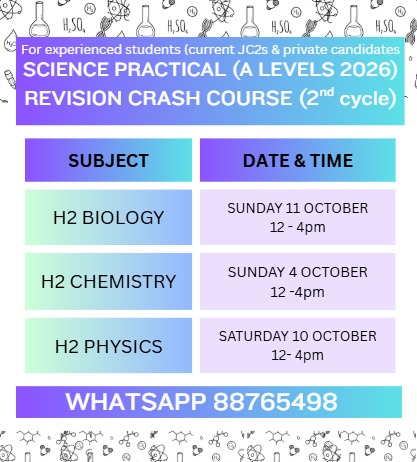
We have two kinds of crash courses: BASIC and REVISION.

BASIC CRASH COURSE – for beginners or students who have been out of touch with science practicals. Features: slower pace of teaching, more teacher demonstrations and hand-holding. Focus is on how to set up the apparatus, using instruments correctly, recording, tabling and graphing.

REVISION CRASH COURSE – for students who need a refresher course or guided extra practice for science practicals, such as retakers, government school students or graduates of our Basic Crash Course. Features:  Quick recap on how to use instruments correctly, and what examiners look for in students’ recordings, tables and graphs. More discussions on sources of error, important topics, difficult experiments and Planning (if applicable).

(Topics Tested in Past H2 Biology Paper 4 Practical Exam)

The two courses above consist of different experiments, thus students may attend both the Basic and Revision crash courses, followed by mock exams if needed.


Topics: Microscopy, Food Tests, Commonly-tested Experiments (Diffusion, Osmosis, Enzymes)

Skills and Content for Microscopy: Hands-on practice on the proper use of the microscope for viewing specimen, calibration of eyepiece graticule using the stage micrometer, producing biological drawings at low-power and high-power, as well as calculating the drawing magnification.

Skills and Content for Food Tests: Hands-on practice on how to conduct the Benedict’s Test, test for non-reducing sugars,  Alcohol Emulsion Test, Biuret’s Test and Starch-Iodine Test, as well as Serial Dilution.

Skills and Content for Common Experiments: Revision on practical aspects of Diffusion, Osmosis, Enzymes, and Photosynthesis; Hands-on practice on one or more of these experiments; Sources of Error for these experiments.


Location: Singapore Learner @ Blk 644, Bukit Batok Central, #01-68. S(650644).

Booking is by full payment only. Kindly send a message to +(65) 88765498 (WHATSAPP) for payment info. Thank you.


Tel: +(65) 6569 4897,   +(65) 88765498 (WHATSAPP)

Email:  principal@singaporelearner.com

If you wish to visit us, kindly call or sms first. Thank you.


For Standard Practical Training, click here:

A-LEVEL H2 PRACTICALS

For Practical Mock Exam, click here:

MOCK EXAMS FOR SCIENCE PRACTICAL (Sep & Oct)

OTHER PRACTICAL CRASH COURSES (Mar, Jun, Sep and Oct)


Posted in Practical

H2 CHEMISTRY HANDS-ON PRACTICAL CRASH COURSE

Singapore Learner has been a Comprehensive Science Practical Training provider since 2017.

As at 19 Apr 2026, we have trained about 1060 students for their science practical exams and we have conducted a total of about 4044 lab sessions.

Our laboratory apparatus are exam-grade and similar to those used in MOE schools and our chemicals are all NEA-approved.


We have two kinds of crash courses: BASIC and REVISION.

BASIC CRASH COURSE – for beginners or students who have been out of touch with science practicals. Features: slower pace of teaching, more teacher demonstrations and hand-holding. Focus is on how to set up the apparatus, using instruments correctly, recording, tabling and graphing.

REVISION CRASH COURSE – for students who need a refresher course or guided extra practice for science practicals, such as retakers, government school students or graduates of our Basic Crash Course. Features:  Quick recap on how to use instruments correctly, and what examiners look for in students’ recordings, tables and graphs. More discussions on sources of error, important topics, difficult experiments and Planning (if applicable).

The two courses above consist of different experiments, thus students may attend both the Basic and Revision crash courses, followed by mock exams if needed.


Topics: Volumetric Analysis, Gravimetric Analysis, Kinetics, Qualitative Analysis (Organic & Inorganic)


Skills and Content for Volumetric Analysis: Revision on proper rinsing and usage of burette, pipette and volumetric flasks; Tabling and correct recording of data; Mole calculations; Sources of error and how these affect the final answer; Hands-on practice on a selected Titration topic. Revision on Iodimetric Titration, Redox Titration, Double-Indicator Titration and Thermometric Titration.

Skills and Content for Gravimetric AnalysisHands-on practice on a selected Gravimetric Analysis experiment.

Skills and Content for Kinetics: Revision on Order of Reaction and Rate of Reaction.

Skills and Content for QA (Organic & Inorganic): Revision on proper techniques for testing of Cations, Gases and Anions; Common mistakes in QA and how to avoid them in order to maximise your marks; Correct recording of observations and conclusions. Hands-on practice on testing of Ammonia gas, Carbon Dioxide gas, Hydrogen gas, and some common cations and anions.


Location: Singapore Learner @ Bukit Batok, Blk 644, Bukit Batok Central, #01-68. S(650644).

Booking is by full payment only. Kindly send a message to +(65) 88765498 (WHATSAPP) for payment info. Thank you.


Tel: +(65) 6569 4897,   +(65) 88765498 (WHATSAPP)

Email:  principal@singaporelearner.com

If you wish to visit us, kindly call or sms first. Thank you.


For Standard Practical Training, click here:

A-LEVEL H2 PRACTICALS

For Practical Mock Exam, click here:

MOCK EXAMS FOR SCIENCE PRACTICAL (Sep & Oct)

OTHER PRACTICAL CRASH COURSES (Mar, Jun, Sep and Oct)


Posted in Practical

SCIENCE (BIOLOGY) HANDS-ON PRACTICAL CRASH COURSE

We have two kinds of crash courses: BASIC and REVISION.

BASIC CRASH COURSE – for beginners or students who have been out of touch with science practicals. Features: slower pace of teaching, more teacher demonstrations and hand-holding. Focus is on how to set up the apparatus, using instruments correctly, recording, tabling and graphing.

PREDICTIVE REVISION CRASH COURSE – for students who need a refresher course or guided extra practice for science practicals, such as retakers, government school students or graduates of our Basic Crash Course. Features:  Quick recap on how to use instruments correctly, and what examiners look for in students’ recordings, tables and graphs. More discussions on sources of error, important or predicted topics, difficult experiments and Planning (if applicable).

The two courses above consist of different experiments, thus students may attend both the Basic and Revision crash courses, followed by mock exams if needed.


Topics: Food Tests, Osmosis/Diffusion, Enzyme Reactions

Skills and Content for Food Tests: Hands-on revision on how to conduct Benedict’s Test, Alcohol Emulsion Test, Biuret’s Test and Starch-Iodine Test. Common mistakes in food tests and how to avoid them in order to maximise your marks; Correct recording of observations and conclusions.

Skills and Content for Osmosis/Diffusion: Hands-on revision on one Osmosis/Diffusion experiment. Good techniques to achieve correct observations and results; Tabling and correct recording of data.

Skills and Content for Enzyme Reactions: Hands-on revision on one Enzyme-related experiment. Tabling and correct recording of data. Sources of error and how these affect the final answer.


Location: Singapore Learner @ Blk 644, Bukit Batok Central, #01-68. S(650644)

Booking is by full payment (non-refundable) only. Kindly send a message to +(65) 88765498 (WHATSAPP) for payment info. Thank you.


Singapore Learner

Tel: +(65) 6569 4897,   +(65) 88765498 (WHATSAPP)

Email:  principal@singaporelearner.com

If you wish to visit us, kindly call or sms first. Thank you.


For Standard Practical Training, click here:

O-LEVEL PRACTICALS

For Practical Mock Exam, click here:

MOCK EXAMS FOR SCIENCE PRACTICAL (Sep & Oct)

Posted in Practical, Pure Physics

O-LEVEL PURE PHYSICS HANDS-ON PRACTICAL CRASH COURSE

We have two kinds of crash courses: BASIC and REVISION.

BASIC CRASH COURSE – for beginners or students who have been out of touch with science practicals. Features: slower pace of teaching, more teacher demonstrations and hand-holding. Focus is on how to set up the apparatus, using instruments correctly, recording, tabling and graphing.

PREDICTIVE REVISION CRASH COURSE – for students who need a refresher course or guided extra practice for science practicals, such as retakers, government school students or graduates of our Basic Crash Course. Features:  Quick recap on how to use instruments correctly, and what examiners look for in students’ recordings, tables and graphs. More discussions on sources of error, important or predicted topics, difficult experiments and Planning (if applicable).

The two courses above consist of different experiments, thus students may attend both the Basic and Revision crash courses, followed by mock exams if needed.


Topics: Mechanics, Light, Electricity

Skills and Content for Mechanics: How to draw a good table and how to record data with correct units and decimal places; How to assign the correct number of significant figures for calculated data; How to plot a good graph with appropriate scales and axes; How to draw a best-fit straight line or curve and how to calculate gradients; Hands-on practice with Oscillation experiment.

Skills and Content for Light: Hands-on practice with Light experiment involving a thin converging lens or a glass block. Revision on sources of error for common experiments; How to identify and properly describe sources of error.

Skills and Content for Electricity: Quick revision on how to use various electrical apparatus such as the ammeter, voltmeter, rheostat and potentiometer with hands-on practice via an Electricity Experiment.


Location: Singapore Learner @ Blk 644, Bukit Batok Central, #01-68. S(650644)

Booking is by full payment (non-refundable) only. Kindly send a message to +(65) 88765498 (WHATSAPP) for payment info. Thank you.


Singapore Learner 

Tel: +(65) 6569 4897,   +(65) 88765498 (WHATSAPP)

Email:  principal@singaporelearner.com

If you wish to visit us, kindly call or sms first. Thank you.


For Standard Practical Training, click here:

O-LEVEL PRACTICALS

For Practical Mock Exam, click here:

MOCK EXAMS FOR SCIENCE PRACTICAL (Sep & Oct)

Other Crash Courses:

O-LEVEL PURE CHEMISTRY HANDS-ON PRACTICAL CRASH COURSE

O-LEVEL PURE BIOLOGY HANDS-ON PRACTICAL CRASH COURSE

Posted in Practical

SCIENCE (CHEMISTRY) HANDS-ON PRACTICAL CRASH COURSE

We have two kinds of crash courses: BASIC and REVISION.

BASIC CRASH COURSE – for beginners or students who have been out of touch with science practicals. Features: slower pace of teaching, more teacher demonstrations and hand-holding. Focus is on how to set up the apparatus, using instruments correctly, recording, tabling and graphing.

PREDICTIVE REVISION CRASH COURSE – for students who need a refresher course or guided extra practice for science practicals, such as retakers, government school students or graduates of our Basic Crash Course. Features:  Quick recap on how to use instruments correctly, and what examiners look for in students’ recordings, tables and graphs. More discussions on sources of error, important or predicted topics, difficult experiments and Planning (if applicable).

The two courses above consist of different experiments, thus students may attend both the Basic and Revision crash courses, followed by mock exams if needed.


Topics: Titration, Speed of Reaction, Qualitative Analysis.

Skills and Content for Titration: Proper rinsing and usage of burette, pipette and conical flasks; Good techniques to achieve end-point FAST and accurately; Tabling and correct recording of data; Mole calculations; Sources of error and how these affect the final answer; Hands-on practice on Titration and mole calculations.

Skills and Content for Speed of Reaction: Measuring change in mass, volume or temperature over time using apparatus such as electronic balance, measuring cylinder, syringe, thermometer and stopwatch. Hands-on practice on a popular speed of reaction experiment.

Skills and Content for QA: Proper techniques for testing of Cations, Gases and Anions; Common mistakes in QA and how to avoid them in order to maximise your marks; Correct recording of observations and conclusions. Hands-on practice on testing of Ammonia gas, Carbon Dioxide gas, Hydrogen gas, and some common cations and anions; Theory Topics to revise to excel in QA.


Location: Singapore Learner @ Blk 644, Bukit Batok Central, #01-68. S(650644)

Booking is by full payment (non-refundable) only. Kindly send a message to +(65) 88765498 (WHATSAPP) for payment info. Thank you.


Singapore Learner 

Tel: +(65) 6569 4897,   +(65) 88765498 (WHATSAPP)

Email:  principal@singaporelearner.com

If you wish to visit us, kindly call or sms first. Thank you.


For Standard Practical Training, click here:

O-LEVEL PRACTICALS

For Practical Mock Exam, click here:

MOCK EXAMS FOR SCIENCE PRACTICAL (Sep & Oct)

Posted in Practical

A LEVEL RESULTS

Congratulations on obtaining your A-Level results.

We hope you are able to move on to the next level of your education journey.

However, if you intend to improve your Science grades by retaking the A-Level exam, you may consider our Science Practical Training Programme by clicking on any of the relevant links below. Thank you.


A-LEVEL TUITION

A-Level BIOLOGY (H1/H2) – Whatsapp 88668423 (Specialist)

A-Level CHEMISTRY (H1/H2) – Whatsapp 88668423 (Specialist)

GENERAL PAPER BONUS SESSIONS 


Note:

Our practical fees are lowest for those who sign up in the Jan-Feb period. SIGN UP NOW  to enjoy great discounts!


H2 PHYSICS PRACTICAL

H2 CHEMISTRY PRACTICAL

H2 BIOLOGY PRACTICAL

PRACTICAL CRASH COURSES

MOCK EXAMS FOR SCIENCE PRACTICAL


LOOKING FOR THE BEST PLACE TO DO YOUR SCIENCE PRACTICALS? JOIN US!

We provide A-Level / H2 / IP and O-Level Physics, Chemistry, Biology and Science (Physics/Chemistry/Biology) Practical Training for both local (eg. H2, Singapore-Cambridge) and international exams (CIE, IB, IGCSE).


Our Main Practical Programmes:

A-LEVEL H2 PRACTICALS (Available Jan to Dec)

PRACTICAL CRASH COURSES (Mar, Jun, July, Sep and Oct)

MOCK EXAMS FOR SCIENCE PRACTICAL (Mar to Oct)

For a limited time only, attend our A-Level or O-Level CHEMISTRY practical sessions for just $180 or $130 respectively per session!


PRACTICAL TUITION FEES (check out our promotions in February!)

PRACTICAL DAYS AND TIMINGS


Other Practical Programmes We Provide:

CIE A-LEVEL PRACTICALS

IB DIPLOMA INTERNAL ASSESSMENT (IA)

IGCSE PRACTICALS

INTEGRATED PROGRAMME (IP) PRACTICALS

INDIVIDUAL 1-1 PRACTICAL COACHING

For details on Practical Courses, Mock Exams or Schedules, kindly click on any of the above links relevant to the exam and level you will be doing.


Why Us?

  • Our teachers are highly qualified and very experienced, and we actually TEACH you good practical techniques.

  • We have been a one-stop comprehensive science practical centre providing solid practical training for ALL THREE sciences and for all levels and streams since 2017.

  • Our laboratory apparatus are exam-grade and the same as those used in MOE schools and our chemicals are all NEA-approved.

  • We have a structured practical training programme catering to the needs of both beginners and experienced students.

  • We have a small class size so that the teacher is able to observe the actions of each student more closely and demonstrate the correct practical techniques where and when necessary.


You may need science practical lessons if you are a private candidate who needs a science lab and apparatus as well as practical coaching, or you are a school candidate who needs more practical training to get top grades.


IMPORTANT INFORMATION FOR PRIVATE CANDIDATES 

The registration for ‘A’ and ‘O’ Level exams as a private candidate usually opens around early to mid-April (Please check SEAB website). If you are registering for a Science subject (Physics, Chemistry, Biology or Combined Sciences), at the time of registration in April, you will be asked whether you have done any science practical training in any school, centre, or institute. 

Thus if you are considering Singapore Learner as your science practical training provider, you are strongly advised to register with us and begin your science practical sessions for each subject BEFORE APRIL for us to certify that you have attended basic science practical training. Thus it is recommended that you commence practical training with us in Jan/Feb. Please note students usually do about 10 practical sessions per subject to be competent in practicals.


The following is taken from SEAB website:

“If you are registering for a Science subject with a practical paper, you:
• Must have sat the same Science subject(s) previously, OR
• are currently attending or will be attending a course of instruction in Science practical at any institute/school. You must complete the course of instruction in Science practical at the institute/school enrolled in. You are required to declare that you have fulfilled the above requirements at the point of registration. Registration for the subject may be cancelled without a refund of the examination fees if a false declaration is made.


PRACTICAL TUITION FEES

PRACTICAL DAYS AND TIMINGS


Singapore Learner @ Bukit Batok

Blk 644, Bukit Batok Central, #01-68. S(650644).


Tel: +(65) 6569 4897,   +(65) 88765498 (WHATAPPS)

Email: singaporelearner@gmail.com

If you wish to visit us, kindly call or sms first. Thank you.