These notes consolidate the recurring sources of error across common H2 Biology practicals — enzyme kinetics, photosynthesis, respiration, osmosis/water potential, microscopy, and quantitative technique — together with the planning conventions (dilution, controls, precision, statistics) that determine whether an error is even avoidable in the first place.
1. The H2-Level Standard for “Source of Error” Answers
1.1 What Distinguishes a Full-Mark H2 Answer
At O-Level, a source of error can often be stated qualitatively. At H2, examiners expect the same three-part structure, but each part must be more mechanistically explicit and quantitatively aware.
- Name the exact step or material at fault — e.g. “the interval between removing each potato disc from the corer and placing it into solution was not standardised”, not “timing error”.
- Explain the mechanism and direction of the effect — link it explicitly to the underlying biological or physical process (enzyme kinetics, diffusion, water potential, absorbance) and state whether the recorded value is an over- or under-estimate.
- Propose an improvement that is specific, feasible with standard laboratory apparatus, and clearly removes the source of error rather than merely repeating a flawed method.
1.2 Random Error versus Systematic Error
| Source of Error | Effect on Result | How to Overcome / Improve |
| Random error | Unpredictable variation between repeats or replicates, e.g. biological variation between algal beads, reaction-time variation in starting a stopwatch, or variation in cutting tissue by hand. | Increase the number of replicates and repeats (H2 planning conventions typically call for a minimum of 3 replicates per condition and the whole experiment repeated at least once, giving 12–15 data points for statistical validity); calculate a mean and identify/exclude anomalies. |
| Systematic error | A consistent bias in one direction from a flaw in equipment, calibration or technique, e.g. an uncalibrated eyepiece graticule, evaporation from an uncovered water bath, or heat from a lamp confounding a light-intensity investigation. | Identify and correct the specific flaw in technique or apparatus. Repeats will not remove a systematic error, since every trial is biased in the same direction. |
1.3 Reliability, Validity and Statistical Confidence
Reliability refers to whether an experiment gives consistent results on repetition; it depends on reproducibility (would the same data be obtained if repeated using the same procedure) and variability (how much replicated data deviates from the trend or from each other). Validity refers to whether only the independent variable was allowed to vary, with every other variable adequately controlled. Where relevant, a t-test can be used to determine whether the difference between two means is statistically significant, and a chi-squared test can be used to determine whether observed and expected frequencies differ significantly — both may be examined on Papers 1–3, with the concept examinable on Paper 4.
2. Planning Conventions That Prevent Avoidable Error
2.1 Precision and Significant Figures
Recording precision must match the limit of reading of the instrument used. All raw readings of the same type must be recorded to the same number of decimal places, and processed data (rates, percentages, ratios) should follow the significant figures of the least precise raw measurement used in the calculation — except where doing so would make it impossible to distinguish one processed value from another, in which case a consistent number of significant figures is chosen that preserves the distinction.
| Instrument | Smallest Division | Recorded To | Example |
| Stopwatch | 0.01 s (digital display) | nearest 0.01 s (full display) | 13.42 s, 50.11 s — record to the instrument’s full precision; state the uncertainty separately as ± reaction time (≈0.2–0.3 s), rather than rounding the reading itself |
| Ruler | 1 mm | 0.5 mm (0.05 cm) | 10.0 mm, 7.5 mm |
| Thermometer | 1 °C | nearest 0.5 °C or 1 °C | 23.0 °C, 40.5 °C |
| Balance | 0.01 g / 0.1 g | matching smallest division | 121.00 g / 121.1 g |
| Colorimeter / data logger | instrument-specific | as displayed, consistent d.p. | 0.482 (absorbance) |
A count (e.g. number of bubbles, number of cells) is always recorded as a whole number — fractional counts are a common but avoidable presentation error. Note also that the balance and the digital stopwatch above are recorded to the full smallest division shown, not half of it: the half-division convention applies to analogue scales, whereas a digital display’s uncertainty is taken as ± the smallest displayed digit, since a digital reading cannot be halved.
2.2 Dilution and Serial Dilution
Most H2 investigations require candidates to prepare a range of concentrations from a single stock solution using the formula C₁V₁ = C₂V₂ (concentration of stock × volume of stock = concentration of final × volume of final). Unless the question specifies otherwise, five concentrations at regular intervals are expected. A serial dilution reduces concentration by a constant factor at each step (e.g. ten-fold), so that each new tube is prepared from the previous tube rather than from the original stock.
| Source of Error | Effect on Result | How to Overcome / Improve |
| Dilutions calculated or measured using a single syringe/pipette across increasing or decreasing concentrations without rinsing between transfers. | Carry-over of a more concentrated (or more dilute) solution contaminates the next dilution, so the actual concentration in each tube deviates from the intended value — the error compounds down a serial dilution series. | Use a syringe sized appropriately for the volume being measured, rinse with distilled water between transfers, or dedicate one syringe per solution where practicable. |
| Bubbles trapped in the syringe when measuring small volumes of stock or diluent. | The true volume of reagent delivered is less than the volume read off the syringe scale, so the actual concentration prepared differs from the intended concentration. | Invert the syringe and tap gently to move bubbles to the tip before expelling them, then take the reading. |
| Stock solution left uncovered for an extended period before use. | Evaporation increases the concentration of the stock, so every dilution prepared from it is more concentrated than intended. | Prepare stock solutions freshly, or keep them covered/sealed until immediately before use. |
2.3 Designing a Valid Control
A control must be produced by replacing the specific factor under investigation — never simply removing it, since removing a reagent entirely also removes the volume/dilution consistency of the set-up. The control shows that the change observed is due to the factor being investigated and not to some other variable.
| Investigation | Appropriate Control |
| Effect of light intensity on photosynthesis | Identical set-up kept in complete darkness (e.g. wrapped in foil), rather than simply omitting the light source from the description. |
| Effect of substrate concentration | Replace the substrate with an equal volume of distilled water (i.e. absence of substrate, but volume kept constant). |
| Effect of enzyme concentration | Replace the enzyme with an equal volume of boiled-and-cooled enzyme, or with distilled water, keeping total volume constant. |
| Rate of respiration of yeast | Replace live yeast suspension with an equal volume/mass of boiled-and-cooled yeast, or distilled water. |
| Rate of respiration of an insect or seeds | Replace the specimen with inert glass beads of equivalent mass, to control for any change in gas volume/pressure not due to respiration. |
| Effect of temperature or pH on enzyme activity | Cannot be negated by omission; use boiled-and-cooled enzyme (or distilled water in place of enzyme) as the negative control instead. |
The full set of notes, which includes sections such as Sources of Error by Practical Topic is available in hard copy for students who sign up for any of our regular practical lessons, Crash Courses or Mock Exams.
LOOKING FOR THE BEST PLACE TO DO YOUR SCIENCE PRACTICALS? JOIN US!
Singapore Learner has been a Comprehensive Science Practical Training provider since 2017.
As at 19 Apr 2026, we have trained about 1060 students for their science practical exams and we have conducted a total of about 4044 lab sessions.
Our laboratory apparatus are exam-grade and similar to those used in MOE schools and our chemicals are all NEA-approved.
We provide A-Level / H2 / IP and O-Level Physics, Chemistry, Biology and Combined Science (Physics/Chemistry/Biology) Practical Training/Crash Course/Mock Exams for both local (eg. H2, Singapore-Cambridge) and international exams (CIE, Pearson Edexcel, IGCSE).
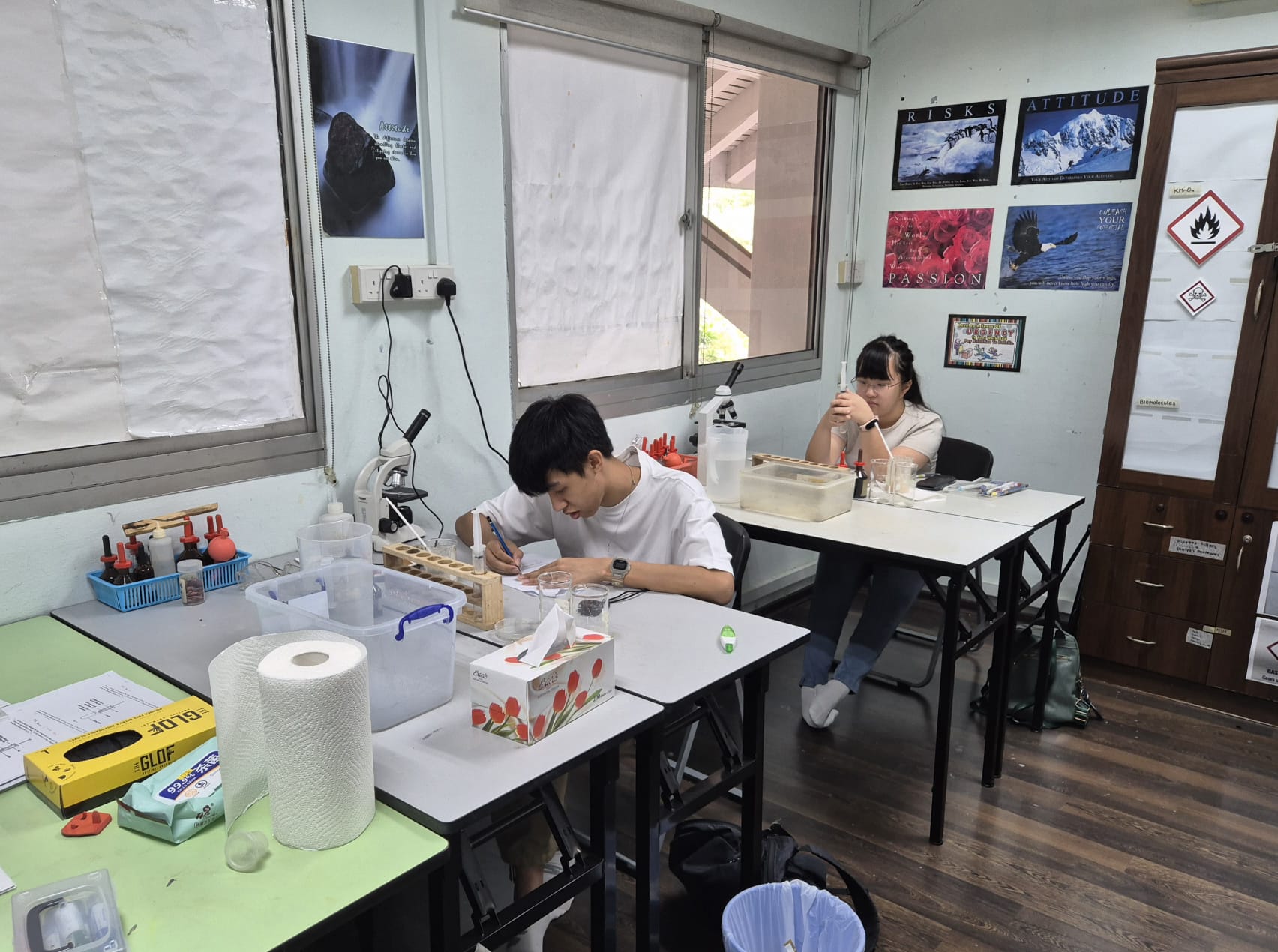
Why Choose Us?
- Our teachers are very experienced, and we actually TEACH you good practical techniques.
- We have been a one-stop comprehensive science practical centre providing solid practical training for ALL THREE sciences and for all levels and streams since 2017.
- Our laboratory apparatus are exam-grade and similar to those used in MOE schools and our chemicals are all NEA-approved.
- We have a structured practical training programme catering to the needs of both beginners and experienced students.
- We have a small class size so that the teacher is able to observe the actions of each student more closely and demonstrate the correct practical techniques where and when necessary.
- Many private schools trust us to prepare and conduct science practical training and assessment for their students, including structured training, mock exams and even actual CIE science practical exams.
