1. Answering a Source-of-Error Question
Give the one or two factors inherent to the set-up, not a general list. Every answer has three parts: (i) the specific physical cause of the deviation; (ii) the quantity affected and the direction of the effect — systematic (biased) or random (scattered); (iii) a concrete precaution, with the reasoning for why it works where this is not obvious.
Rejected as “too general” unless further justified for the exact set-up:
- Parallax error, without stating why it cannot be avoided here.
- “Random error” or “human error”, without a stated cause.
- Zero error — correctable by calibration or subtraction, not a genuine source of error.
- “Instrument not precise enough”, without naming the reading it limits and why that matters.
- Anything solved by “being more careful” or “repeating the reading” — repetition addresses random error only.
1.1 Random and Systematic Error
| Source of Error | Effect on the Reading / Result | Precaution / Improvement |
| Random error | Scatter about the true relationship, in either direction, from the limit of instrument resolution or from inexact repetition of a procedure. | Average repeated readings; spread readings over the widest practicable range and take the gradient of a line of best fit rather than a value from any two points. |
| Systematic error | A constant bias in one direction, from an apparatus fault, an uncorrected offset, or a flaw in method. Displaces a y-intercept; does not, by itself, change a gradient. | Not reduced by averaging. Identify and correct the fault, or choose the plotted quantities so the offset is confined to the intercept and the gradient — and any constant derived from it — is unaffected. |
1.2 Precision of Common H2 Apparatus
| Apparatus | Precision (Uncertainty) | How to Read / Use Correctly |
| Metre rule / half-metre rule | ± 0.1 cm | Read with eye level to the scale; avoid parallax. |
| Vernier calipers | ± 0.01 cm | Record zero error before use; read the coincident vernier division. |
| Micrometer screw gauge | ± 0.01 mm | Close using the ratchet only; record zero error before use. |
| Digital multimeter | ± 1 in the last digit displayed | Select the most sensitive range without overload; resolution changes with range. |
| Digital stopwatch | ± 0.01 s (device); reaction time ≈ 0.2 s dominates | Trigger electronically (light gate, data logger) where the timed interval is short. |
| Light gate with data logger | ± (flag width / speed), typically sub-millisecond | Use a narrow flag of known width so timed speed approximates instantaneous speed. |
| Cathode-ray oscilloscope | ± half the smallest division, scaled by the time-base or Y-gain setting | Set gain/time-base so the trace fills the screen; read at eye level, not at an angle. |
| Signal generator | Dial value may not equal true output frequency | Confirm frequency from the CRO trace period or a frequency counter, not the dial. |
| Temperature probe with data logger | ± 0.1 °C (probe); ± 0.5 °C (liquid-in-glass) | Allow thermal equilibrium; keep the sensor immersed, clear of the vessel wall. |
| Newton meter / top-pan balance | ± 0.01 N or ± 0.01 g, model-dependent | Zero (tare) before each set of readings. |
2. Mechanics
2.1 Simple Pendulum — Determination of g
T = 2π√(l/g); gradient of T² against l gives 4π²/g.
| Source of Error | Effect on the Reading / Result | Precaution / Improvement |
| Amplitude too large: sin θ ≈ θ no longer holds. | T is systematically longer than the true small-angle value; g calculated is too small. | Release from < 10°; confirm T is unchanged when amplitude is reduced further. |
| Length measured to the bottom of the bob, or thread extends under load. | l is recorded larger or smaller than the true effective length — a systematic error in g from the T²–l gradient. | Measure to the bob’s centre (add its radius); use an inextensible thread and re-check l with the bob hanging. |
| Reaction time is a fixed error, large relative to one period. | T is randomly high or low, with a large percentage error for a single swing. | Time 20 oscillations and divide by 20, so the fixed error is spread over many periods; or time with a light gate at the lowest point of swing. |
2.2 Free Fall with Light Gates — Determination of g
d = ut + ½gt²; plot d against t², gradient = ½g.
| Source of Error | Effect on the Reading / Result | Precaution / Improvement |
| Interrupt flag has finite width. | Gate measures an average speed over the flag width, not the instantaneous speed at that point — a systematic error in g. | Use as narrow a flag as practicable, or apply the standard flag-width correction. |
| Fixed delay between release/trigger and timer start; air resistance not negligible for a light object. | Every time is offset by the same constant, or g is systematically low. | Plot d against t² and use the gradient — a fixed offset is absorbed into the intercept, not the gradient; use a small, dense sphere to keep air resistance negligible. |
The full set of notes, which includes more sections on Sources of Error by Practical Topic is available in hard copy for students who sign up for any of our regular practical lessons, Crash Courses or Mock Exams.
LOOKING FOR THE BEST PLACE TO DO YOUR SCIENCE PRACTICALS? JOIN US!
Singapore Learner has been a Comprehensive Science Practical Training provider since 2017.
As at 19 Apr 2026, we have trained about 1060 students for their science practical exams and we have conducted a total of about 4044 lab sessions.
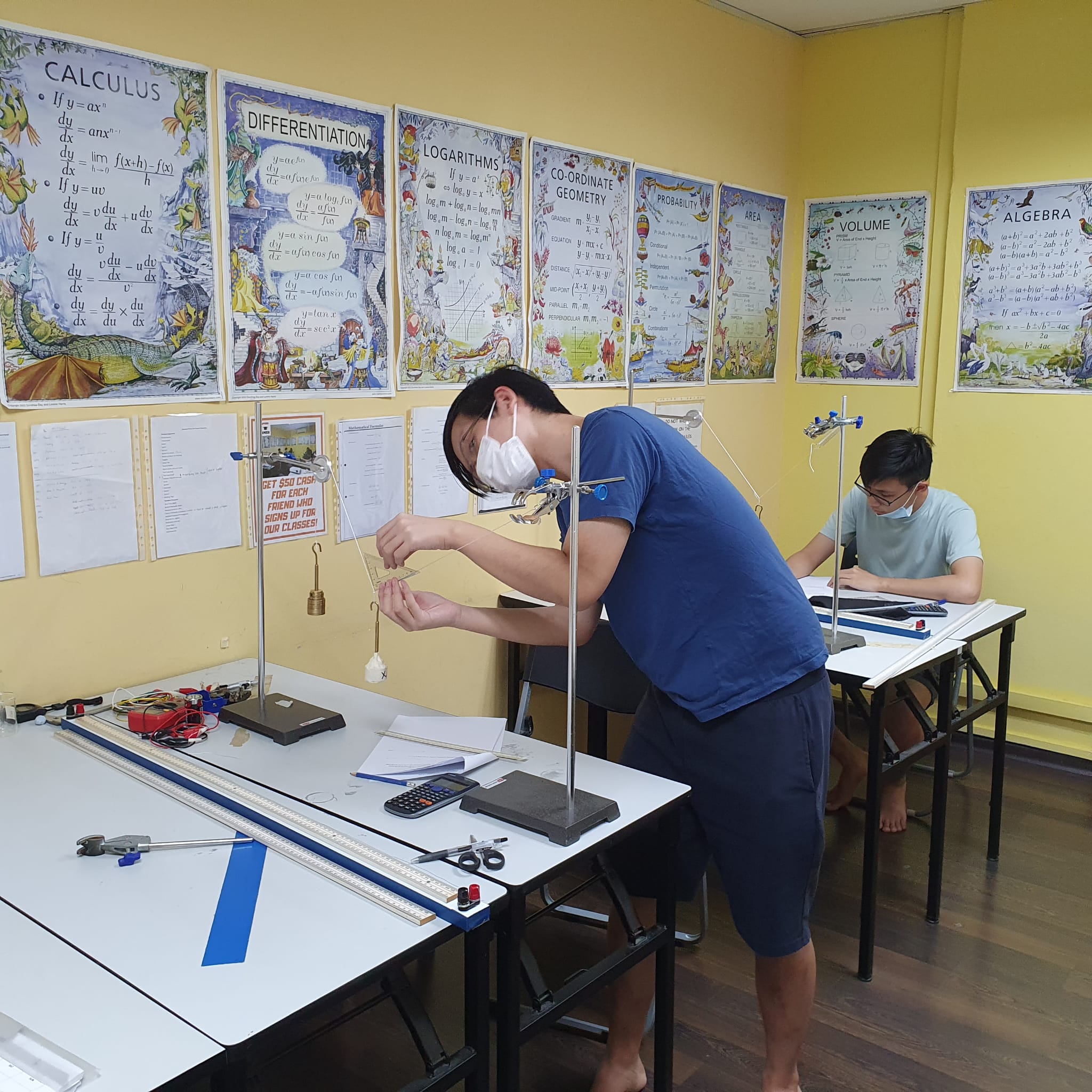
Our laboratory apparatus are exam-grade and similar to those used in MOE schools and our chemicals are all NEA-approved.
We provide A-Level / H2 / IP and O-Level Physics, Chemistry, Biology and Combined Science (Physics/Chemistry/Biology) Practical Training/Crash Course/Mock Exams for both local (eg. H2, Singapore-Cambridge) and international exams (CIE, Pearson Edexcel, IGCSE).
Why Choose Us?
- Our teachers are very experienced, and we actually TEACH you good practical techniques.
- We have been a one-stop comprehensive science practical centre providing solid practical training for ALL THREE sciences and for all levels and streams since 2017.
- Our laboratory apparatus are exam-grade and similar to those used in MOE schools and our chemicals are all NEA-approved.
- We have a structured practical training programme catering to the needs of both beginners and experienced students.
- We have a small class size so that the teacher is able to observe the actions of each student more closely and demonstrate the correct practical techniques where and when necessary.
- Many private schools trust us to prepare and conduct science practical training and assessment for their students, including structured training, mock exams and even actual CIE science practical exams.