Section 1: What is Planning?
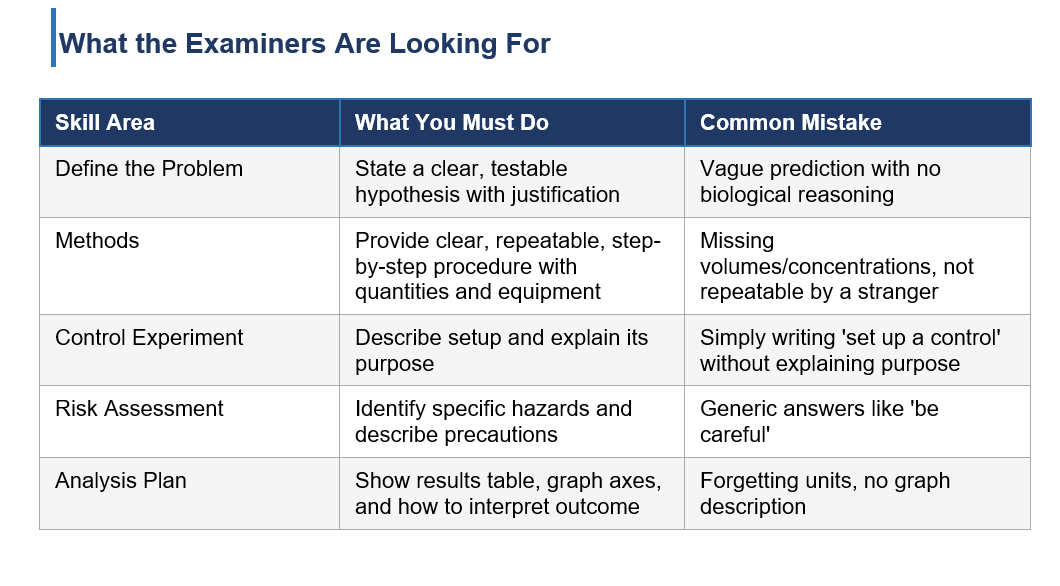
The Planning (P) component of Paper 4 tests your ability to design a complete, workable scientific investigation from scratch. You are given a research question and a list of materials, and you must produce a structured experimental plan that a stranger could follow and repeat.
Key Insight: Planning is not just about listing steps. Every mark corresponds to a specific component — hypothesis, variables, method, control, data recording, and risk. You must address ALL components to score full marks.
Section 2: The 6 Steps of a Perfect Planning Answer
Follow this structure EVERY TIME. Marks are allocated to specific components. A disorganised answer loses marks even if it contains the right information. Always use numbered steps and subheadings.
Step 1: Hypothesis
What to write
A hypothesis is a specific, testable, quantitative prediction of what you expect to happen, with biological justification. It must reference the independent variable (IV) and dependent variable (DV).
Exact Format
STRUCTURE: [DV] will [increase/decrease] as [IV] increases, because [biological mechanism].
Mark-scoring Example
“The rate of photosynthesis (measured by the extent of colour change of hydrogencarbonate indicator) will increase as the concentration of NaHCO3 increases, because a higher substrate (CO2) concentration increases the frequency of enzyme-substrate collisions at RuBisCO, increasing the rate of the Calvin cycle.”
NEVER write: “The plant will photosynthesise more.” — This is vague, has no reference to IV/DV, and no mechanism.
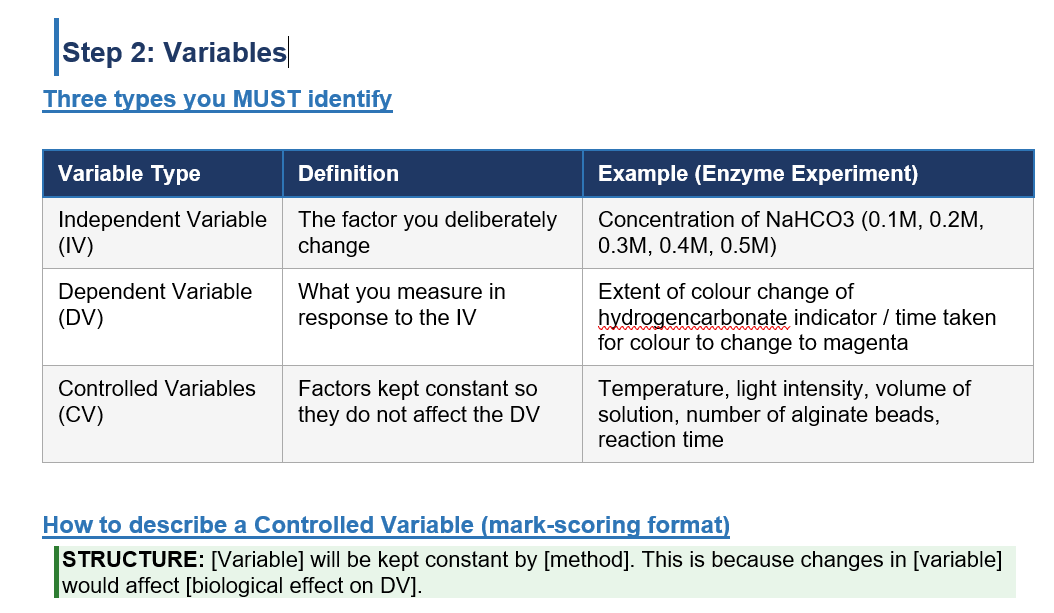
“Temperature will be maintained at 25°C using a water bath monitored with a thermometer. This is because changes in temperature alter the kinetic energy of molecules, affecting the rate of enzyme-catalysed reactions and hence the DV.”
Step 3: Control Experiment
A control experiment is a modified version of your experiment where the independent variable is removed or negated (replaced, NOT simply omitted). It proves that the result you observe is due to the IV and not any other factor.
CRITICAL RULE: You must REPLACE the IV — never just remove it. Everything else stays the same.
The full set of Planning notes is available in hard copy for students who sign up for any of our regular practical lessons, Crash Courses or Mock Exams.
LOOKING FOR THE BEST PLACE TO DO YOUR SCIENCE PRACTICALS? JOIN US!
Singapore Learner has been a Comprehensive Science Practical Training provider since 2017.
As at 19 Apr 2026, we have trained about 1060 students for their science practical exams and we have conducted a total of about 4044 lab sessions.
Our laboratory apparatus are exam-grade and similar to those used in MOE schools and our chemicals are all NEA-approved.
We provide A-Level / H2 / IP and O-Level Physics, Chemistry, Biology and Combined Science (Physics/Chemistry/Biology) Practical Training/Crash Course/Mock Exams for both local (eg. H2, Singapore-Cambridge) and international exams (CIE, Pearson Edexcel, IGCSE).
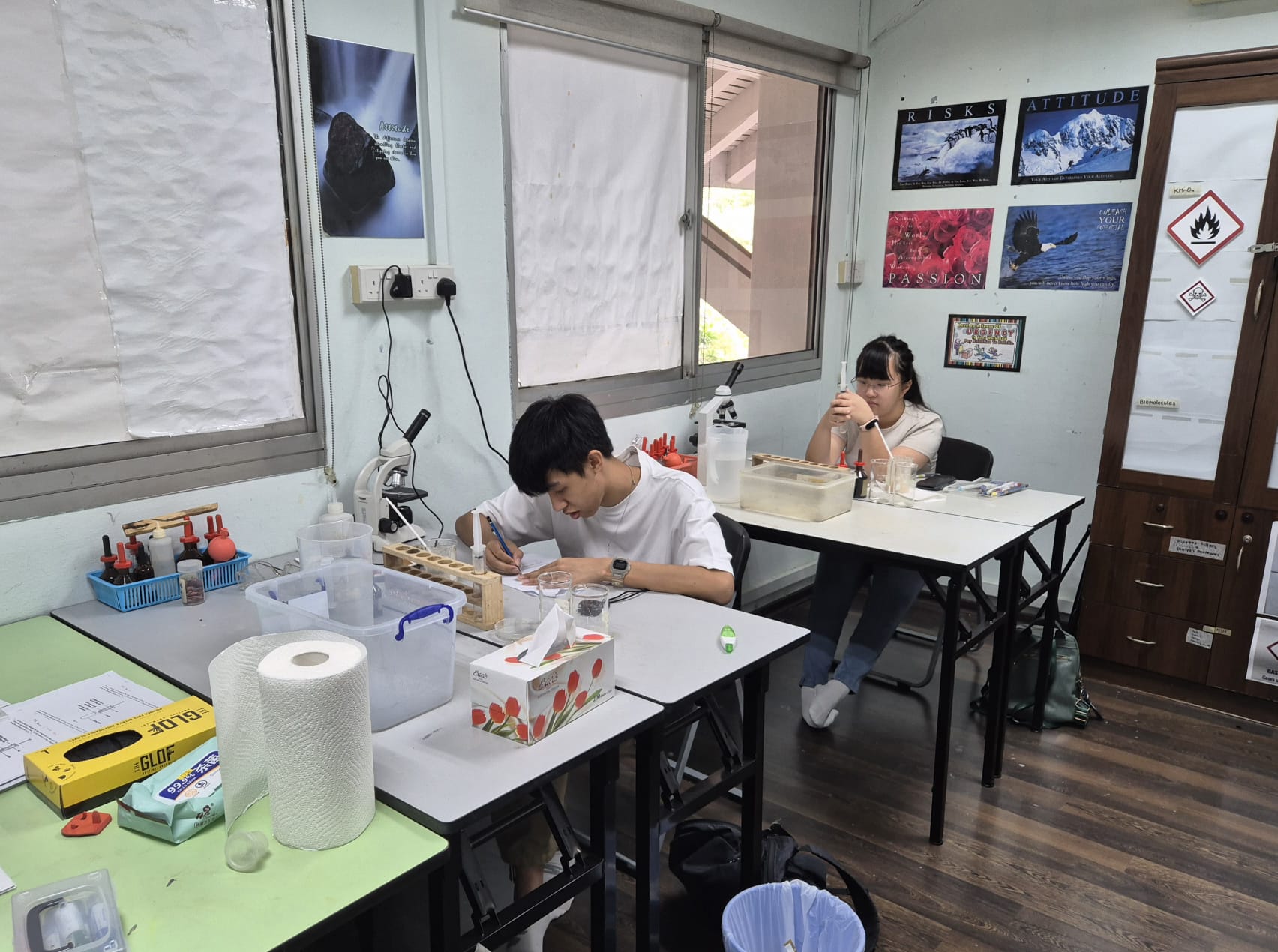
Why Choose Us?
- Our teachers are very experienced, and we actually TEACH you good practical techniques.
- We have been a one-stop comprehensive science practical centre providing solid practical training for ALL THREE sciences and for all levels and streams since 2017.
- Our laboratory apparatus are exam-grade and similar to those used in MOE schools and our chemicals are all NEA-approved.
- We have a structured practical training programme catering to the needs of both beginners and experienced students.
- We have a small class size so that the teacher is able to observe the actions of each student more closely and demonstrate the correct practical techniques where and when necessary.
- Many private schools trust us to prepare and conduct science practical training and assessment for their students, including structured training, mock exams and even actual CIE science practical exams.


