Posted in Practical

Notes on Planning for A-Level H2 Physics Practicals

Purpose of These Notes

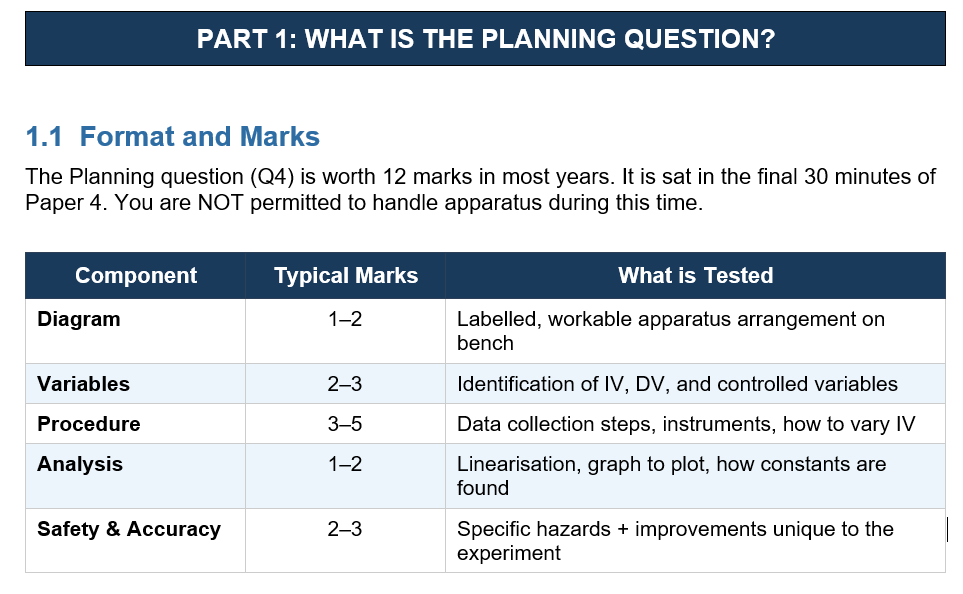
These notes provide a complete framework for answering the Planning question in the H2 Physics A-Level Paper 4 practical examination. A full Planning question is worth 11–12 marks and must be answered in the final 30 minutes of the paper. You may not touch any apparatus during this time.

Use these notes to understand: what each component of the answer is testing, exactly how to write it, common errors to avoid, and how a top-band response is structured.

1.2 How to Approach the Question (Time Strategy)
• Read the question carefully twice (2 min). Identify the equation and what constants need to be found.
• Sketch the diagram first — this locks in your apparatus before writing.
• Write variables explicitly before the procedure — markers look for these early.
• Write the procedure in numbered steps — never continuous prose.
• End with Safety and Accuracy — these often carry 3 marks and are easy to score.

⚠ You CANNOT earn marks by repeating information already given in the question. Read the question carefully and ensure every point you write adds new, specific information.

PART 2: THE EXACT FORMAT — COMPONENT BY COMPONENT

(a) Diagram

The diagram is worth 1–2 marks. It must show a WORKABLE setup that a student could actually build in a lab.

What a top-band diagram must include:
• A clear 2D side-view (or top-view if needed) — label it as such
• A drawn table-top (horizontal line at the bottom) — all apparatus rests on it
• All relevant apparatus labelled, including instrument names (e.g. ‘metre rule’, ‘GM tube’, ‘ratemeter’)
• Quantities to be measured labelled directly on the diagram (e.g. arrows showing distance d, thickness t)
• Retort stands and clamps shown where apparatus needs support
• Circuit diagrams (if electrical) using conventional symbols — do not draw 3D boxes

⚠ Equipment must not float in mid-air. If an instrument stands unsupported, it must be shown clamped to a retort stand. Equipment likely to topple (motors, heavy masses) must be firmly clamped.

Diagram Checklist: Table top drawn? All items labelled? Quantities marked with arrows/letters? Supports shown? No floating equipment?

(b) Defining the Problem — Variables

This section carries 2–3 marks. State variables explicitly, clearly, and quantifiably. Vague statements like ‘keep other factors the same’ score zero.


Singapore Learner has been a Comprehensive Science Practical Training provider since 2017.

As at 19 Apr 2026, we have trained about 1060 students for their science practical exams and we have conducted a total of about 4044 lab sessions.

Our laboratory apparatus are exam-grade and similar to those used in MOE schools and our chemicals are all NEA-approved.


Why Choose Us?

  • Our teachers are very experienced, and we actually TEACH you good practical techniques.
  • We have been a one-stop comprehensive science practical centre providing solid practical training for ALL THREE sciences and for all levels and streams since 2017.
  • Our laboratory apparatus are exam-grade and similar to those used in MOE schools and our chemicals are all NEA-approved.
  • We have a structured practical training programme catering to the needs of both beginners and experienced students.
  • We have a small class size so that the teacher is able to observe the actions of each student more closely and demonstrate the correct practical techniques where and when necessary.
  • Many private schools trust us to prepare and conduct science practical training and assessment for their students, including structured training, mock exams and even actual CIE science practical exams.

Our Main Practical Programmes:

A-LEVEL H2 PRACTICALS (Available Nov to Oct)

O-LEVEL PRACTICALS (Available Nov to Oct)

PRACTICAL CRASH COURSES (Jun, July, Sep and Oct)

MOCK EXAMS FOR SCIENCE PRACTICAL (Apr to Oct)

Posted in Practical

Notes on Sources of Error in A-Level H2 Physics Practicals

1. Answering a Source-of-Error Question

Give the one or two factors inherent to the set-up, not a general list. Every answer has three parts: (i) the specific physical cause of the deviation; (ii) the quantity affected and the direction of the effect — systematic (biased) or random (scattered); (iii) a concrete precaution, with the reasoning for why it works where this is not obvious.

Rejected as “too general” unless further justified for the exact set-up:

  • Parallax error, without stating why it cannot be avoided here.
  • “Random error” or “human error”, without a stated cause.
  • Zero error — correctable by calibration or subtraction, not a genuine source of error.
  • “Instrument not precise enough”, without naming the reading it limits and why that matters.
  • Anything solved by “being more careful” or “repeating the reading” — repetition addresses random error only.

1.1 Random and Systematic Error

Source of ErrorEffect on the Reading / ResultPrecaution / Improvement
Random errorScatter about the true relationship, in either direction, from the limit of instrument resolution or from inexact repetition of a procedure.Average repeated readings; spread readings over the widest practicable range and take the gradient of a line of best fit rather than a value from any two points.
Systematic errorA constant bias in one direction, from an apparatus fault, an uncorrected offset, or a flaw in method. Displaces a y-intercept; does not, by itself, change a gradient.Not reduced by averaging. Identify and correct the fault, or choose the plotted quantities so the offset is confined to the intercept and the gradient — and any constant derived from it — is unaffected.

1.2 Precision of Common H2 Apparatus

ApparatusPrecision (Uncertainty)How to Read / Use Correctly
Metre rule / half-metre rule± 0.1 cmRead with eye level to the scale; avoid parallax.
Vernier calipers± 0.01 cmRecord zero error before use; read the coincident vernier division.
Micrometer screw gauge± 0.01 mmClose using the ratchet only; record zero error before use.
Digital multimeter± 1 in the last digit displayedSelect the most sensitive range without overload; resolution changes with range.
Digital stopwatch± 0.01 s (device); reaction time ≈ 0.2 s dominatesTrigger electronically (light gate, data logger) where the timed interval is short.
Light gate with data logger± (flag width / speed), typically sub-millisecondUse a narrow flag of known width so timed speed approximates instantaneous speed.
Cathode-ray oscilloscope± half the smallest division, scaled by the time-base or Y-gain settingSet gain/time-base so the trace fills the screen; read at eye level, not at an angle.
Signal generatorDial value may not equal true output frequencyConfirm frequency from the CRO trace period or a frequency counter, not the dial.
Temperature probe with data logger± 0.1 °C (probe); ± 0.5 °C (liquid-in-glass)Allow thermal equilibrium; keep the sensor immersed, clear of the vessel wall.
Newton meter / top-pan balance± 0.01 N or ± 0.01 g, model-dependentZero (tare) before each set of readings.

2. Mechanics

2.1 Simple Pendulum — Determination of g

T = 2π√(l/g); gradient of T² against l gives 4π²/g.

Source of ErrorEffect on the Reading / ResultPrecaution / Improvement
Amplitude too large: sin θ ≈ θ no longer holds.T is systematically longer than the true small-angle value; g calculated is too small.Release from < 10°; confirm T is unchanged when amplitude is reduced further.
Length measured to the bottom of the bob, or thread extends under load.l is recorded larger or smaller than the true effective length — a systematic error in g from the T²–l gradient.Measure to the bob’s centre (add its radius); use an inextensible thread and re-check l with the bob hanging.
Reaction time is a fixed error, large relative to one period.T is randomly high or low, with a large percentage error for a single swing.Time 20 oscillations and divide by 20, so the fixed error is spread over many periods; or time with a light gate at the lowest point of swing.

2.2 Free Fall with Light Gates — Determination of g

d = ut + ½gt²; plot d against t², gradient = ½g.

Source of ErrorEffect on the Reading / ResultPrecaution / Improvement
Interrupt flag has finite width.Gate measures an average speed over the flag width, not the instantaneous speed at that point — a systematic error in g.Use as narrow a flag as practicable, or apply the standard flag-width correction.
Fixed delay between release/trigger and timer start; air resistance not negligible for a light object.Every time is offset by the same constant, or g is systematically low.Plot d against t² and use the gradient — a fixed offset is absorbed into the intercept, not the gradient; use a small, dense sphere to keep air resistance negligible.

LOOKING FOR THE BEST PLACE TO DO YOUR SCIENCE PRACTICALS? JOIN US!

Singapore Learner has been a Comprehensive Science Practical Training provider since 2017.

As at 19 Apr 2026, we have trained about 1060 students for their science practical exams and we have conducted a total of about 4044 lab sessions.

Our laboratory apparatus are exam-grade and similar to those used in MOE schools and our chemicals are all NEA-approved.


Why Choose Us?

  • Our teachers are very experienced, and we actually TEACH you good practical techniques.
  • We have been a one-stop comprehensive science practical centre providing solid practical training for ALL THREE sciences and for all levels and streams since 2017.
  • Our laboratory apparatus are exam-grade and similar to those used in MOE schools and our chemicals are all NEA-approved.
  • We have a structured practical training programme catering to the needs of both beginners and experienced students.
  • We have a small class size so that the teacher is able to observe the actions of each student more closely and demonstrate the correct practical techniques where and when necessary.
  • Many private schools trust us to prepare and conduct science practical training and assessment for their students, including structured training, mock exams and even actual CIE science practical exams.

Our Main Practical Programmes:

A-LEVEL H2 PRACTICALS (Available Nov to Oct)

O-LEVEL PRACTICALS (Available Nov to Oct)

PRACTICAL CRASH COURSES (Jun, July, Sep and Oct)

MOCK EXAMS FOR SCIENCE PRACTICAL (Apr to Oct)

Posted in EDUCATIONAL ADVICE, Practical

Excel Skills in the New H2 Physics 9478 Syllabus (2026)

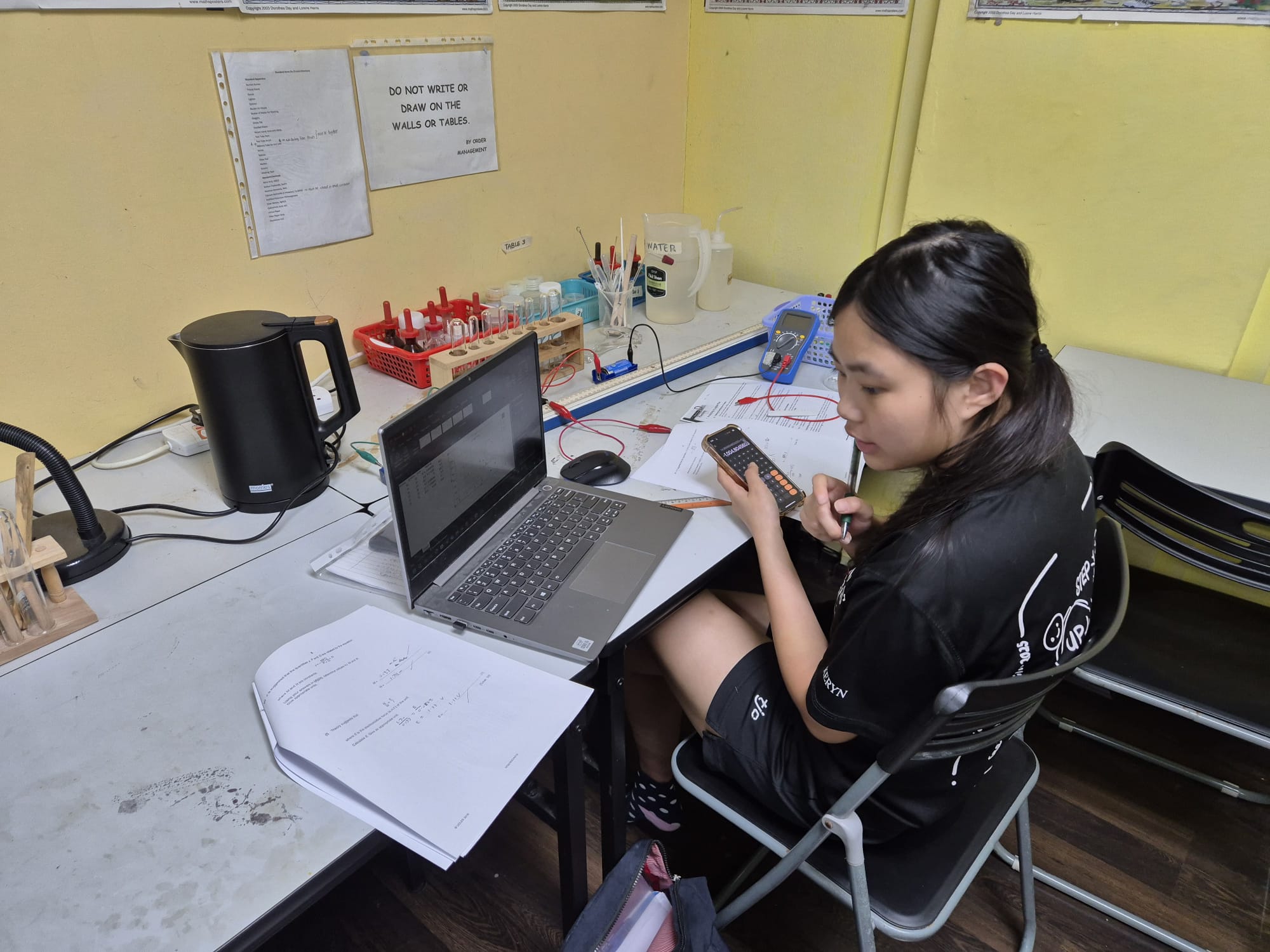
The new H2 Physics syllabus introduces a digital shift: students must now use spreadsheet software for data analysis in Paper 4.

The Essential Spreadsheet Skills You Need to Master

The official syllabus documentation outlines the following skills, which can be assessed in the Practical Examination (Paper 4):

  1. Data Entry and Import
    • Importing Files: You must be able to open and process external data files in .xlsx format.
    • Manual Input: Correctly inputting raw data obtained directly from your experiment.
    • Organisation: Creating meaningful headers with quantities and units (e.g., Current/A) and ensuring data matches the required precision.
  2. Mathematical Operations and Functions
    • Operations: Perform calculations including sines, cosines, tangents (and their inverse) using radian, as well as exponentials and logarithms (lg and ln).
    • Scientific Notation: Correctly inputting and displaying values in scientific notation (e.g., 3.00E + 14 for 3.00 x 10¹⁴ ).
    • Formula Duplication: Writing a formula once and using “fill” features to duplicate it across multiple cells efficiently.
  3. Numerical Manipulation and Formatting
    • Data Type Adjustment: Adjusting formatting for different data types (e.g., number of decimal places or percentage) and duplicating across different cells.
  4. Graphing and Trendlines
    • Scales and Labels: Plotting labeled line graphs and adjusting the scales of both axes for clarity.
    • Linear Trendlines: Using built-in functions to add a best fit line through the data points and displaying the equation of the trendline.
  5. Calculas-Based Analysis

We have sixteen H2 Physics practical worksheets requiring students to use Excel to handle data and plot graphs.

H2 PHYSICS PRACTICAL (BASIC AND EXAM PAPER TRAINING)

H2 PHYSICS HANDS-ON PRACTICAL CRASH COURSE

MOCK EXAMS FOR SCIENCE PRACTICAL

For enquiries, contact 88765498 (Lab Coordinator).

We provide A-Level / H2 and O-Level Physics, Chemistry, Biology and Science (Physics/Chemistry/Biology) Practical training for private / school candidates and homeschoolers, for both local (eg. H2, Singapore-Cambridge) and international exams (CIE, IGCSE).

QUICK ACCESS: H2 PHYSICS HANDS-ON PRACTICAL CRASH COURSE


MOE/SEAB SYLLABUS FOR H2 PHYSICS PRACTICAL

Paper 4 (Practical) is weighted to 20% of the Higher 2 assessment.

SKILL AREAS FOR PRACTICAL EXAM

General practical skill areas in which students will be assessed are as follows:

(a) Planning

(b) Manipulation, measurement and observation.

(c) Presentation of data and observations.

(d) Analysis, conclusions and evaluation.

Students doing the older 9749 syllabus are expected to draw graphs and calculate gradients manually using graph paper.

Students doing the new 9478 syllabus (2026 onwards) are expected to draw graphs and make calculations using Excel spreadsheets (see link below):

TOPICS FOR PRACTICAL EXAM

The topics to be examined for the H2 Physics practical exam are not stated in the new syllabus, but based on past papers, candidates are expected to have been exposed to a range of topics and experimental techniques such as:

  1. Measurement and Uncertainty, including the use of vernier callipers and the micrometer screw gauge
  2. Calculation of percentage errors
  3. Precision of instruments, including decimal places and significant figures
  4. Kinematics and Forces, including the use of the Newton-meter, springs and pulleys.
  5. Period of Oscillations
  6. Moments and Centre of Gravity
  7. Thermal Physics
  8. Electricity, including the use of potentiometers, diodes, capacitors and digital multimeters
  9. Electromagnetism
  10. Recording of observations in tables and plotting of graphs
  11. Identification of Sources of Error in experiments and ways to overcome them
  12. Planning an experiment including identification of independent, dependent and control variables as well as safety precautions

OUR STRUCTURED PRACTICAL TRAINING SYSTEM

Based on the above syllabus, we have several structured programs for you, depending on whether you are a private or school candidate.

PRIVATE CANDIDATES

If you are a private candidate, for each subject, you must complete 4 Basic practicals plus a further 4 Exam-Paper-Style practicals, before we issue you a certificate to acknowledge that you have completed a sufficient amount of practical training necessary for your actual exam. Beyond these 8 practical sessions, you may also opt to attend our Practical Crash Courses and our Practical Mock Exams in June, September or October.

SCHOOL CANDIDATES

If you are a current school candidate, you may select any of the training labs found in our schedule, and you are strongly encouraged to sign up early for our Practical Crash Courses and our Practical Mock Exams which will be held in March, June, September or October.


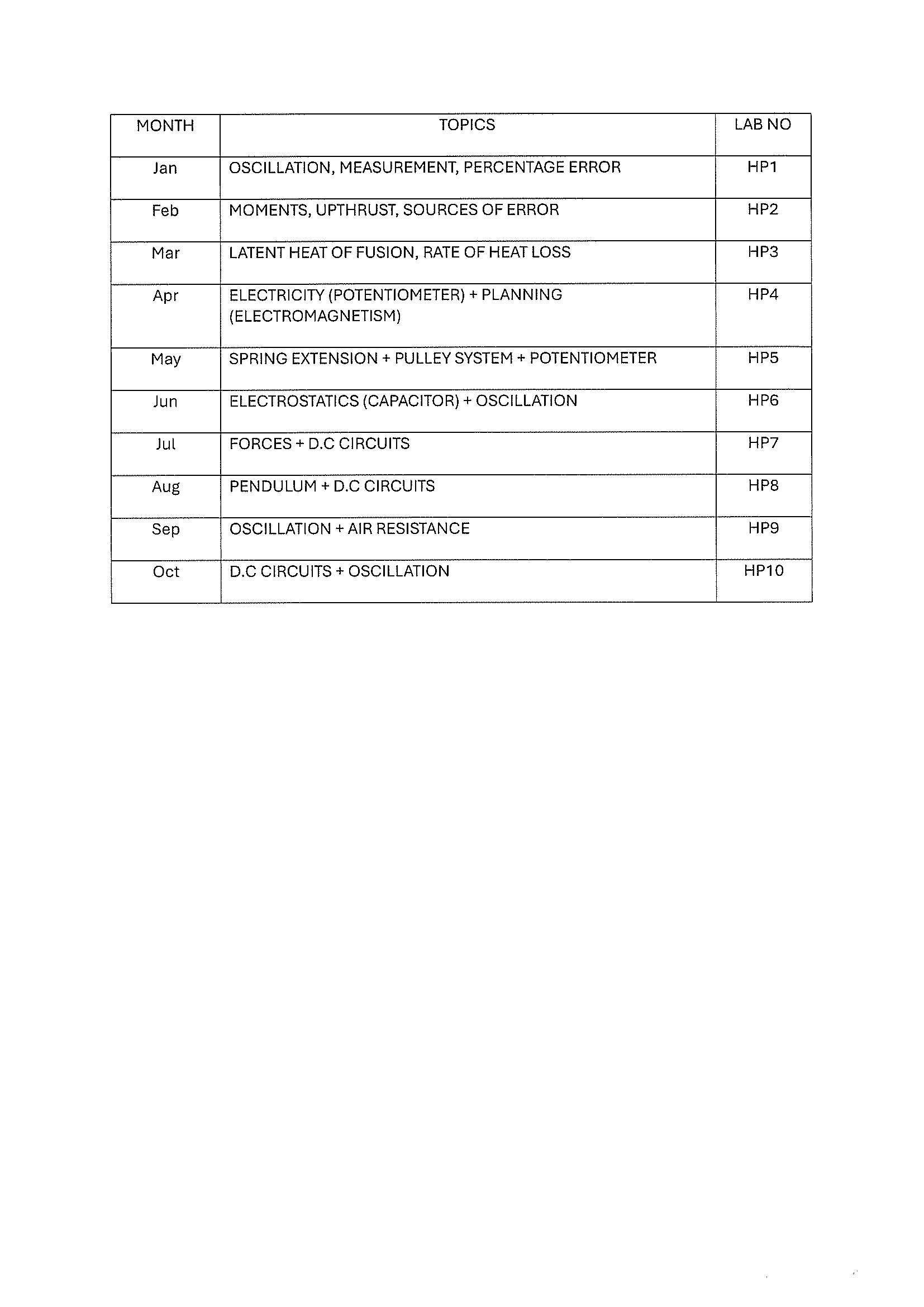
OUR H2 PHYSICS PRACTICAL SCHEDULE (Jan to Oct)

*Other labs, such as HP11-16, are also available for those who want further training or as mock exams.

*All our H2 Physics lab sessions are available in both the old (non-Excel) and new (Excel) formats.

*If you sign up after January, we will adjust the above schedule for you but you may have to attend more than one practical session per month per subject.


IMPORTANT POINTS TO NOTE:

The above is the ideal schedule for students who want to excel in their H2 Physics practical exams, by starting in Jan and having a final practical revision or mock exam in Oct. The practical sessions are well spread out, giving students time to study the theory components as well as other subjects. Thus it is highly recommended that you commence your practical training in January.


HOW TO BOOK A LAB SESSION:

(1) Decide which Program or Lab sessions you need or most suitable for.

(2) Whatsapp or Message our staff at 88765498 with your Name, Private or School Candidate, A or O level, Subject or Lab Name (e.g Lab PP2), Date and Time of Lab. (Our staff will then guide you on how to register and make payment. If you are not sure about the lab sessions, just state your Name and the Subjects and we will get back to you)

(3) Register Online by clicking below:

(4) Pay Registration fee of $50 via Paynow or funds transfer.

(5) Make the required payment for each lab session at least 7 days before the date of the lab session. (You may also pay for several sessions at one go to ensure that you will have a place in future slots)


BASIC LABS:

Lab HP1:    OSCILLATION 1, MEASUREMENT 1, PERCENTAGE ERROR (TOPICAL TRAINING) (Available sessions: (JAN – AUG, CONFIRM WITH ADMIN)

Lab HP2:  MOMENTS, UPTHRUST, SOURCES OF ERROR (TOPICAL TRAINING) (Available sessions : (JAN – AUG, CONFIRM WITH ADMIN)

Lab HP3:   LATENT HEAT OF FUSION, RATE OF HEAT LOSS (TOPICAL TRAINING) (Available sessions: (JAN- AUG , CONFIRM SLOT WITH ADMIN)

Lab HP4:   ELECTRICITY (POTENTIOMETER 4) + PLANNING (ELECTROMAGNETISM) (TOPICAL TRAINING) (Available sessions: (JAN – AUG , CONFIRM SLOT WITH ADMIN)

Note: The above 4 labs are BASIC TRAINING LABS which are available throughout the year, every week every month, as they are compulsory for all private candidates. Thus if the date you can attend is not listed above, please message our Admin at 88765498 for a new schedule.


STANDARD LABS:

Lab HP5:   SPRING EXTENSION + PULLEY 5 + POTENTIOMETER 5 (EXAM PAPER TRAINING) (Available sessions: (CONFIRM SLOT WITH ADMIN)

Lab HP6:    ELECTROSTATICS (CAPACITOR) + OSCILLATION 6 (EXAM PAPER TRAINING) (Available sessions: (CONFIRM SLOT WITH ADMIN)

Lab HP7:    FORCES 7 + D.C CIRCUITS 7 (EXAM PAPER TRAINING) (Available sessions: (CONFIRM SLOT WITH ADMIN)

Lab HP8:  PENDULUM 8 + D.C CIRCUITS 8  (EXAM PAPER TRAINING) (Available sessions: (CONFIRM SLOT WITH ADMIN)

Lab HP9:  OSCILLATION 9 + AIR RESISTANCE (EXAM PAPER TRAINING) (Available sessions: (CONFIRM SLOT WITH ADMIN)

Lab HP10:  D.C CIRCUITS 10 + OSCILLATION 10 (EXAM PAPER TRAINING)  (Available session : (AUG-OCT,CONFIRM SLOT WITH ADMIN)

Lab HP11:  INCLINED PLANE + POTENTIOMETER 11 (EXAM PAPER TRAINING) (Available sessions: (AUG-OCT,CONFIRM SLOT WITH ADMIN)


Lab HP12:  UPTHRUST 12 + POTENTIOMETER 12 + OSCILLATION 12 (FULL PAPER MOCK EXAM) (Available Session: (AUG-OCT,CONFIRM SLOT WITH ADMIN)

Lab HP13:  FRICTION 13 + OSCILLATION 13 + POTENTIOMETER 13 (FULL PAPER MOCK EXAM) (Available Session: (SEPT-OCT,CONFIRM SLOT WITH ADMIN)

Lab HP14:  OSCILLATION OF WIRE + RATE OF HEAT LOSS + POWER OF A RESISTOR (FULL PAPER MOCK EXAM) (Available session: (AUG-OCT,CONFIRM SLOT WITH ADMIN))

Lab HP15:  PENDULUM 15 + FRICTION 15 + POTENTIOMETER 15 (FULL PAPER MOCK EXAM) (Available sessions: (SEPT-OCT,CONFIRM SLOT WITH ADMIN)

Lab HP16:  OSCILLATION 16 + POTENTIOMETER 16 + FORCES 16 (NEWTON-METER) (FULL PAPER MOCK EXAM) (Available sessions: (SEPT-OCT,CONFIRM SLOT WITH ADMIN)


CRASH COURSES AND MOCK EXAMS (Jun, Sep, Oct)

H2 CHEMISTRY HANDS-ON PRACTICAL CRASH COURSE

H2 BIOLOGY HANDS-ON PRACTICAL CRASH COURSE

H2 PHYSICS HANDS-ON PRACTICAL CRASH COURSE

MOCK EXAMS FOR SCIENCE PRACTICAL


PAST TOPICS OF H2 PHYSICS PRACTICAL:

2022: Oscillation (slotted masses hanging from a string), W.E.P, Electricity (not potentiometer)

2023:

The first question (14m) was on circuits, construct a circuit with a wire-jockey potentiometer and a fixed resistor in parallel, then vary the fixed resistors (we were given 5 in total) while adjusting the length of the wire in contact with the jockey to keep the ammeter reading in the circuit constant.

The second question (8m) was on oscillations, where there was a short stick with two metal balls hanging from it by strings, and a diagonal stick crossing the strings which allowed the length of string to be varied and hence the period of oscillation.

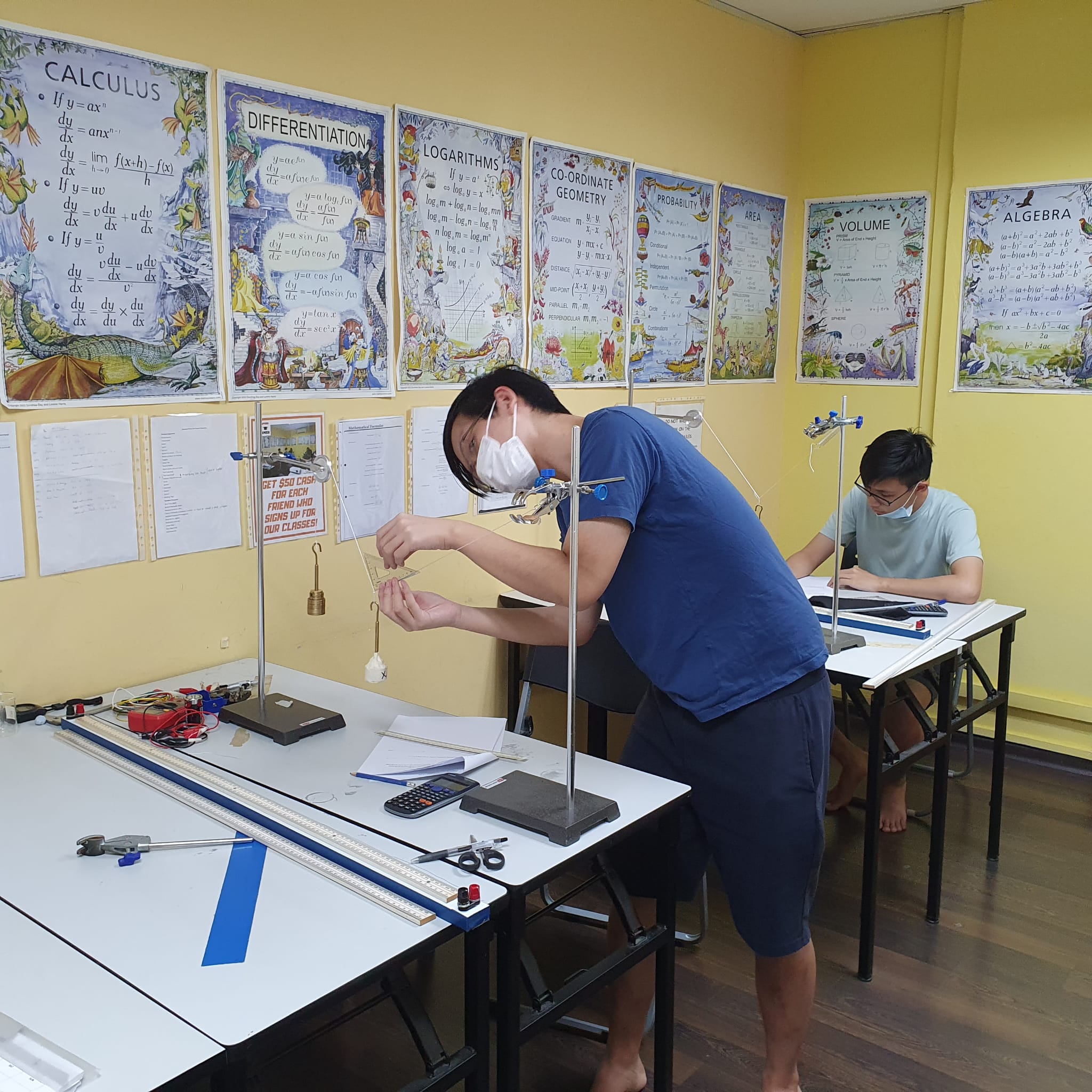
The third question (22m) was on forces where students had to build a cantilever by hanging one edge of a meter rule off the table while the other edge remained on the table, and placing weights on it to find the balance point, then do calculations.

The planning question was on measuring background radioactivity count rate for different distances from a building and from the ground.


What you will get at each practical session:

(1) Teaching and instruction on how to use the various scientific tools and instruments.

(2) Tips on how to answer a practical worksheet or exam paper, including recording of observations, drawing graphs, writing conclusions, describing precautions and planning a practical.

(3) Notes on important aspects of science practicals.

We will also conduct Mock Practical Exams in September and October


PRACTICAL TUITION FEES

PRACTICAL DAYS AND TIMINGS


Our Practical Centre:

Singapore Learner @ Bukit Batok

Blk 644, Bukit Batok Central, #01-68. S(650644).


Tel: +(65) 6569 4897,   +(65)88765498 (WHATSAPP)

Email:  principal@singaporelearner.com

If you wish to visit us, kindly call or sms first. Thank you.

Posted in Administrative, Practical

H2 PHYSICS PRACTICAL

PLEASE NOTE THIS IS AN OUTDATED POST.

FOR THE LATEST SCHEDULE, CLICK ON

H2 PHYSICS PRACTICAL


We provide A-Level / H2 and O-Level Physics, Chemistry, Biology and Science (Physics/Chemistry/Biology) Practical training for private / school candidates and homeschoolers, for both local (eg. H2, Singapore-Cambridge) and international exams (CIE, IGCSE).


MOE/SEAB SYLLABUS FOR H2 PHYSICS PRACTICAL

Paper 4 (Practical) is weighted to 20% of the Higher 2 assessment.

Candidates are expected to have been exposed to a range of topics and experimental techniques such as:

  1. Measurement and Uncertainty, including the use of vernier callipers and the micrometer screw gauge
  2. Calculation of percentage errors
  3. Precision of instruments, including decimal places and significant figures
  4. Kinematics and Forces, including the use of the Newton-meter, springs and pulleys.
  5. Period of Oscillations
  6. Moments and Centre of Gravity
  7. Thermal Physics
  8. Electricity, including the use of potentiometers, diodes, capacitors and digital multimeters
  9. Electromagnetism
  10. Recording of observations in tables and plotting of graphs
  11. Identification of Sources of Error in experiments and ways to overcome them
  12. Planning an experiment including identification of independent, dependent and control variables as well as safety precautions


OUR STRUCTURED PRACTICAL TRAINING SYSTEM

Based on the above syllabus, we have several structured programs for you, depending on whether you are a Beginner or a Reviser.

You are at the Beginner level if you have never done any H2 Physics Practical work before, or your last Physics Practical session was more than 2 years ago.

You are at the Reviser level if you have completed the Beginner practicals, or you are re-taking your Physics Practical exam, or you are a school candidate who has completed JC1/Y5.


OUR H2 PHYSICS PRACTICAL SCHEDULE (OUTDATED)

BASIC LABS (for Beginners only):

Lab HP1:    OSCILLATION 1, MEASUREMENT 1, PERCENTAGE ERROR (TOPICAL TRAINING, LEVEL: BEGINNER) (Available sessions: 29/11 (10:30-1pm), 16/1 (2-4:30pm), 18/1 (2-4:30pm), 19/1 (2-4:30pm), 20/1 (10:30-1pm), 21/1 (2-4:30pm))

Lab HP2:  MOMENTS, UPTHRUST, SOURCES OF ERROR (TOPICAL TRAINING, LEVEL: BEGINNER) (Available sessions : 6/2 (2-4:30pm), 8/2 (2-4:30pm), 9/2 (2-4:30pm), 10/2 (10:30-1pm), 11/2 (2-4:30pm))

Lab HP3:   THERMAL PHYSICS (TOPICAL TRAINING, LEVEL: BEGINNER) (Available sessions: 27/2 (2-4:30pm), 29/2 (2-4:30pm), 1/3 (2-4:30pm), 2/3 (10:30-1pm), 3/3 (2-4:30pm))

Lab HP4:   ELECTRICITY (POTENTIOMETER 4) + PLANNING (ELECTROMAGNETISM) (TOPICAL TRAINING, LEVEL: BEGINNER) (Available sessions: 19/3 (2-4:30pm), 21/3 (2-4:30pm), 22/3 (2-4:30pm), 23/3 (10:30-1pm), 24/3 (2-4:30pm))

Note: The above 4 labs are BASIC TRAINING LABS which are available throughout the year, every week every month, as they are compulsory for all beginners. Thus if the date you can attend is not listed above, please message our Admin at 88765498 for a new schedule.


STANDARD LABS (for Retakers and current govt school students):

Lab HP5:   SPRING EXTENSION + PULLEY 5 + POTENTIOMETER 5+ OSCILLATION 5 (EXAM PAPER TRAINING, LEVEL: REVISER) (Available sessions: 16/4 (2-4:30pm), 18/4 (2-4:30pm), 19/4 (2-4:30pm), 20/4 (10:30-1pm), 21/4 (2-4:30pm))

Lab HP6:    MEASUREMENT 6 (VERNIER CALIPER & MICROMETER) + ELECTROSTATICS (CAPACITOR) + OSCILLATION 6 (EXAM PAPER TRAINING, LEVEL: REVISER) (Available sessions: 14/5 (2-4:30pm), 16/5 (2-4:30pm), 17/5 (2-4:30pm), 18/5 (10:30-1pm), 19/5 (2-4:30pm))

Lab HP7:    FORCES 7+ OSCILLATION 7 + D.C CIRCUITS 7 (EXAM PAPER TRAINING, LEVEL: REVISER) (Available sessions: 28/5 (2-4:30pm), 30/5 (2-4:30pm), 31/5 (2-4:30pm), 1/6 (10:30-1pm), 2/6 (2-4:30pm))

Lab HP8:  PENDULUM 8 + D.C CIRCUITS 8 + PULLEY SYSTEM 8 (EXAM PAPER TRAINING, LEVEL: REVISER) (Available sessions: 18/6 (2-4:30pm), 20/6 (2-4:30pm), 21/6 (2-4:30pm), 22/6 (10:30-1pm), 23/6 (2-4:30pm))

Lab HP9:  OSCILLATION 9 + D.C CIRCUITS 9 + AIR RESISTANCE (EXAM PAPER TRAINING, LEVEL: REVISER) (Available sessions: 9/7 (2-4:30pm), 11/7 (2-4:30pm), 12/7 (2-4:30pm), 13/7 (10:30-1pm), 14/7 (2-4:30pm))

Lab HP10:  D.C CIRCUITS 10 + OSCILLATION 10 + SPRING 10 (EXAM PAPER TRAINING, LEVEL: REVISER)  (Available session : 30/7 (2-4:30pm), 1/8 (2-4:30pm), 2/8 (2-4:30pm), 3/8 (10:30-1pm), 4/8 (2-4:30pm))

Lab HP11:  REBOUND HEIGHT + INCLINED PLANE + POTENTIOMETER 11 (EXAM PAPER TRAINING, LEVEL: REVISER) (Available sessions: 20/8 (2-4:30pm), 22/8 (2-4:30pm), 23/8 (2-4:30pm), 24/8 (10:30-1pm), 25/8 (2-4:30pm))

Lab HP12:  MECHANICS + ELECTRICITY (POTENTIOMETER 12) (EXAM PAPER TRAINING, LEVEL: REVISER (Available Session: 10/9 (2-4:30pm), 12/9 (2-4:30pm), 13/9 (2-4:30pm), 14/9 (10:30-1pm), 15/9 (2-4:30pm))

Lab HP13:  FRICTION 13 + OSCILLATION 13 + POTENTIOMETER 13 (EXAM PAPER TRAINING, LEVEL: REVISER ) (Available Session: 1/10 (2-4:30pm), 3/10 (2-4:30pm), 4/10 (2-4:30pm), 5/10 (10:30-1pm), 6/10 (2-4:30pm))

Lab HP14:  OSCILLATION OF WIRE + RATE OF HEAT LOSS + POWER OF A RESISTOR (EXAM PAPER TRAINING, LEVEL: REVISER) (Available session: 22/10 (2-4:30pm), 24/10 (2-4:30pm), 25/10 (2-4:30pm), 26/10 (10:30-1pm), 27/10 (2-4:30pm))

Lab HP15:  PENDULUM 15 + FRICTION 15 + POTENTIOMETER 15 (EXAM PAPER TRAINING, LEVEL: REVISER) (Available sessions: (Comfirm with admin)

Lab HP16:  OSCILLATION 16 + POTENTIOMETER 16 + FORCES 16 (NEWTON-METER) (EXAM PAPER TRAINING, LEVEL: REVISER) (Available sessions: (Comfirm with admin)

MOCK EXAMS FOR SCIENCE PRACTICAL (JUNE TO OCT)


CRASH COURSES (JUNE TO OCT):

H2 CHEMISTRY HANDS-ON PRACTICAL CRASH COURSE

H2 BIOLOGY HANDS-ON PRACTICAL CRASH COURSE

H2 PHYSICS HANDS-ON PRACTICAL CRASH COURSE


PAST TOPICS OF H2 PHYSICS PRACTICAL:

2022: Oscillation (slotted masses hanging from a string), W.E.P, Electricity (not potentiometer)

2023:

The first question (14m) was on circuits, construct a circuit with a wire-jockey potentiometer and a fixed resistor in parallel, then vary the fixed resistors (we were given 5 in total) while adjusting the length of the wire in contact with the jockey to keep the ammeter reading in the circuit constant.

The second question (8m) was on oscillations, where there was a short stick with two metal balls hanging from it by strings, and a diagonal stick crossing the strings which allowed the length of string to be varied and hence the period of oscillation.

The third question (22m) was on forces where students had to build a cantilever by hanging one edge of a meter rule off the table while the other edge remained on the table, and placing weights on it to find the balance point, then do calculations.

The planning question was on measuring background radioactivity count rate for different distances from a building and from the ground.


What you will get at each practical session:

(1) Teaching and instruction on how to use the various scientific tools and instruments.

(2) Tips on how to answer a practical worksheet or exam paper, including recording of observations, drawing graphs, writing conclusions, describing precautions and planning a practical.

(3) Notes on important aspects of science practicals.

We will also conduct Mock Practical Exams in September and October


HOW TO BOOK A LAB SESSION:

(1) Decide which Program or Lab sessions you need or most suitable for.

(2) Whatsapp or Message our staff at 88765498 with your Name, Private or School Candidate, A or O level, Subject or Lab Name (e.g Lab PP2), Date and Time of Lab. (Our staff will then guide you on how to register and make payment. If you are not sure about the lab sessions, just state your Name and the Subjects and we will get back to you)

(3) Register Online by clicking below:

(4) Pay Registration fee of $30 via Paynow or funds transfer.

(5) Make the required payment for each lab session at least 5 days before the date of the lab session. (You may also pay for several sessions at one go to ensure that you will have a place in future slots)


FEES PER SESSION

Practical Training Session: $320

Mock Exam:- $380

SPECIAL DISCOUNT FOR ADDITIONAL SUBJECT: For every H2 Physics lab session you book, you can also book a H2 Chemistry lab session for only $270 (usual fee: $320). To view our H2 Chem schedule, click the link below:

H2 CHEMISTRY PRACTICAL

Note: Above fees are subject to changes without prior notice.


IMPORTANT : The full fee must be paid at least 5 days before the practical session to confirm your attendance as a lot of preparation is needed for practicals coupled with very limited class size. PLEASE NOTE IF YOU ARE ABSENT FOR A LAB SESSION, A PENALTY OF $50 MUST BE PAID TO POSTPONE THIS LAB TO ANOTHER SESSION, AND ONLY 1 POSTPONEMENT IS ALLOWED FOR EACH LAB, ELSE THE LAB IS CONSIDERED COMPLETED AND PAID FOR, AND NO REFUND WILL BE GIVEN. THE FEE FOR THE MISSED LAB CANNOT BE USED FOR ANOTHER LAB.


Singapore Learner @ Bukit Batok

Blk 644, Bukit Batok Central, #01-68. S(650644).


Tel: +(65) 6569 4897,   +(65) 88765498 (WHATAPPS) http://wa.link/w0xxk2

Email:  principal@singaporelearner.com

If you wish to visit us, kindly call or sms first. Thank you.


Posted in A-Level, H2 Physics, JC Physics, Practical, Pure Physics

H2 MOCK PRACTICAL EXAM (PHYSICS)

For 2020 schedule click on this link:

MOCK EXAMS FOR SCIENCE PRACTICAL (2020)


To do your A-Level H2 Physics Practical Mock Exam, please choose one or more of the following slots:

Session 1: Thursday 17/10, 9 am – 12 pm. (Code: H2PP1)

Session 2: Thursday 17/10, 2 pm – 5 pm. (Code: H2PP2)

Session 3: Friday 18/10, 9 am – 12 pm. (Code H2PP3)

Location: BLK 644, BUKIT BATOK CENTRAL, #01-68. s(650644)


At the end of each session, the tutor will go through the answers with you, highlight your mistakes (if any) and give you tips on how to score well for your actual practical.


If you need training,

Session 1: Saturday 28/9, 4.30 pm – 7 pm. (Code: H2TPP1)

Session 2: Friday 4/10, 10 am – 12.30 pm. (Code: H2TPP2)

Session 3: Saturday 5/10, 4.30 pm – 7 pm. (Code: H2TPP3)

Session 4: Tuesday 8/10, 10 am – 12.30 pm. (Code: H2TPP4)

Session 5: Friday 11/10, 10 am – 12.30 pm. (Code: H2TPP5)

Session 6: Saturday 12/10, 4.30 pm – 7 pm. (Code: H2TPP6)

To book a Practical session (MUST be at least 3 days in advance),

(1) SMS or Whatsapp the following info to 9786 0411: (a) Name of student; (b) Date and Time; (c) Subject OR (d) Name and Code.

(2) Pay $160 (O-level, per session) or $280 (A-level, per session) via cash or online transfer or Paylah or Paynow (to 9786 0411).

* If you prefer days and timings different from our regular schedule, a surcharge of $30 per session is imposed as extra preparation is needed on our side.

For enquiries, please whatsapp to 9786 0411 or call our centre at 6569 4897.

Location: BLK 644, BUKIT BATOK CENTRAL, #01-68. s(650644)


Posted in A-Level, H2 Physics, JC Physics

H2 PHYSICS MARCH HOLIDAYS INTENSIVE TOPICAL RELEARNING 2018


Dates: 12/3 (Day 1), 13/3 (Day 2), 14/3 (Day 3), 15/3 (Day 4)

Time : 9.30 am  12.30 pm (Session 1), 2.00 pm – 5.00 pm (Session 2)

Location West: Blk 644, Bukit Batok Central, #01-68. S(650644).

(Our location is just a 3-min walk from either the Bukit Batok MRT station or theBukit Batok Bus Interchange. Buses that stop along the roads surrounding our location are numbers 157, 178, 66, 506, 173, 174, 176, 187, 985. Buses services which terminate at Bukit Batok Bus Interchange are 61, 77, 106, 173, 177, 189, 852, 941, 945, 947)

Focus: CONCEPTUAL UNDERSTANDING & APPLICATION OF SKILLS

Format: Teaching + Worksheets + Discussions

Course Outline (Each session is 3 hrs long):

Day 1 Session 1: Kinematics – Projectile Motion

Day 1 Session 2: Dynamics – Linear Momentum

Day 2 Session 1: Forces – Turning Effects & Equilibrium

Day 2 Session 2: WEP – Inclined Plane & Spring Problems

Day 3 Session 1: Circular Motion

Day 3 Session 2: Gravitational Field

Day 4 Session 1: Oscillations

Day 4 Session 2: Thermal Physics

FEES for Each Session: $180 (must be paid in full by 8/3 to confirm your attendance)

Minimum number of students to start each session: 2 (if only one student signs up, either the course is cancelled and he will be refunded his $180 or he can proceed to have a 1-1 coaching by topping up an additional $90 only).

TO REGISTER, SMS <STUDENT NAME> , <H2PHYMAR>, <DAY>, <SESSION> TO +(65) 9786 0411

_______________________________________

TUITION CLASSES:

jcbutton          secbutton

ipbutton                    pributton

_______________________________________________________________

EDUCATIONAL SERVICES:

hwsupervbutton                   intensivebutton

alevelprepbutton                   olevelprepbutton

______________________________________________________________

By EX-MOE TEACHERS & EXPERIENCED TUTORS

@ BLK 644, BUKIT BATOK CENTRAL, #01-68. S(650644).

CALL 65694897 OR SMS 997860411.

Posted in H2 Physics

H2 PHYSICS TOPICAL CRASH COURSE

This H2 Physics Syllabus 9646 Topical Crash Course is designed to help busy students prepare sufficiently for the H2 Physics A-Level Exam in 2016. Conducted by an experienced JC Physics Tutor, this course aims to help students understand, master and apply the key concepts tested in the H2 Physics Exam.

DUE TO ADDITIONAL REQUESTS, NEW DATES HAVE BEEN ADDED.

From 3/10 to 31/10, 1-1 or group lessons are also available from 10 am – 12 pm or 1 pm – 3 pm for students on study leave. Fee is $200 per 2-hr lesson. Fee can also be shared between 2 or 3 students.

DATE DAY TIME TOPIC CODE
22/8 MON 8.00 PM – 9.30 PM Measurement H2P1
24/8 WED 8.00 PM – 9.30 PM Kinematics H2P2
25/8 THUR 8.00 PM – 9.30 PM Dynamics H2P3
1/10 SAT 9.30 AM – 11.00 AM Forces H2P4
1/10 SAT 8.00 PM – 9.30 PM Work, Energy & Power H2P5
2/10 SUN 9.30 AM – 11.00 AM Circular Motion H2P6
3/10 MON 8.00 PM – 9.30 PM Gravitational Field H2P7
5/10 WED 8.00 PM – 9.30 PM Oscillations H2P8
8/10 SAT 9.30 AM – 11.00 AM Thermal Physics H2P9
8/10 SAT 8.00 PM – 9.30 PM Wave Motion H2P10
9/10 SUN 9.30 AM – 11.00 AM Superposition H2P11
10/10 MON 8.00 PM – 9.30 PM Electric Fields H2P12
12/10 WED 8.00 PM – 9.30 PM Current of Electricity H2P13
13/10 THUR 8.00 PM – 9.30 PM D.C. Circuits H2P14
15/10 SAT 9.30 AM – 11.00 AM Electromagnetism H2P15
15/10 SAT 8.00 PM – 9.30 PM Electromagnetic Induction H2P16
19/10 WED 8.00 PM – 9.30 PM Alternating Currents H2P17
20/10 THUR 8.00 PM – 9.30 PM Quantum Physics H2P18
22/10 SAT 9.30 AM – 11.00 AM Lasers & Semiconductors H2P19
22/10 SAT 8.00 PM – 9.30 PM Nuclear Physics H2P20

Location: Blk 644, Bukit Batok Central, #01-68. S(650644).

(Our location is just a 3-min walk from either the Bukit Batok MRT station or the Bukit Batok Bus Interchange. Buses that stop along the roads surrounding our location are numbers 157, 178, 66, 506, 173, 174, 176, 187, 985. Buses services which terminate at Bukit Batok Bus Interchange are 61, 77, 106, 173, 177, 189, 852, 941, 945, 947)

Focus: CONCEPTUAL UNDERSTANDING & APPLICATION OF SKILLS

Format: Teaching + Worksheets + Discussions

Fee: $90 per student per session

Background of Tutor:

The tutor is a RI & RJC alumnus and a NIE-trained ex-teacher who has been teaching JC Physics for 8 years.

TO REGISTER, SMS <STUDENT NAME> , <CODE> TO 97860411.

Note:

(1) As places are limited, pre-payment is necessary to confirm your attendance. You can make cash or cheque payment by visiting the centre at the address above. If student attendance for a session is not confirmed, the centre reserves the right to cancel that session.

(2) If only one student signs up for a particular session, that session is considered a 1-1 session and the student will be asked whether he or she wants that session to be conducted at a fee of $120.

(3) The centre reserves the right to cancel any session due to unforeseen circumstances. If payment has been made for a cancelled session, the student (s) will be refunded in full.

(4) If a student withdraws from a session, a full refund can only be given if the centre is notified of the withdrawal not less than 5 days from the date of the session. No refund will be given if no notification of withdrawal is given or the notification is given on or just one day before the date of the session.

_______________________________________

TUITION CLASSES:

jcbutton          secbutton

ipbutton                    pributton

_______________________________________________________________

EDUCATIONAL SERVICES:

hwsupervbutton                   intensivebutton

alevelprepbutton                   olevelprepbutton

______________________________________________________________

By EX-MOE TEACHERS & EXPERIENCED TUTORS

@ BLK 644, BUKIT BATOK CENTRAL, #01-68. S(650644).

CALL 65694897 OR SMS 98530744 OR 97860411.


Posted in H2 Physics Answers

Suggested Answers to 2014 A Level H2 Physics 9646 PAPER 3

H2 PHYSICS PRACTICAL (20% weightage)

We provide A-Level / H2 and O-Level Physics, Chemistry, Biology and Science (Physics/Chemistry/Biology) Practical training for private / school candidates and homeschoolers, for both local (eg. H2, Singapore-Cambridge) and international exams (CIE, IGCSE).

A-LEVEL H2 PRACTICALS (Available Nov to Oct)

PRACTICAL CRASH COURSES (Jun, July, Sep and Oct)

MOCK EXAMS FOR SCIENCE PRACTICAL (Apr to Oct)


MOE/SEAB SYLLABUS FOR H2 PHYSICS PRACTICAL

Paper 4 (Practical) is weighted to 20% of the Higher 2 assessment.

Candidates are expected to have been exposed to a range of topics and experimental techniques such as:

  1. Measurement and Uncertainty, including the use of vernier callipers and the micrometer screw gauge
  2. Calculation of percentage errors
  3. Precision of instruments, including decimal places and significant figures
  4. Kinematics and Forces, including the use of the Newton-meter, springs and pulleys.
  5. Period of Oscillations
  6. Moments and Centre of Gravity
  7. Thermal Physics
  8. Electricity, including the use of potentiometers, diodes, capacitors and digital multimeters
  9. Electromagnetism
  10. Recording of observations in tables and plotting of graphs
  11. Identification of Sources of Error in experiments and ways to overcome them
  12. Planning an experiment including identification of independent, dependent and control variables as well as safety precautions


OUR STRUCTURED PRACTICAL TRAINING SYSTEM

Based on the above syllabus, we have several structured programs for you, depending on whether you are a private or school candidate.

PRIVATE CANDIDATES

If you are a private candidate, for each subject, you must complete 4 Basic practicals plus a further 2 Exam-Paper-Style practicals, before we issue you a certificate to acknowledge that you have completed a sufficient amount of practical training necessary for your actual exam. Beyond these 6 practical sessions, you may also opt to attend our Practical Crash Courses and our Practical Mock Exams in June, September or October.

SCHOOL CANDIDATES

If you are a current school candidate, you may select any of the training labs found in our schedule, and you are strongly encouraged to sign up early for our Practical Crash Courses and our Practical Mock Exams which will be held in June, September or October.


OUR H2 PHYSICS PRACTICAL SCHEDULE (Jan to Oct)

*Other labs, such as HP11-16, are also available for those who want further training or as mock exams.


IMPORTANT POINTS TO NOTE:

The above is the ideal schedule for students who want to excel in their H2 Physics practical exams, by starting in Jan and having a final practical revision or mock exam in Oct. The practical sessions are well spread out, giving students time to study the theory components as well as other subjects. Thus it is highly recommended that you commence your practical training in January.


HOW TO BOOK A LAB SESSION:

(1) Decide which Program or Lab sessions you need or most suitable for.

(2) Whatsapp or Message our staff at 88765498 with your Name, Private or School Candidate, A or O level, Subject or Lab Name (e.g Lab PP2), Date and Time of Lab. (Our staff will then guide you on how to register and make payment. If you are not sure about the lab sessions, just state your Name and the Subjects and we will get back to you)

(3) Register Online by clicking below:


Suggested Answers to 2014 A Level H2 Physics 9646 PAPER 3


1 ai) The horizontal component of the velocity is unchanged.

ii) Along the vertical direction, the object’s velocity increases linearly from zero. This is because a resultant downward force acts on the object to cause it to accelerate. Thus velocity increases with t by the relationship of v(y) = gt.

bi) Horizontal component of the velocity decreases with time due to air resistance acting opposite to the object’s direction of motion.

ii) Vertical component of the object’s velocity increases from 0 with time at a slower rate due to air resistance. Thus the downward acceleration is less than g.

c) Path with air resistance will fall closer to the building.

2 ai) The angle which is subtended at the centre of a circle by an arc length equal to the radius of the circle.

ii) The product of 2π radian and the frequency.

bi) Ek = 0 ,  Ep = mgh = 4.7 x 10^-3 J

ii) 0.557 Hz

3 a) Increase in internal energy of a system is the sum of work done on the system and the heat supplied to the system.

bi) 4.98 x 10^-2  mol

ii) 1. -226 J

  1. 0 J

iii) work done on gas: -226 , heat supplied to gas: -884

increase in internal energy: 344, 540, -884

4 a) Resultant displacement at a point due to two or more waves is the vector sum of the displacements due to those waves acting individually.

bi) 57.3º

ii) 0.49 : 1

5 a) Emax = h (c/f) – hf

bi) 4.35 x 10^-7

ii) Gradient of graph = hc

h = 6.667 x 10^34 J

c) Draw a line parallel to the original line but cutting the x-axis at a larger value.

6 a) A region of space set up by a mass, a charged particle or magnet, and surrounding the body, a field which can exert a force on another body that is not physical.

ii) The statement did not specify the type of field and state of particle. Hence the field may be gravitational field, and the force is due to the mass of the particle. The field may also be magnetic field. The magnetic force on the particle is only zero when it is in motion and not moving parallel to the magnetic field.

bi) Any point within a charged sphere will have no electric field.

ii) 1. A = 4.0cm   B = 2.0cm

  1. The spheres have opposite signs. Since E is always >0, indicating that the electric fields from A and B are in the same direction.

iii) 1. 3.00 x 10^-15  J

  1. a= 1.24 x 10^13 m/s²

  2. From 4 to 18.5 cm, the electric field is predomniantly contributed by sphere A and decreasing with distance from A. Acceleration is +3eE/m

The acceleration of the nucleus decreases from a max value at 4cm to a minimum value at 18.5cm

From 18.5 to 28 cm, the minimum E starts to increase again, indicating that the E-field from 18.5cm onwards is predominantly from B. The E field’s direction is the same, and E >0, the lithium nucleus acceleration increases again.

7 ai) The ratio of the potential difference across the wire to the current flowing through the wire.

ii) The resistivity of a wire is a property of the material. It is related to the resistance by the equation R = pl/A

bi) 4.9Ω

ii) 118 turns

c) B = 0.72μ (NI/r)

di) 8.54 x 10^-24

ii) 4.58 x 10^-2

e) Vertical component of the electron’s velocity is perpendicular to the B field and hence it is subjected to a centripetal force. Horizontal component is parallel to the B field and remains constant as there is no magnetic force accelerating the horizontal velocity. Hence the resultant path is helical.

8 ai) A spontaneous and random process in which an unstable nucleus changes into a different nuclide, emitting radiation.

ii) It is unpredictable in both when and which particular nuclide will decay.

iii) Not triggered by external factors.

bi) 2.54 x 10^-10

ii) 4.25kg

ci) 156 W

di) The half life of plutonium is much longer than polonium. For a space flight lasting several years, the original quantity of polonium will have decayed to less than half in a year. Since plutonium has a long half life, over seven years, more than half would still be remaining.

ii) Plutonium has a higher power density as strontium has a much smaller mass and energy release.


A-LEVEL H2 MATH JUNE HOLIDAYS INTENSIVE REVISION

A-LEVEL H2 PHYSICS JUNE HOLIDAYS INTENSIVE REVISION


JUNIOR COLLEGE / A-LEVEL TUITION:


gp              math jc

physics jc               chem jc

poa                mob

f math                econs

_______________________________________________________________________

TUITION FEES

______________________________________________________________

By EX-MOE TEACHERS & EXPERIENCED TUTORS

@ BLK 644, BUKIT BATOK CENTRAL, #01-68. S(650644).

CALL 65694897 OR SMS 98530744 OR 97860411.

Posted in H2 Physics Answers

Suggested Answers to 2014 A Level H2 Physics 9646 PAPER 1 and 2

NEW!

H2 PHYSICS HANDS-ON PRACTICAL CRASH COURSE

H2 CHEMISTRY HANDS-ON PRACTICAL CRASH COURSE

H2 BIOLOGY HANDS-ON PRACTICAL CRASH COURSE

Practical training:

H2 PHYSICS PRACTICAL

H2 CHEMISTRY PRACTICAL

H2 BIOLOGY PRACTICAL


1) C  2) A  3) A  4) D  5) D

6) C  7) C  8) D  9) C  10) D

11) B  12) B  13) B  14) C  15) A

16) B  17) A  18) C  19) A  20) D

21) D  22) C  23) B  24) D  25) A

26) D  27) D  28) B  29) A  30) D

31) D  32) C  33) D  34) B  35) D

36) C  37) A  38) D  39) A  40) C


ai) Y = 60.0 N

ii) θ = 13°

b) For S to be in equilibrium, Rx = Ry = 0. If weight of S and angle of rope A is maintained, then Rx = X cos 30° > 0

2 a) P-type doping introduces more holes to the semiconductor, increasing the number of charge carriers. This increases the semiconductor’s ability to conduct electric current.

b) When forward biased, the holes in the p-type will be attracted to the negative terminal of the battery while electrons of the n-type will be attracted towards the positive terminal. A large current flows through and depletion region is decreased.

When battery is reversed, the holes in p-type are attracted to negative terminaal and elecrtons of the n-type are attracted to the positive terminal. Width of depletion region increases, junction voltage increases. No current flow.

3 a) As R increases from 0, V of qx decreases, V of xq increases. Since the terminal pd is V(wq) = V(wx) + V(xq) = 5.0 + V(xq) , V(wq) increases with R.

bi) 4.84V

ii) 96.8%

ci) 1.2V

ii) 0.531m

iii) When J is moved towards Q, L will be more than 0.531m. Hence the V in pj will be greater than in pk. Therefore the pd across K and J is greater than 0, which means there is a current through the ammeter now.

4 ai) After time, the coil would have turned an angle about the axis PQ. The magnetic flux linkage is 120BA cos (2π/T)t.

According to Faraday’s law, the induced emf is directly proportional to the rate of change of magnetic flux linkage through the coil, hence E is a sinusoidal function. The negative sign comes from Lenz’s law which states that induced emf opposes the change producing it.

ii) 1. 0.170V

  1. 25.0 Hz

b) 6.94 x 10^-3  T

5 a) The work done per unit  mass by an external agent in bringing a mass from infinity to that point.

bi) 1.19 x 10^27 kg

ii) -1.36 c 10^31 J

c) 1.41 x 10^7 m/s

d) Both Gravitational and electric field strength is related to their respective potentials by the negative of their potential gradient.
Gravitational potential is always < 0 whereas electric potential can be either positive or negative.

6 a) Rate of change of A decreases with increasing time. At the start, the system M and the disc moves very quickly. There is alot of resistive force from the fluid for the disc to overcome and thus A decreases at a high rate. As M and the disc moves slower, there is lesser resistive force and thus a slower energy loss, causing A to decrease at a lower rate.

bi) 5.00, 1.8, -4.0

ii) Plot the point ( 5.00 , -4.0 ), Draw the best fit line.

iii) -0.310 kg

iv) Equation 1 represents a straight line graph of ln A against 1/m with a negative gradient and a non-zero y-intercept.

v) 1. 0.124 kg/s

  1. 8.62 x 10^-2

c) 5.59 s

d) since t is directly proportional to m, as m increases, t also increases.

  1. The lamp, detector and material are all placed in a black box.

After the lid is put in place, the intensity meter should read zero. The holes which the wires are should be kept as small as possible.

The lamp itself is isolated in a compartment and light can only enter via a converging lens. Distance between light source and material d is 1m. Leave a small gap of 1mm between the detector and material.

  1. Set up the experiment.

  2. Switch on the lamp and measure the intensity.

  3. Switch off the lamp, put the slab in and measure I through the slab.

  4. Use a pair of vernier calipers to measure t.

  5. Repeat steps by using 2 slabs taped together, then 3 slabs, and so on, till a total of 6 results is obtained.

  6. Record readings in a table.

  7. Plot a graph of ln I vs t.

Reliability

Ensure minimum spread of light waves by adding a converging lens or using a laser source.

Safety

If laser source is used, keep flat reflecting materials away and avoid looking directly at laser source.


A-LEVEL H2 MATH JUNE HOLIDAYS INTENSIVE REVISION

A-LEVEL H2 PHYSICS JUNE HOLIDAYS INTENSIVE REVISION


JUNIOR COLLEGE / A-LEVEL TUITION:


gp              math jc

physics jc               chem jc

poa                mob

f math                econs

_______________________________________________________________________

TUITION FEES

______________________________________________________________

By EX-MOE TEACHERS & EXPERIENCED TUTORS

@ BLK 644, BUKIT BATOK CENTRAL, #01-68. S(650644).

CALL 65694897 OR SMS 98530744 OR 97860411.