What is Titration?
Titration is a laboratory method to determine the concentration or volume of an acid or alkali by reacting it with a solution of known concentration.
It is based on the idea of neutralisation:
Acid + Base → Salt + Water
Example:
H₂SO₄ + 2 NaOH → Na₂SO₄ + 2 H₂O
1. Key Definitions
| Term | Meaning |
| Titration | Method to find an unknown concentration using neutralisation |
| Titre | Volume delivered from the burette |
| End-point | Point where indicator changes colour |
| Concordant results | Titres close to each other (usually within 0.10–0.20 cm³) |
| Standard solution | Solution with known concentration |
| Neutralisation | Acid reacts with alkali to form salt + water |
SEAB commonly expects burette readings to the nearest 0.05 cm³ and concordant titres within about 0.20 cm³.
2. Apparatus and Their Functions
(a) Burette
- Holds the solution added during titration
- Usually 50.0 cm³
- Used for variable volumes
- Read to 2 decimal places
- Precision: nearest 0.05 cm³
Important:
- Scale goes from top to bottom
- 0 cm³ at the top
- 50 cm³ at the bottom
Common mistakes
❌ Reading from top incorrectly
❌ Not removing air bubbles
❌ Reading meniscus wrongly
(b) Pipette
- Measures a fixed volume
- Usually 25.0 cm³
- More accurate than measuring cylinder
Important:
- Use a pipette filler
- Never suck by mouth
(c) Conical Flask
- Contains solution being analysed
- Easy to swirl without spilling
(d) White Tile
- Helps observe colour change clearly
(e) Indicator
- Substance that changes colour near end-point
Common indicators:
- Methyl orange
- Phenolphthalein
3. Indicator Colours
Methyl Orange
| In Acid | Neutral | In Alkali |
| Red | Orange | Yellow |
Typical colour change in titration
- Alkali → acid added:
- Yellow → orange
Phenolphthalein
| In Acid | In Alkali |
| Colourless | Pink |
Typical colour change
- Alkali → acid added:
- Pink → colourless
4. Choosing the Correct Indicator
For O-Level:
- Strong acid + strong alkali:
- Either methyl orange or phenolphthalein works
Examiner favourites
- Methyl orange often used in school practicals
- Phenolphthalein sometimes tested
Wide-range indicators are unsuitable because colour change is not sharp enough.
5. Step-by-Step Titration Procedure
Step 1 — Rinse apparatus
Burette
- Rinse with distilled water
- Then rinse with solution going inside
Pipette
- Rinse with solution to be pipetted
Conical flask
- Rinse with distilled water only
Step 2 — Fill burette
- Use funnel
- Remove funnel afterwards
- Ensure no air bubbles
- Record initial reading
Step 3 — Pipette solution
- Pipette exactly 25.0 cm³
- Transfer into conical flask
Step 4 — Add indicator
- Add 2–3 drops only
Too much indicator causes error.
Step 5 — Perform rough titration
- Add solution quickly while swirling
- Stop when colour changes
Step 6 — Accurate titration
Near end-point:
- Add solution drop by drop
- Swirl continuously
Step 7 — Record final reading
Calculate:
Titre = Final burette reading – Initial burette reading
Step 8 — Repeat
Repeat until:
- Two titres are concordant
Typical acceptable difference:
- ≤ 0.10 cm³
- Sometimes ≤ 0.20 cm³ in practical guidance
6. How to Read the Burette Correctly
Read at eye level
To avoid:
- Parallax error
Read bottom of meniscus
For colourless solutions:
- Read lowest point of curve
Record to 2 decimal places
Correct:
- 24.50 cm³
- 18.05 cm³
Wrong:
- 24.5
- 18.053
7. Concordant Results
Meaning
Titres close together.
Example:
| Trial | Titre/cm³ |
| 1 | 24.80 |
| 2 | 24.75 |
| 3 | 24.85 |
Trials 2 and 3 are concordant.
Average titre
Use only concordant values.
Example:
Average titre = 24.75 + 24.852
8. Titration Calculations
This is the MOST tested section.
Step-by-Step Calculation Method
Step 1 — Write balanced equation
Example:
H₂SO₄ + 2 NaOH → Na₂SO₄ + 2 H₂O
Step 2 — Convert volume to dm³
1 dm³ = 1000 cm³
Example:
25.0 cm³ = 0.0250 dm³
Step 3 — Use mole formula
n = cV
Where:
- n = moles
- c = concentration
- V = volume in dm³
Step 4 — Use mole ratio
From balanced equation.
Example:
- 1 mol H₂SO₄ reacts with 2 mol NaOH
Step 5 — Find unknown concentration
Rearrange:
c = nv
9. Worked Example
Question
25.0 cm³ of sodium hydroxide reacted with 20.0 cm³ of 0.100 mol/dm³ sulfuric acid.
Find concentration of sodium hydroxide.
Step 1
Balanced equation:
H₂SO₄ + 2 NaOH → Na₂SO₄ + 2 H₂O
Step 2
Moles of sulfuric acid:
n = cV = 0.100 x 0.0200
= 0.00200 mol
Step 3
Use ratio:
1:2
NaOH moles:
= 0.00400 mol
Step 4
Volume of NaOH:
25.0 cm³ = 0.0250 dm³
Step 5
Concentration:
c =0.004000.0250
= 0.160 mol/dm³
10. Sources of Error
| Error | Effect |
| Overshooting end-point | Titre too large |
| Air bubble in burette | Wrong titre |
| Parallax error | Wrong reading |
| Not rinsing apparatus properly | Dilution error |
| Adding too much indicator | Affects result |
11. Improvements
| Problem | Improvement |
| Difficult to see colour | Use white tile |
| Overshooting | Add dropwise near end-point |
| Human judgement error | Repeat titrations |
| Parallax | Read at eye level |
12. Practical Exam Tips
Before starting
✔ Check burette for air bubbles
✔ Remove funnel
✔ Record initial reading properly
During titration
✔ Swirl continuously
✔ Wash flask walls with distilled water
✔ Slow down near end-point
Near end-point
✔ Add one drop at a time
✔ Watch carefully for permanent colour change
13. Colour Change Tips
Methyl orange
- Yellow → orange = end-point
- Red means overshot
Phenolphthalein
- Pink → colourless = end-point
14. Common Exam Questions
Describe how to carry out a titration
Must mention:
- Pipette 25.0 cm³ into flask
- Add indicator
- Fill burette
- Record readings
- Add solution slowly with swirling
- End-point colour change
- Repeat for concordant results
Why use conical flask?
Allows swirling without spilling.
Why use pipette instead of measuring cylinder?
More accurate.
Why remove funnel?
Drops may enter burette and change reading.
Why wash flask sides with distilled water?
Ensures all reactants react.
15. Must-Memorise Values
| Item | Value |
| Pipette reading | 1 d.p. |
| Burette reading | 2 d.p. |
| Burette precision | 0.05 cm³ |
| Concordant titres | within 0.10–0.20 cm³ |
| Pipette common volume | 25.0 cm³ |
| Burette common volume | 50.0 cm³ |
16. Ultimate Exam Checklist
Before practical ends:
✅ Initial and final readings recorded
✅ 2 decimal places used
✅ Concordant results obtained
✅ Average titre calculated correctly
✅ Units included
✅ Balanced equation written
✅ Mole ratio used correctly
✅ Volume converted to dm³
17. High-Yield Mistakes Students Make
❌ Forgetting to convert cm³ to dm³
❌ Using wrong mole ratio
❌ Reading top of meniscus
❌ Overshooting endpoint
❌ Averaging rough titre with accurate titres
❌ Forgetting units
❌ Recording burette reading with 1 d.p.
18. Fast Memory Summary
TITRATION FORMULA FLOW
Volume → dm³ → n = cV → mole ratio → c = nv
19. What Cambridge Examiners Look For
- Accurate technique
- Proper burette readings
- Correct significant figures
- Concordant titres
- Proper mole calculations
- Clear practical method
- Topics Tested in Past O-Level Physics Paper 3 Practical Exam
- Topics Tested in Past O-Level Chemistry Paper 3 Practical Exam
- Topics Tested in Past O-Level Biology Paper 3 Practical Exam
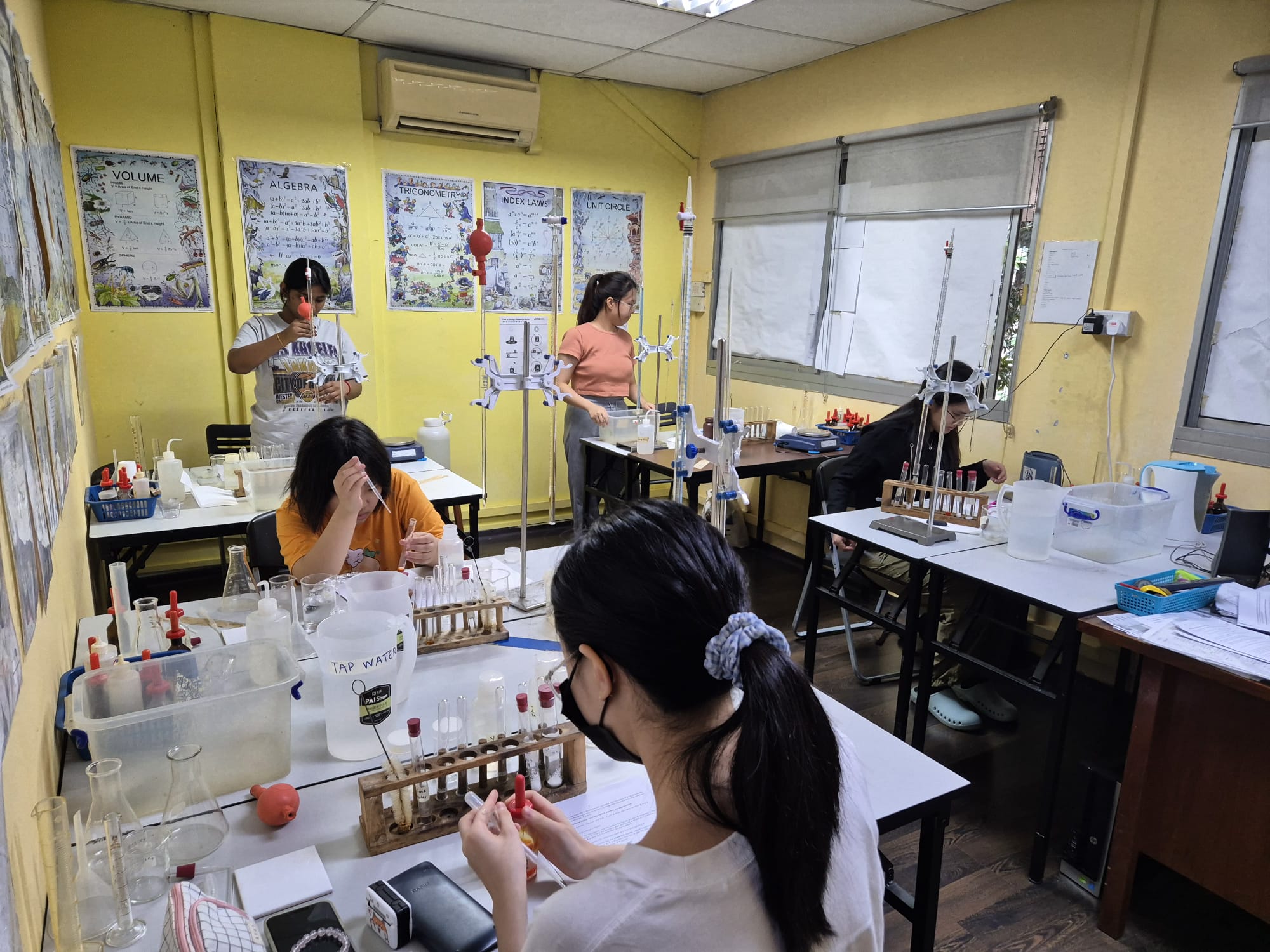
LOOKING FOR THE BEST PLACE TO DO YOUR SCIENCE PRACTICALS? JOIN US!
Singapore Learner has been a Comprehensive Science Practical Training provider since 2017.
As at 19 Apr 2026, we have trained about 1060 students for their science practical exams and we have conducted a total of about 4044 lab sessions.
Our laboratory apparatus are exam-grade and similar to those used in MOE schools and our chemicals are all NEA-approved.
We provide A-Level / H2 / IP and O-Level Physics, Chemistry, Biology and Combined Science (Physics/Chemistry/Biology) Practical Training/Crash Course/Mock Exams for both local (eg. H2, Singapore-Cambridge) and international exams (CIE, Pearson Edexcel, IGCSE).
Why Choose Us?
- Our teachers are very experienced, and we actually TEACH you good practical techniques.
- We have been a one-stop comprehensive science practical centre providing solid practical training for ALL THREE sciences and for all levels and streams since 2017.
- Our laboratory apparatus are exam-grade and similar to those used in MOE schools and our chemicals are all NEA-approved.
- We have a structured practical training programme catering to the needs of both beginners and experienced students.
- We have a small class size so that the teacher is able to observe the actions of each student more closely and demonstrate the correct practical techniques where and when necessary.
- Many private schools trust us to prepare and conduct science practical training and assessment for their students, including structured training, mock exams and even actual CIE science practical exams.