- Titration, e.g. acid-base titration (with suitable indicators such as methyl orange, screened methyl orange, and thymolphthalein). Other types of titrations may also be required, and where appropriate, sufficient working details will be given. [2025 & 2019 (thermometric), 2024, 2020 & 2014 (acid-base), 2021 & 2016 (redox-iodine), 2018 (redox-KMnO4), 2017 (acid-carbonate)]
- Speeds of reaction that may involve measuring of quantities, e.g. temperature, volume, length, mass or time measurements (2024-gas collection, 2023-Na2S2O3, 2022p, 2020, 2015)
- Experiments involving separation techniques such as simple paper chromatography, filtration and distillation (2024p-distillation)
- Salt preparation (not tested in the last 10 years)
- Gas collection, but no drying of gases (2020p)
- Thermal decomposition (2025, 2022, 2019)
- Enthalpy change (2022, 2021, 2018)
- Percentage mass (2023, 2019, 2017p, 2018p, 2014p)
- Organic chemistry (2023p)
- Qualitative inorganic analysis involving an element, a compound or a mixture, including displacement reactions and tests for oxidising and reducing agents. Candidates should be familiar with the reactions of cations, reactions of anions and tests for gases as detailed in the Notes for Qualitative Analysis. Candidates would not be required to carry out tests involving sulfur dioxide gas.
Reactions involving ions not included in the Notes for Qualitative Analysis may be tested: in such cases, candidates will not be expected to identify the ions but only to draw conclusions of a general nature.
Candidates should not attempt tests, other than those specified, on substances, except when it is appropriate to test for a gas. (tested almost every year, except for 2018) - Qualitative organic analysis requiring a knowledge of simple organic reactions as outlined in Topic 11 Organic Chemistry, e.g. test-tube reactions indicating the presence of unsaturation (C=C) may be set, but this would be for the testing of observation skills and drawing general conclusions only (not tested in the last 10 years)
So what topics are most likely to be tested THIS YEAR?
Sign up for our Revision Crash Course for O-Level Chemistry Practical, details of which can be found here: O-LEVEL PURE CHEMISTRY HANDS-ON PRACTICAL CRASH COURSE. Hurry, places are very limited as our lab can only take in 7 students max.

DO YOU KNOW THAT THE SCIENCE PRACTICAL IS WEIGHTED TO BETWEEN 15% TO 20% OF YOUR TOTAL SCIENCE EXAM MARKS?
It can actually make a 1 to 3 grade difference in your total points for your exam! And it is easier to score a Distinction for your Science exam if you are very competent in your Science Practicals.
Right now, ARE YOU CONFIDENT that you can complete your science practical exam and answer all its questions correctly in the time allocated?
If you are looking for SCIENCE PRACTICAL TRAINING, CRASH COURSE OR MOCK EXAM PRACTICE (FOR PHYSICS, CHEMISTRY, BIOLOGY), don’t hesitate to contact us at 65694897 or 88765498.
Singapore Learner has been a One-Stop Comprehensive Science Practical Training provider since 2017.
As at 19 Apr 2026, we have trained about 1060 students for their science practical exams and we have conducted a total of about 4044 lab sessions.
Our laboratory apparatus are exam-grade and similar to those used in MOE schools and our chemicals are all NEA-approved.
We provide A-Level / H2 / IP and O-Level Physics, Chemistry, Biology and Combined Science (Physics/Chemistry/Biology) Practical Training/Crash Course/Mock Exams for both local (eg. H2, Singapore-Cambridge) and international exams (CIE, Pearson Edexcel, IGCSE).
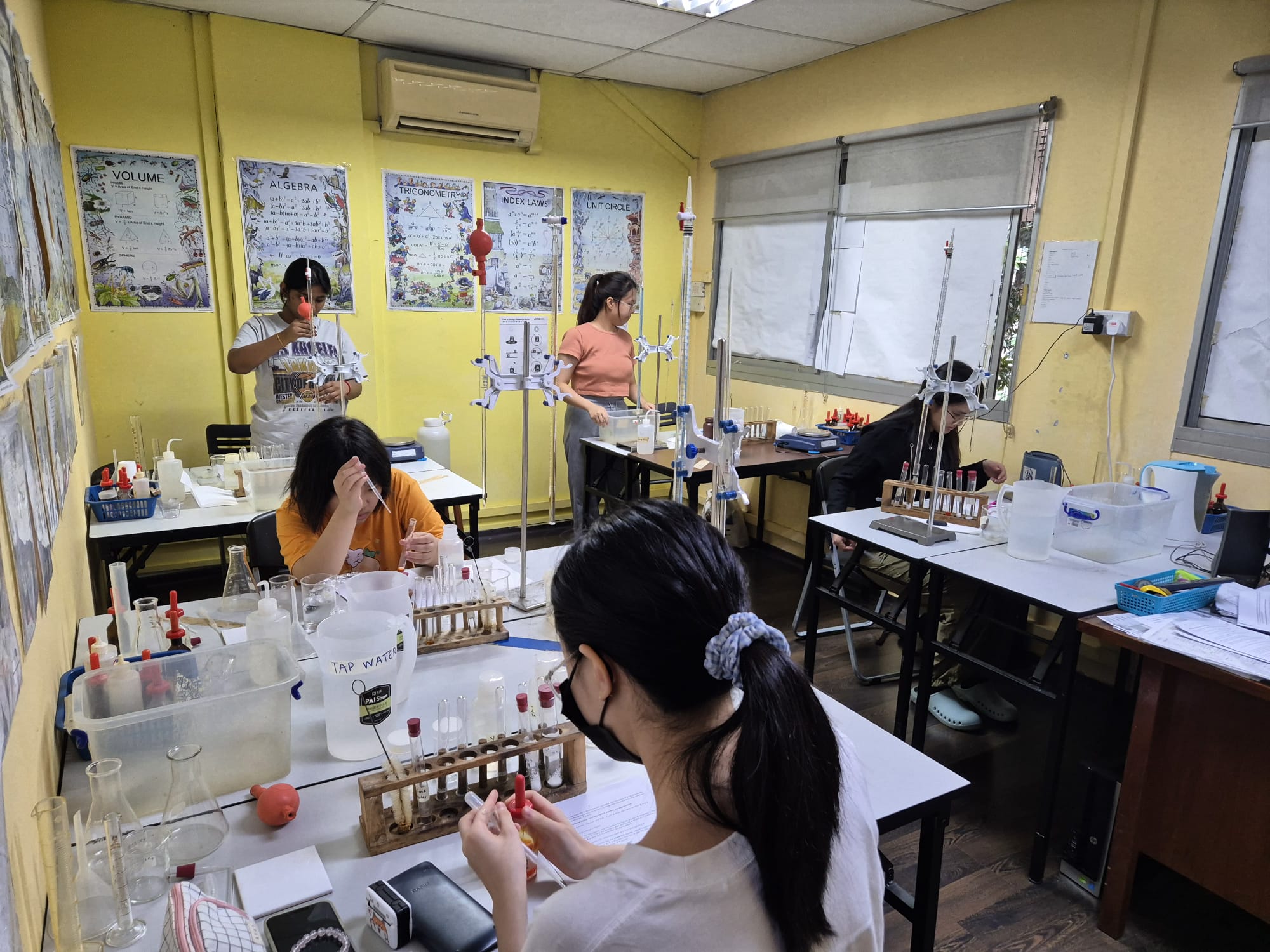
Why Choose Us?
- Our teachers are very experienced, and we actually TEACH you good practical techniques.
- We have been a one-stop comprehensive science practical centre providing solid practical training for ALL THREE sciences and for all levels and streams since 2017.
- Our laboratory apparatus are exam-grade and similar to those used in MOE schools and our chemicals are all NEA-approved.
- We have a structured practical training programme catering to the needs of both beginners and experienced students.
- We have a small class size so that the teacher is able to observe the actions of each student more closely and demonstrate the correct practical techniques where and when necessary.
- Many private schools trust us to prepare and conduct science practical training and assessment for their students, including structured training, mock exams and even actual CIE science practical exams.
For enquiries, contact 88765498 (Admin).
Our Main Practical Programmes:
A-LEVEL H2 PRACTICALS (Available Nov to Oct)
O-LEVEL PRACTICALS (Available Nov to Oct)
SEC 3 PRACTICALS (Available Nov to Jun)
PRACTICAL CRASH COURSES (Jun, July, Sep and Oct)
MOCK EXAMS FOR SCIENCE PRACTICAL (Apr to Oct)
Share this:
- Notes on Planning for O-Level Chemistry Practicals
- Notes on Planning for O-Level Physics Practicals
- Notes on Planning for O-Level Biology Practicals
- Notes on Sources of Error in O-Level Physics Practicals
- Notes on Sources of Error in O-Level Chemistry Practicals
- Notes on Sources of Error in O-Level Biology Practicals
