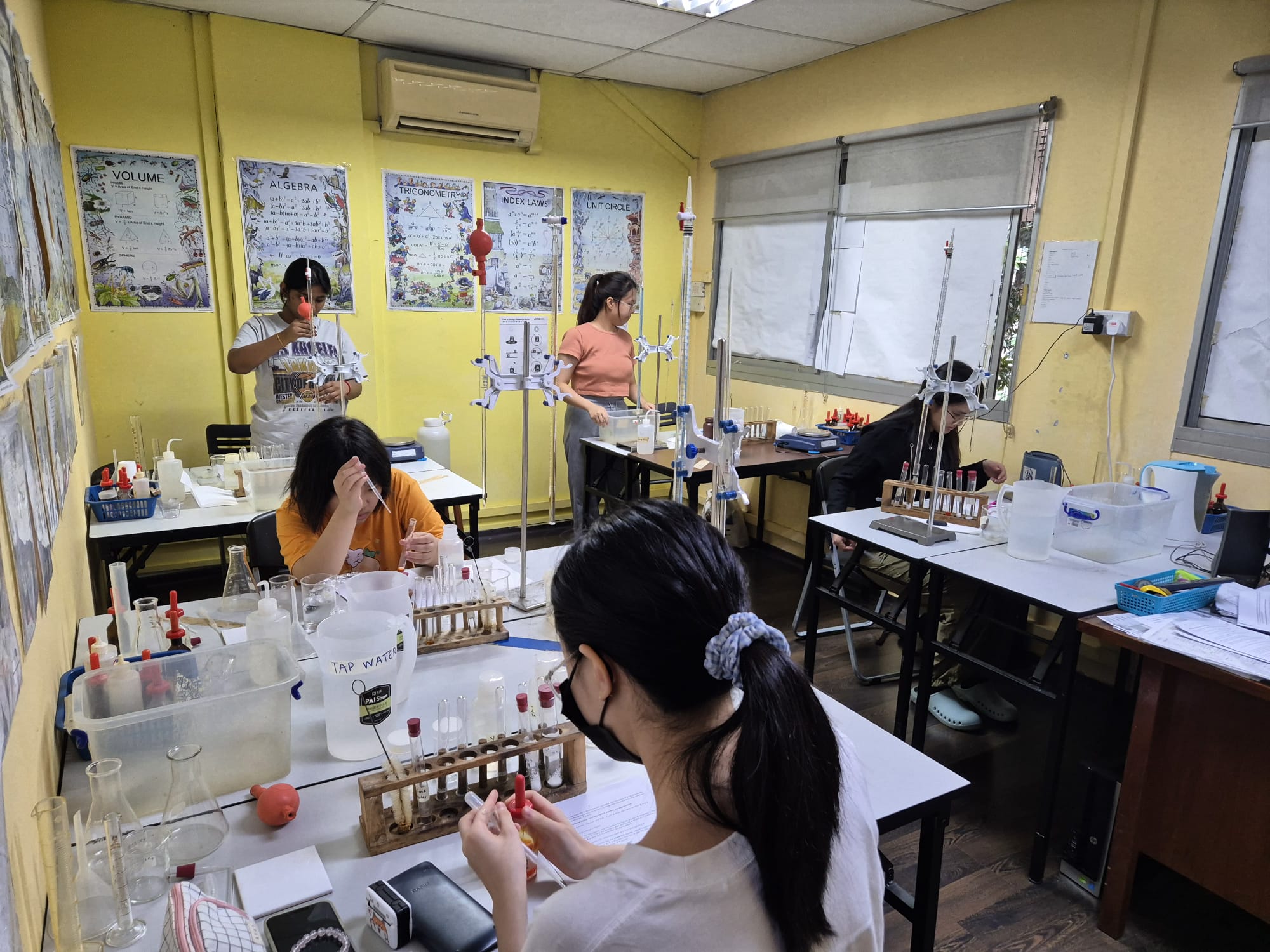
Posted in Pure Chemistry

Notes on O-Level Chemistry Titration

What is Titration?

Titration is a laboratory method to determine the concentration or volume of an acid or alkali by reacting it with a solution of known concentration.

It is based on the idea of neutralisation:

Acid + Base → Salt + Water

Example:

H₂SO₄ + 2 NaOH → Na₂SO₄ + 2 H₂O


1. Key Definitions

TermMeaning
TitrationMethod to find an unknown concentration using neutralisation
TitreVolume delivered from the burette
End-pointPoint where indicator changes colour
Concordant resultsTitres close to each other (usually within 0.10–0.20 cm³)
Standard solutionSolution with known concentration
NeutralisationAcid reacts with alkali to form salt + water

SEAB commonly expects burette readings to the nearest 0.05 cm³ and concordant titres within about 0.20 cm³


2. Apparatus and Their Functions

(a) Burette

  • Holds the solution added during titration
  • Usually 50.0 cm³
  • Used for variable volumes
  • Read to 2 decimal places
  • Precision: nearest 0.05 cm³

Important:

  • Scale goes from top to bottom
  • 0 cm³ at the top
  • 50 cm³ at the bottom

Common mistakes

❌ Reading from top incorrectly
❌ Not removing air bubbles
❌ Reading meniscus wrongly


(b) Pipette

  • Measures a fixed volume
  • Usually 25.0 cm³
  • More accurate than measuring cylinder

Important:

  • Use a pipette filler
  • Never suck by mouth

(c) Conical Flask

  • Contains solution being analysed
  • Easy to swirl without spilling

(d) White Tile

  • Helps observe colour change clearly

(e) Indicator

  • Substance that changes colour near end-point

Common indicators:

  • Methyl orange
  • Phenolphthalein

3. Indicator Colours

Methyl Orange

In AcidNeutralIn Alkali
RedOrangeYellow

Typical colour change in titration

  • Alkali → acid added:
    • Yellow → orange

Phenolphthalein

In AcidIn Alkali
ColourlessPink

Typical colour change

  • Alkali → acid added:
    • Pink → colourless

4. Choosing the Correct Indicator

For O-Level:

  • Strong acid + strong alkali:
    • Either methyl orange or phenolphthalein works

Examiner favourites

  • Methyl orange often used in school practicals
  • Phenolphthalein sometimes tested

Wide-range indicators are unsuitable because colour change is not sharp enough.


5. Step-by-Step Titration Procedure

Step 1 — Rinse apparatus

Burette

  • Rinse with distilled water
  • Then rinse with solution going inside

Pipette

  • Rinse with solution to be pipetted

Conical flask

  • Rinse with distilled water only

Step 2 — Fill burette

  • Use funnel
  • Remove funnel afterwards
  • Ensure no air bubbles
  • Record initial reading

Step 3 — Pipette solution

  • Pipette exactly 25.0 cm³
  • Transfer into conical flask

Step 4 — Add indicator

  • Add 2–3 drops only

Too much indicator causes error.


Step 5 — Perform rough titration

  • Add solution quickly while swirling
  • Stop when colour changes

Step 6 — Accurate titration

Near end-point:

  • Add solution drop by drop
  • Swirl continuously

Step 7 — Record final reading

Calculate:

Titre = Final burette reading – Initial burette reading


Step 8 — Repeat

Repeat until:

  • Two titres are concordant

Typical acceptable difference:

  • ≤ 0.10 cm³
  • Sometimes ≤ 0.20 cm³ in practical guidance 

6. How to Read the Burette Correctly

Read at eye level

To avoid:

  • Parallax error

Read bottom of meniscus

For colourless solutions:

  • Read lowest point of curve

Record to 2 decimal places

Correct:

  • 24.50 cm³
  • 18.05 cm³

Wrong:

  • 24.5
  • 18.053

7. Concordant Results

Meaning

Titres close together.

Example:

TrialTitre/cm³
124.80
224.75
324.85

Trials 2 and 3 are concordant.


Average titre

Use only concordant values.

Example:

Average titre = 24.75 + 24.852


8. Titration Calculations

This is the MOST tested section.


Step-by-Step Calculation Method

Step 1 — Write balanced equation

Example:

H₂SO₄ + 2 NaOH → Na₂SO₄ + 2 H₂O


Step 2 — Convert volume to dm³

1 dm³ = 1000 cm³

Example:

25.0 cm³ = 0.0250 dm³


Step 3 — Use mole formula

n = cV

Where:

  • n = moles
  • c = concentration
  • V = volume in dm³

Step 4 — Use mole ratio

From balanced equation.

Example:

  • 1 mol H₂SO₄ reacts with 2 mol NaOH

Step 5 — Find unknown concentration

Rearrange:

c = nv


9. Worked Example

Question

25.0 cm³ of sodium hydroxide reacted with 20.0 cm³ of 0.100 mol/dm³ sulfuric acid.

Find concentration of sodium hydroxide.


Step 1

Balanced equation:

H₂SO₄ + 2 NaOH → Na₂SO₄ + 2 H₂O


Step 2

Moles of sulfuric acid:

n = cV = 0.100 x 0.0200

= 0.00200 mol


Step 3

Use ratio:

1:2

NaOH moles:

= 0.00400 mol


Step 4

Volume of NaOH:

25.0 cm³ = 0.0250 dm³


Step 5

Concentration:

c =0.004000.0250

= 0.160 mol/dm³


10. Sources of Error

ErrorEffect
Overshooting end-pointTitre too large
Air bubble in buretteWrong titre
Parallax errorWrong reading
Not rinsing apparatus properlyDilution error
Adding too much indicatorAffects result

11. Improvements

ProblemImprovement
Difficult to see colourUse white tile
OvershootingAdd dropwise near end-point
Human judgement errorRepeat titrations
ParallaxRead at eye level

12. Practical Exam Tips

Before starting

✔ Check burette for air bubbles
✔ Remove funnel
✔ Record initial reading properly


During titration

✔ Swirl continuously
✔ Wash flask walls with distilled water
✔ Slow down near end-point


Near end-point

✔ Add one drop at a time
✔ Watch carefully for permanent colour change


13. Colour Change Tips

Methyl orange

  • Yellow → orange = end-point
  • Red means overshot

Phenolphthalein

  • Pink → colourless = end-point

14. Common Exam Questions

Describe how to carry out a titration

Must mention:

  • Pipette 25.0 cm³ into flask
  • Add indicator
  • Fill burette
  • Record readings
  • Add solution slowly with swirling
  • End-point colour change
  • Repeat for concordant results

Why use conical flask?

Allows swirling without spilling.


Why use pipette instead of measuring cylinder?

More accurate.


Why remove funnel?

Drops may enter burette and change reading.


Why wash flask sides with distilled water?

Ensures all reactants react.


15. Must-Memorise Values

ItemValue
Pipette reading1 d.p.
Burette reading2 d.p.
Burette precision0.05 cm³
Concordant titreswithin 0.10–0.20 cm³
Pipette common volume25.0 cm³
Burette common volume50.0 cm³

16. Ultimate Exam Checklist

Before practical ends:

✅ Initial and final readings recorded
✅ 2 decimal places used
✅ Concordant results obtained
✅ Average titre calculated correctly
✅ Units included
✅ Balanced equation written
✅ Mole ratio used correctly
✅ Volume converted to dm³


17. High-Yield Mistakes Students Make

❌ Forgetting to convert cm³ to dm³
❌ Using wrong mole ratio
❌ Reading top of meniscus
❌ Overshooting endpoint
❌ Averaging rough titre with accurate titres
❌ Forgetting units
❌ Recording burette reading with 1 d.p.


18. Fast Memory Summary

TITRATION FORMULA FLOW

Volume → dm³ → n = cV → mole ratio → c = nv


19. What Cambridge Examiners Look For

  • Accurate technique
  • Proper burette readings
  • Correct significant figures
  • Concordant titres
  • Proper mole calculations
  • Clear practical method

Singapore Learner has been a Comprehensive Science Practical Training provider since 2017.

Our laboratory apparatus are exam-grade and similar to those used in MOE schools and our chemicals are all NEA-approved.


Why Choose Us?

  • Our teachers are very experienced, and we actually TEACH you good practical techniques.
  • We have been a one-stop comprehensive science practical centre providing solid practical training for ALL THREE sciences and for all levels and streams since 2017.
  • Our laboratory apparatus are exam-grade and similar to those used in MOE schools and our chemicals are all NEA-approved.
  • We have a structured practical training programme catering to the needs of both beginners and experienced students.
  • We have a small class size so that the teacher is able to observe the actions of each student more closely and demonstrate the correct practical techniques where and when necessary.
  • Many private schools trust us to prepare and conduct science practical training and assessment for their students, including structured training, mock exams and even actual CIE science practical exams.

Our Main Practical Programmes:

A-LEVEL H2 PRACTICALS (Available Nov to Oct)

O-LEVEL PRACTICALS (Available Nov to Oct)

SEC 3 PRACTICALS (Available Nov to Jun)

SEC 1-2 PRACTICALS (Available Nov to Jun)

P3 – P6 PRACTICALS (Available Nov to Jun)

PRACTICAL CRASH COURSES (Jun, July, Sep and Oct)

MOCK EXAMS FOR SCIENCE PRACTICAL (Apr to Oct)

March Holiday Science Enrichment (P4 – S2)

Posted in Practical

H2 CHEMISTRY HANDS-ON PRACTICAL CRASH COURSE

Singapore Learner has been a Comprehensive Science Practical Training provider since 2017.

As at 19 Apr 2026, we have trained about 1060 students for their science practical exams and we have conducted a total of about 4044 lab sessions.

Our laboratory apparatus are exam-grade and similar to those used in MOE schools and our chemicals are all NEA-approved.


We have two kinds of crash courses: BASIC and REVISION.

BASIC CRASH COURSE – for beginners or students who have been out of touch with science practicals. Features: slower pace of teaching, more teacher demonstrations and hand-holding. Focus is on how to set up the apparatus, using instruments correctly, recording, tabling and graphing.

PREDICTIVE REVISION CRASH COURSE – for students who need a refresher course or guided extra practice for science practicals, such as retakers, government school students or graduates of our Basic Crash Course. Features:  Quick recap on how to use instruments correctly, and what examiners look for in students’ recordings, tables and graphs. More discussions on sources of error, important or predicted topics, difficult experiments and Planning (if applicable).

The two courses above consist of different experiments, thus students may attend both the Basic and Revision crash courses, followed by mock exams if needed.


Topics: Volumetric Analysis, Gravimetric Analysis, Kinetics, Qualitative Analysis (Organic & Inorganic)


Skills and Content for Volumetric Analysis: Revision on proper rinsing and usage of burette, pipette and volumetric flasks; Tabling and correct recording of data; Mole calculations; Sources of error and how these affect the final answer; Hands-on practice on a selected Titration topic. Revision on Iodimetric Titration, Redox Titration, Double-Indicator Titration and Thermometric Titration.

Skills and Content for Gravimetric AnalysisHands-on practice on a selected Gravimetric Analysis experiment.

Skills and Content for Kinetics: Revision on Order of Reaction and Rate of Reaction.

Skills and Content for QA (Organic & Inorganic): Revision on proper techniques for testing of Cations, Gases and Anions; Common mistakes in QA and how to avoid them in order to maximise your marks; Correct recording of observations and conclusions. Hands-on practice on testing of Ammonia gas, Carbon Dioxide gas, Hydrogen gas, and some common cations and anions.


Location: Singapore Learner @ Bukit Batok, Blk 644, Bukit Batok Central, #01-68. S(650644).

Booking is by full payment only. Kindly send a message to +(65) 88765498 (WHATSAPP) for payment info. Thank you.


Tel: +(65) 6569 4897,   +(65) 88765498 (WHATSAPP)

Email:  principal@singaporelearner.com

If you wish to visit us, kindly call or sms first. Thank you.


For Standard Practical Training, click here:

A-LEVEL H2 PRACTICALS

For Practical Mock Exam, click here:

MOCK EXAMS FOR SCIENCE PRACTICAL (Sep & Oct)

OTHER PRACTICAL CRASH COURSES (Mar, Jun, Sep and Oct)


Posted in Practical

O-LEVEL PURE CHEMISTRY HANDS-ON PRACTICAL CRASH COURSE

We have two kinds of crash courses: BASIC and REVISION.

BASIC CRASH COURSE – for beginners or students who have been out of touch with science practicals. Features: slower pace of teaching, more teacher demonstrations and hand-holding. Focus is on how to set up the apparatus, using instruments correctly, recording, tabling and graphing.

PREDICTIVE REVISION CRASH COURSE – for students who need a refresher course or guided extra practice for science practicals, such as retakers, government school students or graduates of our Basic Crash Course. Features:  Quick recap on how to use instruments correctly, and what examiners look for in students’ recordings, tables and graphs. More discussions on sources of error, important or predicted topics, difficult experiments and Planning (if applicable).

The two courses above consist of different experiments, thus students may attend both the Basic and Revision crash courses, followed by mock exams if needed.


Topics: Titration, Speed of Reaction, Qualitative Analysis.

Skills and Content for Titration: Proper rinsing and usage of burette, pipette and conical flasks; Good techniques to achieve end-point FAST and accurately; Tabling and correct recording of data; Mole calculations; Hands-on practice on Titration and mole calculations.

Skills and Content for Speed of Reaction: Measuring change in mass, volume or temperature over time using apparatus such as electronic balance, measuring cylinder, syringe, thermometer and stopwatch. Hands-on practice on a popular speed of reaction experiment.

Skills and Content for QA: Proper techniques for testing of Cations, Gases and Anions; Common mistakes in QA and how to avoid them in order to maximise your marks; Correct recording of observations and conclusions. Hands-on practice on a selected QA question paper.


Location: Singapore Learner @ Blk 644, Bukit Batok Central, #01-68. S(650644)

Booking is by full payment (non-refundable) only. Kindly send a message to +(65) 88765498 (WHATSAPP) for payment info. Thank you.


Singapore Learner 

Tel: +(65) 6569 4897,   +(65) 88765498 (WHATSAPP)

Email:  principal@singaporelearner.com

If you wish to visit us, kindly call or sms first. Thank you.


For Standard Practical Training, click here:

O-LEVEL PRACTICALS

For Practical Mock Exam, click here:

MOCK EXAMS FOR SCIENCE PRACTICAL (Sep & Oct)

PLEASE NOTE THIS IS AN OUTDATED POST.

FOR THE LATEST SCHEDULE, CLICK ON

H2 CHEMISTRY PRACTICAL


We provide A-Level / H2 and O-Level Physics, Chemistry, Biology and Science (Physics/Chemistry/Biology) Practical training for private / school candidates and homeschoolers, for both local (eg. H2, Singapore-Cambridge) and international exams (CIE, IGCSE). School candidates are also welcome.


NEW!

H2 CHEMISTRY HANDS-ON PRACTICAL CRASH COURSE

H2 BIOLOGY HANDS-ON PRACTICAL CRASH COURSE

H2 PHYSICS HANDS-ON PRACTICAL CRASH COURSE


MOE/SEAB SYLLABUS FOR H2 CHEMISTRY PRACTICAL

Paper 4 (Practical) is weighted to 20% of the Higher 2 assessment.

Candidates are expected to have been exposed to a range of topics and experimental techniques such as:

  1. Titration, e.g. acid-base titration (using suitable indicators such as methyl orange, screened methyl orange, thymolphthalein, and thymol blue), redox titration, iodimetric titration, indirect titration, including the preparation of standard solutions. Other types of titrations may also be required.
  2. Gravimetric analysis, e.g. volatilization gravimetry
  3. Gas collection
  4. Thermochemistry, including thermometric titration
  5. Chemical kinetics, e.g. continuous and initial rate methods
  6. Qualitative Inorganic analysis involving an element, a compound or a mixture. Systematic analysis will not be required. Candidates should be familiar with the reactions of cations, anions, and tests of gases as detailed in the Qualitative Analysis Notes. Reactions involving ions not included in the QA notes may be tested: in such cases, candidates will not be expected to identify the ions but only to draw conclusions of a general nature. Candidates should not attempt tests, other than those specified, on substances, except when it is appropriate to test for a gas.
  7. Qualitative inorganic analysis requiring a knowledge of simple organic reactions e.g. test-tube reactions indicating the presence of unsaturation ( C = C), alcoholic, phenolic, carbonyl, carboxyl and amino groups, may be tested, but this would be for the testing of observation skills and drawing general conclusions only
  8. Simple organic synthesis and purification, including use of water bath, setting up and the use of reflux and distillation apparatus


OUR STRUCTURED PRACTICAL TRAINING SYSTEM

Based on the above syllabus, we have several structured programs for you, depending on whether you are a Beginner or a Reviser.

You are at the Beginner level if you have never done any Chemistry Practical work before, or your last Chemistry Practical session was more than 2 years ago.

You are at the Reviser level if you have completed the Beginner practicals, or you are re-taking your Chemistry Practical exam, or you are a school candidate who has completed JC1/Y5.

NEW! – 5pm – 7pm time slots on Mon and Wed for students who can only come after school. For advance booking, Whatsapp Admin at 88765498  http://wa.link/w0xxk2

OUR H2 CHEMISTRY PRACTICAL SCHEDULE 2023

BASIC LABS (for Beginners only):

Lab HC1: TITRATION BASICS, MOLE CALCULATIONS + PLANNING (PERCENTAGE MASS) (TOPICAL TRAINING, LEVEL: BEGINNER) (Available sessions: 30/11 (10:30-1pm), 9/1 (2-4:30pm), 11/1 (2-4:30pm), 12/1 (2-4:30pm), 13/1 (10:30-1pm), 14/1 (2-4:30pm))

Lab HC2:   QA BASICS: TESTING OF GASES AND ANIONS (TOPICAL TRAINING, LEVEL: BEGINNER) (Available sessions: 7/12 (10:30-1pm), 30/1 (2-4:30pm), 1/2 (2-4:30pm), 2/2 (2-4:30pm), 3/2 (10:30-1pm), 4/2 (2-4:30pm))

Lab HC2A:   QA BASICS: TESTING OF CATIONS AND UNKNOWN SALTS  (TOPICAL TRAINING, LEVEL: BEGINNER) (Available sessions: 7/12 (2-4:30pm), 20/2 (2-4:30pm), 22/2 (2-4:30pm), 23/2 (2-4:30pm), 24/2 (10:30-1pm), 25/2 (2-4:30pm))

Lab HC3: GRAVIMETRIC ANALYSIS 3 + KINETICS 3(TOPICAL TRAINING, LEVEL: BEGINNER)(Available sessions: 12/3 (2-4:30pm), 14/3 (2-4:30pm), 15/3 (2-4:30pm), 16/3 (10:30-1pm), 17/3 (2-4:30pm))

Note: The above 4 labs are BASIC TRAINING LABS which are available throughout the year, every week every month, as they are compulsory for all beginners. Thus if the date you can attend is not listed above, please message our Admin at 88765498 for a new schedule.


STANDARD LABS (for Retakers and current govt school students):

Lab HC4: ACID-CARBONATE TITRATION 4+ THERMOMETRIC TITRATION 4 INVOLVING COMPLEX IONS  + QA4 (ORGANIC & INORGANIC) (PARTIAL EXAM PAPER TRAINING, LEVEL: REVISER) Available sessions: 9/4 (2-4:30pm), 11/4 (2-4:30pm), 12/4 (2-4:30pm), 13/4 (10:30-1pm), 14/4 (2-4:30pm))

Lab HC5: IODIMETRIC TITRATION 5 + SOLUBILITY PRODUCT + ENTHALPY 5 + QUALITATIVE ANALYSIS 5 (PARTIAL EXAM PAPER TRAINING, LEVEL: REVISER) Available sessions: 30/4 (2-4:30pm), 2/5 (2-4:30pm), 3/5 (2-4:30pm), 4/5 (10:30-1pm), 5/5 (2-4:30pm))

Lab HC6: THERMOMETRIC TITRATION 6 + GRAVIMETRIC ANALYSIS 6 + KINETICS 6+ QA 6  (PARTIAL EXAM PAPER TRAINING, LEVEL: REVISER) (Available sessions: 21/5 (2-4:30pm), 23/5 (2-4:30pm), 24/5 (2-4:30pm), 25/5 (10:30-1pm), 26/5 (2-4:30pm))

Lab HC7: REDOX TITRATION 7 + ENTHALPY CHANGE 7 + QA 7 + TRANSITION METALS 7 (EXAMPAPER TRAINING, LEVEL: REVISER)(Available session : 11/6 (2-4:30pm), 13/6 (2-4:30pm), 14/6 (2-4:30pm), 15/6 (10:30-1pm), 16/6 (2-4:30pm))

Lab HC8: ACID-BASE  + REDOX 8 TITRATION + ENTHALPY CHANGE 8 + QA 8 + TRANSITION METALS 8 (EXAM PAPER TRAINING, LEVEL: REVISER) (Available sessions: 2/7 (2-4:30pm), 4/7 (2-4:30pm), 5/7 (2-4:30pm), 6/7 (10:30-1pm), 7/7 (2-4:30pm))

Lab HC9: REDOX TITRATION 9 (WITH PRE-HEATING)  + PLANNING 9  + ENTHALPY CHANGE 9 + QA 9  (EXAM PAPER TRAINING, LEVEL: REVISER) (Available sessions: 23/7 (2-4:30pm), 25/7 (2-4:30pm), 26/7 (2-4:30pm), 27/7 (10:30-1pm), 28/7 (2-4:30pm))

Lab HC10: INDIRECT TITRATION 10 + GRAVIMETRIC ANALYSIS 10 + QA 10 (EXAM PAPER TRAINING, LEVEL: REVISER) (Available sessions: 13/8 (2-4:30pm), 15/8 (2-4:30pm), 16/8 (2-4:30pm), 17/8 (10:30-1pm), 18/8 (2-4:30pm))

Lab HC11: THERMOMETRIC  TITRATION 11 + ENTHALPY 11 + REDOX TITRATION 11 + WATER OF CRYSTALLIZATION + QA 11 (Available sessions: 3/9 (2-4:30pm), 5/9 (2-4:30pm), 6/9 (2-4:30pm), 7/9 (10:30-1pm), 8/9 (2-4:30pm))

Lab HC12REDOX TITRATION 12 + ENTHALPY 12 + QA12 + PLANNING 12 (THERMOMETRIC TITRATION) (Available sessions: 24/9 (2-4:30pm), 26/9 (2-4:30pm), 27/9 (2-4:30pm), 28/9 (10:30-1pm), 29/9 (2-4:30pm))

Lab HC13IODIMETRIC TITRATION 13 + ENTHALPY CHANGE OF DECOMPOSITION 13 + QA13 (incl ORGANIC) + PLANNING 13 (Available sessions: 15/10 (2-4:30pm), 17/10 (2-4:30pm), 18/10 (2-4:30pm), 19/10 (10:30-1pm), 20/10 (2-4:30pm))

MOCK EXAMS FOR SCIENCE PRACTICAL

H2 CHEMISTRY HANDS-ON PRACTICAL CRASH COURSE

H2 BIOLOGY HANDS-ON PRACTICAL CRASH COURSE

H2 PHYSICS HANDS-ON PRACTICAL CRASH COURSE


PAST TOPICS OF H2 CHEMISTRY PRACTICAL:

2022: QA (Cr3+, Cu2+, Hydrogen), Thermometric Titration (intersecting graphs), Acid-Base Titration, Planning involving Y=mX + c.


What you will get at each practical session:

(1) Teaching and instruction on how to use the various scientific tools and instruments.

(2) Tips on how to answer a practical worksheet or exam paper, including recording of observations, drawing graphs, writing conclusions, describing precautions and planning a practical.

(3) Notes on important aspects of science practicals.

We will also conduct Mock Practical Exams in September and October


HOW TO BOOK A LAB SESSION:

(1) Decide which Program or Lab sessions you need or most suitable for.

(2) Whatsapp or Message our staff at 88765498 with your Name, Private or School Candidate, A or O level, Subject or Lab Name (e.g Lab PP2), Date and Time of Lab. (Our staff will then guide you on how to register and make payment. If you are not sure about the lab sessions, just state your Name and the Subjects and we will get back to you)

(3) Register Online by clicking below:

(4) Pay Registration fee of $30 via Paynow or funds transfer.

(5) Make the required payment for each lab session at least 5 days before the date of the lab session. (You may also pay for several sessions at one go to ensure that you will have a place in future slots)


FEES PER SESSION

Practical Training Session: $320

Mock Exam:- $380

Note: Above fees are subject to changes without prior notice.

IMPORTANT: The full fee must be paid at least 5 days before the practical session to confirm your attendance as a lot of preparation is needed for practicals coupled with very limited class size. PLEASE NOTE IF YOU ARE ABSENT FOR A LAB SESSION, A PENALTY OF $50 MUST BE PAID TO POSTPONE THIS LAB TO ANOTHER SESSION, AND ONLY 1 POSTPONEMENT IS ALLOWED FOR EACH LAB, ELSE THE LAB IS CONSIDERED COMPLETED AND PAID FOR, AND NO REFUND WILL BE GIVEN. THE FEE FOR THE MISSED LAB CANNOT BE USED FOR ANOTHER LAB.


Singapore Learner @ Bukit Batok

Blk 644, Bukit Batok Central, #01-68. S(650644)


Tel: +(65) 6569 4897,   +(65) 88765498 (WHATAPPS) http://wa.link/w0xxk2

Email:  principal@singaporelearner.com

If you wish to visit us, kindly call or sms first. Thank you.


H2 CHEMISTRY PRACTICAL