All Posts

Posted in Practical

Notes on Sources of Error in O-Level Chemistry Practicals

1. Answering a Source-of-Error Question

Give the one or two factors inherent to the procedure, not a general list.

Every answer has three parts: (i) the specific step and the physical or chemical reason the recorded quantity deviates from the true value; (ii) the quantity affected, stated as too high, too low, or inconsistent; (iii) a concrete precaution.

State the effect on the quantity actually recorded — a mass, a volume, a temperature, a time — not on the underlying chemistry itself. “The reaction is faster” is not an answer; “the time recorded is shorter than expected” is.

Rejected as “too general” unless further justified for the exact procedure:

  • Parallax error, without stating which scale and why it cannot be avoided here.
  • “Human error” or “random error”, without a stated cause.
  • Zero error — correctable by taring or calibration, not a genuine source of error.
  • “Apparatus not accurate enough”, without naming the reading it limits.
  • Anything solved by “being more careful” or “repeating the reading” — repetition addresses random error only, and most examined sources here are systematic.

1.1 Random and Systematic Error

Source of ErrorEffect on the Reading / ResultPrecaution / Improvement
Random errorScatter in either direction from the limit of instrument resolution or from inexact repetition — e.g. titre volumes of 24.50, 24.15, 24.40 cm³ for repeats of the same titration.Repeat until two titres agree within 0.10 cm³ (concordant results) and average these; take repeated mass or temperature readings where practicable.
Systematic errorA constant bias in one direction throughout the experiment, from a fault in method or apparatus — e.g. heat loss to the surroundings in every run, or an indicator that changes colour before the true end-point.Not reduced by repetition. Identify the fault and correct the method (insulate, change indicator, use a control) or apply a calculated correction (e.g. a cooling correction).

1.2 Precision of Common Apparatus

ApparatusPrecision (Uncertainty)How to Read / Use Correctly
Burette± 0.05 cm³ (read to 2 d.p.)Read the bottom of the meniscus at eye level for colourless solutions; for deeply coloured solutions (e.g. potassium manganate(VII)), read the top of the meniscus instead.
Pipette (25.0 cm³ / 20.0 cm³)Fixed volume, delivered “to deliver”Allow to drain fully; touch the tip against the vessel wall; do not blow out the last drop unless the pipette is marked to do so.
Measuring cylinder± 0.5 cm³ (10–100 cm³ sizes)Read at eye level to the bottom of the meniscus; select the smallest cylinder that holds the required volume.
Thermometer (liquid-in-glass)± 0.5 °CRead at eye level; keep the bulb fully immersed and clear of the container wall; allow time to reach a steady reading.
Digital stopwatch± 0.01 s (device); human reaction time ≈ 0.2–0.3 s dominatesStart and stop at a clearly defined visual or colour-change cue; where the cue is subjective, use the same observer for all repeats.
Electronic (top-pan) balance± 0.01 gTare before every measurement; close balance doors/draught shields if fitted; avoid draughts from open windows or fans.
Gas syringe± 0.5 cm³, with plunger friction as an added source of lagCheck the plunger moves freely before use; keep the syringe horizontal to avoid its own weight affecting the plunger.

2. Volumetric Analysis (Titration)

MₐVₐ / MᵦVᵦ = x / y, from the mole ratio xA + yB → C + D; used to find an unknown concentration.

Source of ErrorEffect on the Reading / ResultPrecaution / Improvement
Indicator chosen does not change colour sharply at the equivalence point of this acid–base pair (e.g. phenolphthalein used with a weak base–strong acid pair).The volume of titrant recorded is too high or too low, giving a concentration that is too low or too high.Choose an indicator whose colour-change range brackets the equivalence pH of this specific reaction; where the change is still not sharp, verify the end-point with a pH meter or data logger.
Too many drops of indicator added.Excess indicator itself reacts with a small amount of titrant, so a larger volume of titrant is recorded than actually required by the analyte.Add only 2–3 drops of indicator.
The titrant is a coloured solution (e.g. potassium manganate(VII)), so the meniscus is difficult to locate against the burette scale.The initial or final burette reading is misjudged, giving an inaccurate titre.Read the level at the top of the meniscus instead of the bottom, and take the reading against a white card held behind the burette.
An air bubble is trapped in the burette tip below the tap at the start of titration.The bubble later escapes during titration and is counted as if it were titrant delivered, so the titre recorded is too high.Run liquid through the tip before the initial reading to expel any air bubble, and check the tip is full before recording the initial volume.
The pipette, burette, or conical flask was rinsed with water only, and retains residual water that dilutes the solution added.The concentration of the solution actually delivered is lower than intended, and calculated concentrations are inconsistent.Rinse the pipette and burette with the solution they are about to hold (not water alone); the conical flask may be rinsed with water only, since the amount of analyte placed in it is unaffected by dilution.
The overshoot past the true end-point (one drop too many) is a fixed volume that is a larger fraction of a small titre than of a large one.Percentage error in the titre is largest for reactions requiring a small volume of titrant.Where possible, choose concentrations of analyte and titrant that require titre volumes in the region of 20–30 cm³, so a one-drop overshoot is a small percentage of the total.

The full set of notes, which includes sections such as Sources of Error by Practical Topic is available in hard copy for students who sign up for any of our regular practical lessons, Crash Courses or Mock Exams.


LOOKING FOR THE BEST PLACE TO DO YOUR SCIENCE PRACTICALS? JOIN US!

Singapore Learner has been a Comprehensive Science Practical Training provider since 2017.

As at 19 Apr 2026, we have trained about 1060 students for their science practical exams and we have conducted a total of about 4044 lab sessions.

Our laboratory apparatus are exam-grade and similar to those used in MOE schools and our chemicals are all NEA-approved.

We provide A-Level / H2 / IP and O-Level Physics, Chemistry, Biology and Combined Science (Physics/Chemistry/Biology) Practical Training/Crash Course/Mock Exams for both local (eg. H2, Singapore-Cambridge) and international exams (CIE, Pearson Edexcel, IGCSE).
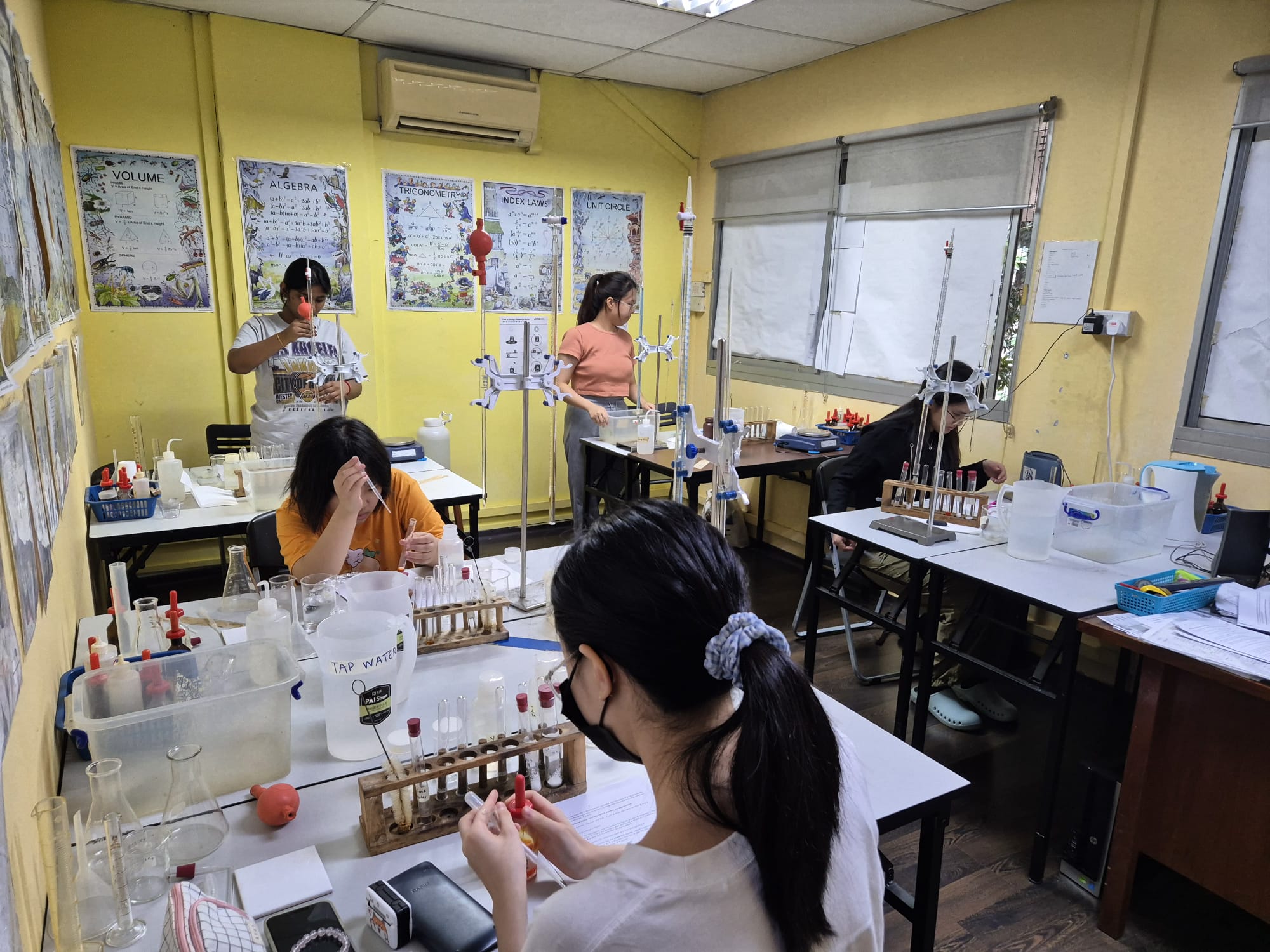

Why Choose Us?


Our Main Practical Programmes:

A-LEVEL H2 PRACTICALS (Available Nov to Oct)

O-LEVEL PRACTICALS (Available Nov to Oct)

SEC 3 PRACTICALS (Available Nov to Jun)

PRACTICAL CRASH COURSES (Jun, July, Sep and Oct)

MOCK EXAMS FOR SCIENCE PRACTICAL (Apr to Oct)


Topics Tested in Past O-Level Physics Paper 3 Practical Exam

Topics Tested in Past O-Level Chemistry Paper 3 Practical Exam

Topics Tested in Past O-Level Biology Paper 3 Practical Exam

Posted in EDUCATIONAL ADVICE

Notes on Sources of Error in O-Level Biology Practicals

Analysis, Conclusions and Evaluation (ACE) makes up 35% of the marks for Paper 3 — the single largest skill category, more than Planning, and equal in weight to Manipulation and Presentation combined with room to spare.

A large share of ACE marks comes from questions asking candidates to identify a source of error and suggest an improvement. Examiners consistently reward answers that are specific and causal, never generic.

These notes gather the sources of error that recur across the common O-Level Biology practicals, organised by topic, together with a working method for constructing full-mark answers.

1. How to Answer “Source of Error” Questions

1.1 The Three-Part Answer

Every full-mark answer to this question type has three linked parts. Omitting any one part usually costs a mark, even when the other two are correct.

  • Identify the source precisely — name the specific step, material or instrument involved, not a vague category. Write “the potato discs were cut by hand and so varied slightly in thickness”, not “human error”.
  • Explain the effect, with direction — state whether the recorded result becomes higher or lower than the true value, and explain why using the relevant biological or physical principle.
  • State a specific improvement — a concrete change to equipment or technique that removes or reduces the source of error. “Repeat and take an average” only earns credit for random error; it does not correct a systematic error.

1.2 Random Error versus Systematic Error

Distinguishing these two is essential, because they call for different types of improvement.

Source of ErrorEffect on ResultHow to Overcome / Improve
Random errorUnpredictable variation that can push a result higher or lower on different trials, e.g. biological variation between specimens, reaction time in starting/stopping a stopwatch, or judging a colour end-point by eye.Repeat the experiment / increase the sample size and calculate a mean. Circle and discard clear anomalies, then repeat those particular trials.
Systematic errorA consistent bias in one direction caused by a flaw in technique or apparatus, e.g. a wrongly calibrated balance, evaporation from an uncovered vessel, or heat from a lamp affecting what is meant to be a “light-only” variable.Change the technique or apparatus responsible for the bias. Repeating the experiment will not remove it, since every repeat is affected in the same way.

1.3 Key Terms Examiners Expect

Source of ErrorEffect on ResultHow to Overcome / Improve
AccuracyHow close a measured value is to the true value.Use a more precise instrument or a better technique (e.g. a burette instead of a measuring cylinder).
PrecisionHow close repeated measurements are to one another, regardless of whether they are accurate.Standardise the technique so that every repeat is measured in exactly the same way.
ReliabilityWhether an experiment gives consistent results when repeated.Increase the number of repeats or trials.
ValidityWhether the experiment truly tests what it claims to — only the independent variable should change, with all other variables controlled.Identify and control any variable that was allowed to change unintentionally.
Anomalous resultA result that clearly does not fit the trend shown by the rest of the data set.Circle it on the graph, label it ‘anomalous result’, exclude it from the line of best fit and from any mean, and repeat that trial if time allows.

The full set of notes, which includes sections such as Sources of Error by Practical Topic is available in hard copy for students who sign up for any of our regular practical lessons, Crash Courses or Mock Exams.


LOOKING FOR THE BEST PLACE TO DO YOUR SCIENCE PRACTICALS? JOIN US!

Singapore Learner has been a Comprehensive Science Practical Training provider since 2017.

As at 19 Apr 2026, we have trained about 1060 students for their science practical exams and we have conducted a total of about 4044 lab sessions.

Our laboratory apparatus are exam-grade and similar to those used in MOE schools and our chemicals are all NEA-approved.

We provide A-Level / H2 / IP and O-Level Physics, Chemistry, Biology and Combined Science (Physics/Chemistry/Biology) Practical Training/Crash Course/Mock Exams for both local (eg. H2, Singapore-Cambridge) and international exams (CIE, Pearson Edexcel, IGCSE).


Why Choose Us?

  • Our teachers are very experienced, and we actually TEACH you good practical techniques.
  • We have been a one-stop comprehensive science practical centre providing solid practical training for ALL THREE sciences and for all levels and streams since 2017.
  • Our laboratory apparatus are exam-grade and similar to those used in MOE schools and our chemicals are all NEA-approved.
  • We have a structured practical training programme catering to the needs of both beginners and experienced students.
  • We have a small class size so that the teacher is able to observe the actions of each student more closely and demonstrate the correct practical techniques where and when necessary.
  • Many private schools trust us to prepare and conduct science practical training and assessment for their students, including structured training, mock exams and even actual CIE science practical exams.

For enquiries, contact 88765498 (Admin).


Our Main Practical Programmes:

A-LEVEL H2 PRACTICALS (Available Nov to Oct)

O-LEVEL PRACTICALS (Available Nov to Oct)

SEC 3 PRACTICALS (Available Nov to Jun)

PRACTICAL CRASH COURSES (Jun, July, Sep and Oct)

MOCK EXAMS FOR SCIENCE PRACTICAL (Apr to Oct)

Posted in Career Opportunities

Job Opportunity

Job Vacancies:

1. Part-time/Full-time Lab Executive/Assistant

Job Scope: Prepare chemicals, substances, specimens, apparatus and worksheets for Biology, Chemistry and Physics experiments (you will receive training if you lack experience or qualification); Clean and store apparatus after experiments; Stock-taking and procurement of lab supplies; General lab maintenance; Support Science Teachers in the conduct of experiments.

Specific Requirements:

Preferably you have an A-level cert in Biology, Chemistry or Physics, or a Diploma in Life Sciences or a Biology-related field, or a Diploma in Chemical Engineering or a Chemistry-related field, or a Diploma in Mechanical Engineering or a Engineering-related field.

General Requirements:

  1. You must be a Singapore Citizen / PR.
  2. You must be able to work on either Sat or Sun or both.
  3. You must be able to work on some weekdays.

2. Part-time/Full-time Assistant Science Teachers

We are currently looking for part-time Assistant Teachers for our Science Practicals.

Specific Requirements:

For Biology, you must have at least an A-level cert in Biology or a Diploma in Life Sciences or a Biology-related field. Undergrads majoring in Biology, Life Sciences or Medicine are welcome.

For Chemistry, you must have at least an A-level cert in Chemistry or a Diploma in Chemical Engineering or a Chemistry-related field. Undergrads majoring in Chemistry or Chemical Engineering are welcome.

For Physics, you must have at least an A-level cert in Physics or a Diploma in Mechanical Engineering or a Engineering-related field. Undergrads majoring in Physics or Engineering are welcome.

General Requirements:

  1. You must be a Singapore Citizen / PR.
  2. You must be available on either Sat or Sun or both.
  3. You must enjoy teaching and guiding young people.

We are at Blk 644 Bukit Batok Central, is very near the Bukit Batok bus interchange as well as the Bukit Batok MRT station.

If interested, please send your resume/CV to singaporelearner@gmail.com

Posted in EDUCATIONAL ADVICE

INTERNSHIP

If you are interested in gaining work experience in any or some of these areas – educational materials, teaching (science practicals), science lab preparation and upkeeping, administration or marketing, you may apply to be a paid intern in our company.

We are open for internship from March to October.

For enquiries, please send an email to singaporelearner@gmail.com.

Posted in Practical

Topics Tested in Past O-Level Physics Paper 3 Practical Exam

  1. measurements of length, time interval, temperature, volume, mass and weight, current and voltage using appropriate instruments (2025, 2022, 2021, 2015)
  2. determination of the density of a liquid, or of a regularly or irregularly shaped solid which sinks in water (not tested in the last 10 years)
  3. determination of the value of the acceleration of free fall (not tested in the last 10 years outside of pendulum experiments)
  4. investigation of the effects of balanced and unbalanced forces (2022)
  5. dynamics (2019, 2017)
  6. extension of spring (2024, 2023p, 2020, 2018, 2016+p, 2014)
  7. mechanical oscillations  (2025+p, 2024, 2023, 2019+p, 2018+p)
  8. the principle of moments (2015, 2014+p)
  9. determination of the position of the centre of gravity of a plane lamina (not tested in the last 10 years)
  10. mechanical energy and power (2020+p)
  11. investigation of the factors affecting thermal energy transfer (not tested in the last 10 years)
  12. determination of heat capacities of materials (2021)
  13. latent heat of substances (not tested in the last 10 years)
  14. the law of reflection (not tested in the last 10 years)
  15. determination of the position and characteristics of an optical image formed by a plane mirror or a thin converging lens (not tested in the last 10 years)
  16. the refraction of light through glass blocks (2021+p)
  17. the principle of total internal reflection (not tested in the last 10 years)
  18. the focal length of lenses (2023, 2016)
  19. determination of the speed, wavelength and frequency of waves (not tested in the last 10 years)
  20. DC circuits (2021, 2020, 2019 (LDR), 2017 (LED)+p, 2015)
  21. potentiometer (2023, 2022, 2018, 2014)
  22. determination of the resistance of a circuit element using appropriate instruments (2025)
  23. investigation of the magnetic effect of current in a conductor (2024+p)
  24. investigation of the effects of electromagnetic induction (not tested in the last 10 years)

So what topics are most likely to be tested THIS YEAR?

Right now, ARE YOU CONFIDENT that you can complete your science practical exam and answer all its questions correctly in the time allocated?


Singapore Learner has been a One-Stop Comprehensive Science Practical Training provider since 2017.


We provide A-Level / H2 / IP and O-Level Physics, Chemistry, Biology and Combined Science (Physics/Chemistry/Biology) Practical Training/Crash Course/Mock Exams for both local (eg. H2, Singapore-Cambridge) and international exams (CIE, Pearson Edexcel, IGCSE).


Why Choose Us?

  • Our teachers are very experienced, and we actually TEACH you good practical techniques.
  • We have been a one-stop comprehensive science practical centre providing solid practical training for ALL THREE sciences and for all levels and streams since 2017.
  • Our laboratory apparatus are exam-grade and similar to those used in MOE schools and our chemicals are all NEA-approved.
  • We have a structured practical training programme catering to the needs of both beginners and experienced students.
  • We have a small class size so that the teacher is able to observe the actions of each student more closely and demonstrate the correct practical techniques where and when necessary.
  • Many private schools trust us to prepare and conduct science practical training and assessment for their students, including structured training, mock exams and even actual CIE science practical exams.

Our Main Practical Programmes:

A-LEVEL H2 PRACTICALS (Available Nov to Oct)

O-LEVEL PRACTICALS (Available Nov to Oct)

SEC 3 PRACTICALS (Available Nov to Jun)

PRACTICAL CRASH COURSES (Jun, July, Sep and Oct)

MOCK EXAMS FOR SCIENCE PRACTICAL (Apr to Oct)


Posted in Practical

Topics Tested in Past O-Level Chemistry Paper 3 Practical Exam

  1. Titration, e.g. acid-base titration (with suitable indicators such as methyl orange, screened methyl orange, and thymolphthalein). Other types of titrations may also be required, and where appropriate, sufficient working details will be given. [2025 & 2019 (thermometric), 2024, 2020 & 2014 (acid-base), 2021 & 2016 (redox-iodine), 2018 (redox-KMnO4), 2017 (acid-carbonate)]
  2. Speeds of reaction that may involve measuring of quantities, e.g. temperature, volume, length, mass or time measurements (2024-gas collection, 2023-Na2S2O3, 2022p, 2020, 2015)
  3. Experiments involving separation techniques such as simple paper chromatography, filtration and distillation (2024p-distillation)
  4. Salt preparation (not tested in the last 10 years)
  5. Gas collection, but no drying of gases (2020p)
  6. Thermal decomposition (2025, 2022, 2019)
  7. Enthalpy change (2022, 2021, 2018)
  8. Percentage mass (2023, 2019, 2017p, 2018p, 2014p)
  9. Organic chemistry (2023p)
  10. Qualitative inorganic analysis involving an element, a compound or a mixture, including displacement reactions and tests for oxidising and reducing agents. Candidates should be familiar with the reactions of cations, reactions of anions and tests for gases as detailed in the Notes for Qualitative Analysis. Candidates would not be required to carry out tests involving sulfur dioxide gas.
    Reactions involving ions not included in the Notes for Qualitative Analysis may be tested: in such cases, candidates will not be expected to identify the ions but only to draw conclusions of a general nature.
    Candidates should not attempt tests, other than those specified, on substances, except when it is appropriate to test for a gas. (tested almost every year, except for 2018)
  11. Qualitative organic analysis requiring a knowledge of simple organic reactions as outlined in Topic 11 Organic Chemistry, e.g. test-tube reactions indicating the presence of unsaturation (C=C) may be set, but this would be for the testing of observation skills and drawing general conclusions only (not tested in the last 10 years)

So what topics are most likely to be tested THIS YEAR?

Right now, ARE YOU CONFIDENT that you can complete your science practical exam and answer all its questions correctly in the time allocated?

If you are looking for SCIENCE PRACTICAL TRAINING, CRASH COURSE OR MOCK EXAM PRACTICE (FOR PHYSICS, CHEMISTRY, BIOLOGY), don’t hesitate to contact us at 65694897 or 88765498.


Singapore Learner has been a One-Stop Comprehensive Science Practical Training provider since 2017.


We provide A-Level / H2 / IP and O-Level Physics, Chemistry, Biology and Combined Science (Physics/Chemistry/Biology) Practical Training/Crash Course/Mock Exams for both local (eg. H2, Singapore-Cambridge) and international exams (CIE, Pearson Edexcel, IGCSE).


Why Choose Us?

  • Our teachers are very experienced, and we actually TEACH you good practical techniques.
  • We have been a one-stop comprehensive science practical centre providing solid practical training for ALL THREE sciences and for all levels and streams since 2017.
  • Our laboratory apparatus are exam-grade and similar to those used in MOE schools and our chemicals are all NEA-approved.
  • We have a structured practical training programme catering to the needs of both beginners and experienced students.
  • We have a small class size so that the teacher is able to observe the actions of each student more closely and demonstrate the correct practical techniques where and when necessary.
  • Many private schools trust us to prepare and conduct science practical training and assessment for their students, including structured training, mock exams and even actual CIE science practical exams.

Our Main Practical Programmes:

A-LEVEL H2 PRACTICALS (Available Nov to Oct)

O-LEVEL PRACTICALS (Available Nov to Oct)

SEC 3 PRACTICALS (Available Nov to Jun)

PRACTICAL CRASH COURSES (Jun, July, Sep and Oct)

MOCK EXAMS FOR SCIENCE PRACTICAL (Apr to Oct)

Share this:

Posted in EDUCATIONAL ADVICE

Topics Tested in Past O-Level Biology Paper 3 Practical Exam

  1. Cell Structure and Organisation: 2025
  2. Movement of Substances: 2024 (Osmosis), 2021 (Diffusion), 2020 (Diffusion in Planning question), 2019 (Osmosis/Plasmolysis), 2015 (Osmosis)
  3. Biological Molecules: 2025 (Enzymes), 2022 (Enzymes), 2020 (Benedict’s test), 2017 (Starch test), 2016 (Enzymes), 2014 (Biuret’s test)
  4. Nutrition in Humans: 2023
  5. Transport in Humans: 2017
  6. Respiration in Humans: 2023 (Yeast), 2018 (Yeast)
  7. Excretion in Humans: not tested yet
  8. Homeostasis, Co-ordination and Response in
    Humans: 2016 (Human eye)
  9. Infectious Diseases in Humans: not tested yet
  10. Nutrition and Transport in Flowering Plants: 2024, 2019, 2018, 2015
  11. Organisms and their Environment: not tested yet
  12. Molecular Genetics: not tested yet
  13. Reproduction: 2022 (Sperm cells), 2021 (Cell division), 2020 (Plants)
  14. Inheritance: 2022

So what topics are most likely to be tested THIS YEAR?

Biology Practical

Right now, ARE YOU CONFIDENT that you can complete your science practical exam and answer all its questions correctly in the time allocated?


Notes on Sources of Error in O-Level Biology Practicals


We provide A-Level / H2 / IP and O-Level Physics, Chemistry, Biology and Combined Science (Physics/Chemistry/Biology) Practical Training/Crash Course/Mock Exams for both local (eg. H2, Singapore-Cambridge) and international exams (CIE, Pearson Edexcel, IGCSE).


Why Choose Us?

  • Our teachers are very experienced, and we actually TEACH you good practical techniques.
  • We have been a one-stop comprehensive science practical centre providing solid practical training for ALL THREE sciences and for all levels and streams since 2017.
  • Our laboratory apparatus are exam-grade and similar to those used in MOE schools and our chemicals are all NEA-approved.
  • We have a structured practical training programme catering to the needs of both beginners and experienced students.
  • We have a small class size so that the teacher is able to observe the actions of each student more closely and demonstrate the correct practical techniques where and when necessary.
  • Many private schools trust us to prepare and conduct science practical training and assessment for their students, including structured training, mock exams and even actual CIE science practical exams.

Our Main Practical Programmes:

A-LEVEL H2 PRACTICALS (Available Nov to Oct)

O-LEVEL PRACTICALS (Available Nov to Oct)

SEC 3 PRACTICALS (Available Nov to Jun)

PRACTICAL CRASH COURSES (Jun, July, Sep and Oct)

MOCK EXAMS FOR SCIENCE PRACTICAL (Apr to Oct)


Posted in EDUCATIONAL ADVICE, H2 Biology

Topics Tested in Past H2 Biology Paper 4 Practical Exam

  1. Dilution of stock solutions through both simple dilution and serial dilution (2025, 2022, 2019).
  2. Microscopy which involves the proper use of the microscope for viewing specimen, calibration of eyepiece graticule (2022), using a stage micrometer, calculation of area of field of view, calculating mean density of specimen, finding the actual width of a specimen, making your own slide (2022-plasmolysis, 2019-banana, 2018-potato).
  3. Producing biological drawings at low-power and high-power as well as calculating the drawing magnification. (2025-stem of willow tree, 2023-plant stem, 2022-leaf of tea plant, plasmolysis, 2021-plant stem, 2020-leaf, 2019-banana, 2018-leaf, 2017-plant stem, 2016-blood cells)
  4.  Identify significant sources of error, limitations of measurements and/or experimental procedures used and explain how they affect the final result(s). (most years)
  5. State and explain how significant sources of errors/limitations may be overcome/reduced, as appropriate, including how experimental procedures may be improved. (most years)
  6. Graph-drawing e.g. best-fit line, best-fit curve, point-to-point graphs, bar graphs and histograms. (most years)
  7. Factors affecting rate of transport of substances e.g. diffusion and osmosis. (2021, 2019-visking tubing)
  8. Presence of biological molecules (food tests) e.g. test for reducing sugars (using suitable indicators such as benedict’s solution), test for non-reducing sugars (using acid hydrolysis), test for proteins (using suitable indicators such as biuret solution), test for lipids (using ethanol-emulsion test) and test for starch (using suitable indicators such as iodine). (2025, 2024, 2021, 2019)
  9. Factors affecting rate of enzyme-catalysed reactions. (2025-invertase, 2024-lipase, 2023-amylase, 2022-catalase, planning, 2020-catalase, 2016-protease)
  10. Factors affecting rate of respiration. (2025-planning, 2024-planning, 2018)
  11. Factors affecting the rate of photosynthesis. (not tested in the last 10 years)
  12. Statistical analysis. (2023-t-test, 2020-t-test)
  13. Growth rate of plants. (2023-planning)
  14. Genetics and Inheritance. (2021-planning)

DO YOU KNOW THAT THE SCIENCE PRACTICAL IS WEIGHTED TO BETWEEN 15% TO 20% OF YOUR TOTAL SCIENCE EXAM MARKS?

It can actually make a 1 to 3 grade difference in your total points for your exam! And it is easier to score a Distinction for your Science exam if you are very competent in your Science Practicals.

Right now, ARE YOU CONFIDENT that you can complete your science practical exam and answer all its questions correctly in the time allocated?

If you are looking for SCIENCE PRACTICAL TRAINING, CRASH COURSE OR MOCK EXAM PRACTICE (FOR PHYSICS, CHEMISTRY, BIOLOGY), don’t hesitate to contact us at 65694897 or 88765498.


Singapore Learner has been a One-Stop Comprehensive Science Practical Training provider since 2017.

As at 19 Apr 2026, we have trained about 1060 students for their science practical exams and we have conducted a total of about 4044 lab sessions.

Our laboratory apparatus are exam-grade and similar to those used in MOE schools and our chemicals are all NEA-approved.

Posted in EDUCATIONAL ADVICE

O LEVEL SCIENCE PRACTICAL BASIC TRAINING LAB SESSIONS – SCHEDULE FOR JUL-AUG 2026

LOOKING FOR THE BEST PLACE TO DO YOUR SCIENCE PRACTICALS? JOIN US!

We provide A-Level / H2 and O-Level Physics, Chemistry, Biology and Science (Physics/Chemistry/Biology) Practical Training for private / school candidates and homeschoolers, for both local (eg. H2, Singapore-Cambridge) and international exams (CIE, IB, IGCSE).

For enquiries, contact 88765498 (Admin).


WEEKDAY SESSIONS

WEEKEND SESSIONS

Posted in Pure Chemistry

Notes on O-Level Chemistry Titration

What is Titration?

Titration is a laboratory method to determine the concentration or volume of an acid or alkali by reacting it with a solution of known concentration.

It is based on the idea of neutralisation:

Acid + Base → Salt + Water

Example:

H₂SO₄ + 2 NaOH → Na₂SO₄ + 2 H₂O


1. Key Definitions

TermMeaning
TitrationMethod to find an unknown concentration using neutralisation
TitreVolume delivered from the burette
End-pointPoint where indicator changes colour
Concordant resultsTitres close to each other (usually within 0.10–0.20 cm³)
Standard solutionSolution with known concentration
NeutralisationAcid reacts with alkali to form salt + water

SEAB commonly expects burette readings to the nearest 0.05 cm³ and concordant titres within about 0.20 cm³


2. Apparatus and Their Functions

(a) Burette

  • Holds the solution added during titration
  • Usually 50.0 cm³
  • Used for variable volumes
  • Read to 2 decimal places
  • Precision: nearest 0.05 cm³

Important:

  • Scale goes from top to bottom
  • 0 cm³ at the top
  • 50 cm³ at the bottom

Common mistakes

❌ Reading from top incorrectly
❌ Not removing air bubbles
❌ Reading meniscus wrongly


(b) Pipette

  • Measures a fixed volume
  • Usually 25.0 cm³
  • More accurate than measuring cylinder

Important:

  • Use a pipette filler
  • Never suck by mouth

(c) Conical Flask

  • Contains solution being analysed
  • Easy to swirl without spilling

(d) White Tile

  • Helps observe colour change clearly

(e) Indicator

  • Substance that changes colour near end-point

Common indicators:

  • Methyl orange
  • Phenolphthalein

3. Indicator Colours

Methyl Orange

In AcidNeutralIn Alkali
RedOrangeYellow

Typical colour change in titration

  • Alkali → acid added:
    • Yellow → orange

Phenolphthalein

In AcidIn Alkali
ColourlessPink

Typical colour change

  • Alkali → acid added:
    • Pink → colourless

4. Choosing the Correct Indicator

For O-Level:

  • Strong acid + strong alkali:
    • Either methyl orange or phenolphthalein works

Examiner favourites

  • Methyl orange often used in school practicals
  • Phenolphthalein sometimes tested

Wide-range indicators are unsuitable because colour change is not sharp enough.


5. Step-by-Step Titration Procedure

Step 1 — Rinse apparatus

Burette

  • Rinse with distilled water
  • Then rinse with solution going inside

Pipette

  • Rinse with solution to be pipetted

Conical flask

  • Rinse with distilled water only

Step 2 — Fill burette

  • Use funnel
  • Remove funnel afterwards
  • Ensure no air bubbles
  • Record initial reading

Step 3 — Pipette solution

  • Pipette exactly 25.0 cm³
  • Transfer into conical flask

Step 4 — Add indicator

  • Add 2–3 drops only

Too much indicator causes error.


Step 5 — Perform rough titration

  • Add solution quickly while swirling
  • Stop when colour changes

Step 6 — Accurate titration

Near end-point:

  • Add solution drop by drop
  • Swirl continuously

Step 7 — Record final reading

Calculate:

Titre = Final burette reading – Initial burette reading


Step 8 — Repeat

Repeat until:

  • Two titres are concordant

Typical acceptable difference:

  • ≤ 0.10 cm³
  • Sometimes ≤ 0.20 cm³ in practical guidance 

6. How to Read the Burette Correctly

Read at eye level

To avoid:

  • Parallax error

Read bottom of meniscus

For colourless solutions:

  • Read lowest point of curve

Record to 2 decimal places

Correct:

  • 24.50 cm³
  • 18.05 cm³

Wrong:

  • 24.5
  • 18.053

7. Concordant Results

Meaning

Titres close together.

Example:

TrialTitre/cm³
124.80
224.75
324.85

Trials 2 and 3 are concordant.


Average titre

Use only concordant values.

Example:

Average titre = 24.75 + 24.852


8. Titration Calculations

This is the MOST tested section.


Step-by-Step Calculation Method

Step 1 — Write balanced equation

Example:

H₂SO₄ + 2 NaOH → Na₂SO₄ + 2 H₂O


Step 2 — Convert volume to dm³

1 dm³ = 1000 cm³

Example:

25.0 cm³ = 0.0250 dm³


Step 3 — Use mole formula

n = cV

Where:

  • n = moles
  • c = concentration
  • V = volume in dm³

Step 4 — Use mole ratio

From balanced equation.

Example:

  • 1 mol H₂SO₄ reacts with 2 mol NaOH

Step 5 — Find unknown concentration

Rearrange:

c = nv


9. Worked Example

Question

25.0 cm³ of sodium hydroxide reacted with 20.0 cm³ of 0.100 mol/dm³ sulfuric acid.

Find concentration of sodium hydroxide.


Step 1

Balanced equation:

H₂SO₄ + 2 NaOH → Na₂SO₄ + 2 H₂O


Step 2

Moles of sulfuric acid:

n = cV = 0.100 x 0.0200

= 0.00200 mol


Step 3

Use ratio:

1:2

NaOH moles:

= 0.00400 mol


Step 4

Volume of NaOH:

25.0 cm³ = 0.0250 dm³


Step 5

Concentration:

c =0.004000.0250

= 0.160 mol/dm³


10. Sources of Error

ErrorEffect
Overshooting end-pointTitre too large
Air bubble in buretteWrong titre
Parallax errorWrong reading
Not rinsing apparatus properlyDilution error
Adding too much indicatorAffects result

11. Improvements

ProblemImprovement
Difficult to see colourUse white tile
OvershootingAdd dropwise near end-point
Human judgement errorRepeat titrations
ParallaxRead at eye level

12. Practical Exam Tips

Before starting

✔ Check burette for air bubbles
✔ Remove funnel
✔ Record initial reading properly


During titration

✔ Swirl continuously
✔ Wash flask walls with distilled water
✔ Slow down near end-point


Near end-point

✔ Add one drop at a time
✔ Watch carefully for permanent colour change


13. Colour Change Tips

Methyl orange

  • Yellow → orange = end-point
  • Red means overshot

Phenolphthalein

  • Pink → colourless = end-point

14. Common Exam Questions

Describe how to carry out a titration

Must mention:

  • Pipette 25.0 cm³ into flask
  • Add indicator
  • Fill burette
  • Record readings
  • Add solution slowly with swirling
  • End-point colour change
  • Repeat for concordant results

Why use conical flask?

Allows swirling without spilling.


Why use pipette instead of measuring cylinder?

More accurate.


Why remove funnel?

Drops may enter burette and change reading.


Why wash flask sides with distilled water?

Ensures all reactants react.


15. Must-Memorise Values

ItemValue
Pipette reading1 d.p.
Burette reading2 d.p.
Burette precision0.05 cm³
Concordant titreswithin 0.10–0.20 cm³
Pipette common volume25.0 cm³
Burette common volume50.0 cm³

16. Ultimate Exam Checklist

Before practical ends:

✅ Initial and final readings recorded
✅ 2 decimal places used
✅ Concordant results obtained
✅ Average titre calculated correctly
✅ Units included
✅ Balanced equation written
✅ Mole ratio used correctly
✅ Volume converted to dm³


17. High-Yield Mistakes Students Make

❌ Forgetting to convert cm³ to dm³
❌ Using wrong mole ratio
❌ Reading top of meniscus
❌ Overshooting endpoint
❌ Averaging rough titre with accurate titres
❌ Forgetting units
❌ Recording burette reading with 1 d.p.


18. Fast Memory Summary

TITRATION FORMULA FLOW

Volume → dm³ → n = cV → mole ratio → c = nv


19. What Cambridge Examiners Look For

  • Accurate technique
  • Proper burette readings
  • Correct significant figures
  • Concordant titres
  • Proper mole calculations
  • Clear practical method


Singapore Learner has been a Comprehensive Science Practical Training provider since 2017.

Our laboratory apparatus are exam-grade and similar to those used in MOE schools and our chemicals are all NEA-approved.


Why Choose Us?

  • Our teachers are very experienced, and we actually TEACH you good practical techniques.
  • We have been a one-stop comprehensive science practical centre providing solid practical training for ALL THREE sciences and for all levels and streams since 2017.
  • Our laboratory apparatus are exam-grade and similar to those used in MOE schools and our chemicals are all NEA-approved.
  • We have a structured practical training programme catering to the needs of both beginners and experienced students.
  • We have a small class size so that the teacher is able to observe the actions of each student more closely and demonstrate the correct practical techniques where and when necessary.
  • Many private schools trust us to prepare and conduct science practical training and assessment for their students, including structured training, mock exams and even actual CIE science practical exams.

Our Main Practical Programmes:

A-LEVEL H2 PRACTICALS (Available Nov to Oct)

O-LEVEL PRACTICALS (Available Nov to Oct)

SEC 3 PRACTICALS (Available Nov to Jun)

SEC 1-2 PRACTICALS (Available Nov to Jun)

P3 – P6 PRACTICALS (Available Nov to Jun)

PRACTICAL CRASH COURSES (Jun, July, Sep and Oct)

MOCK EXAMS FOR SCIENCE PRACTICAL (Apr to Oct)

March Holiday Science Enrichment (P4 – S2)